Return to main Vanishing B.C. page Return to home page
Page last updated December 27, 2017
© Michael Kluckner

|
Painted 2003: Uncle Dudley's cabin in the woods along the Peace River just upstream from Hudson's Hope on the edge of Alwyn Holland Park. There is nothing more dappled than the northern forest on a sunny day around the beginning of September, with the birch and wild rose leaves turning yellow and dancing in the breeze. The cabin is small, made of saddle-notched logs with a grid of solid wire across the windows for bear-proofing. According to a sign nailed to the front door, it was built in 1928. |
|
"Dudley" Shaw "Deadly" or "Dudley" Shaw, more properly Reginald Withers Shaw, is one of the many characters in the Peace area whose exploits became the fodder of literature. As a young man in 1903, he boarded a ship from England to Canada and on board met a man going out to join the Barr colonists in the Lloydminster area, but ended up drifting farther west into northern British Columbia where he worked on survey crews and learned to trap. His nickname arose because he used "deadly" as an adjective – as a synonym for "awful," usually referring to the quality of camp food. Eventually, it was misheard as "Dudley." He homesteaded near Hudson's Hope in 1912, one of the early permanent residents near the Hudson's Bay fort originally called Rocky Mountain Portage. |
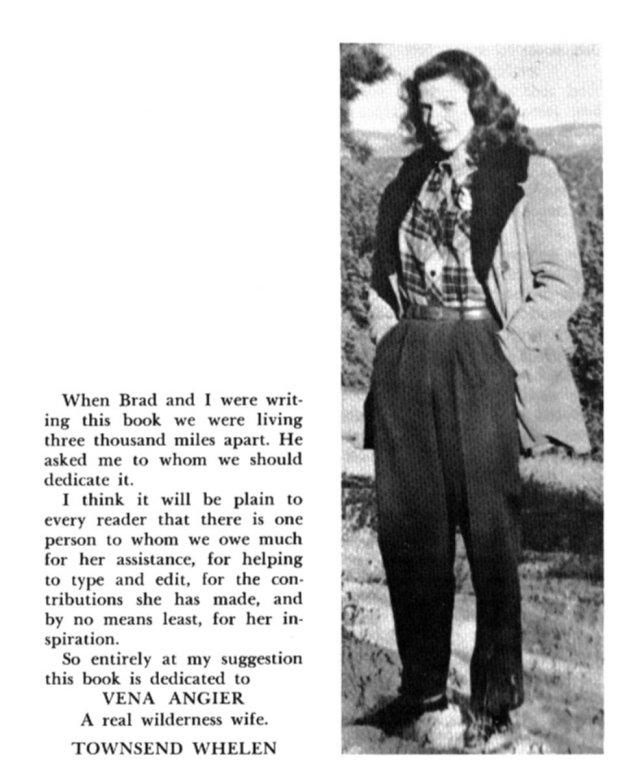
Bradford and Vena Angier bought the cabin in 1969 and lived in it for the next few years, continuing to write their popular back-to-the-land books. A disciple of Henry David Thoreau, Bradford Angier moved from Boston to Hudson's Hope about 1947, leaving behind a career in advertising, and soon became a guru of wilderness survival skills and simplified living – increasingly relevant in the consumption-obsessed, Cold War 1950s. Wilderness Neighbors and At Home in the Woods are two of his myriad titles, many of which were illustrated by his wife Vena. I first bought one of his books, called How to Stay Alive in the Woods (originally published as Living Off the Country in 1956), around 1970 when I spent a summer working as a tour guide on the Bennett dam. Some people in Hudson's Hope today remark that Angier had a way of appropriating stories, telling them as if they had happened to him. July, 2009, request for
information on the Angiers from Carmen
Germain, English Department, Peninsula College, Port
Angeles, Wa.: I am doing research on Bradford Angier
for a paper to be presented at a humanities conference this
fall. Among other questions, I am curious regarding his
influence on so many people who read his books, then strapped
the mattress on the roof of the bus, loaded up the kids, and lit
out for the territory. Some of these people made a success of
their adventure, and many did not. What I’m discovering is
that Angier was astute in marketing an idea (living in the
wilderness), plagiarizing (from Stewart Edward White, for one),
and, as you indicated, appropriating others’ experiences. That
said, he may have been a positive force for many people who did
take action to change their lives.... [Please get in touch
directly to share your experiences at the email address above] |
|
Another book that captured the romance and adventure of the Peace River country for an English audience was John Onslow's Bowler-Hatted Cowboy (William Blackwood and Sons, Edinburgh & London, 1962). Onslow was a British army officer in the Second World War; badly wounded, he eventually joined his brother-in-law R.D. Symons on a ranch in the Upper Cache Creek near Fort St. John.
From William Walker, 2012: I
discovered last night that Elvena Ruth Angier died November 22,
2011. She is buried in Tucson, Arizona. RIP Vera. "Elvena Angier "Elvena Vena Ruth Angier, 97 years of age, entered Life Eternal
at the South Shore Hospital on Tuesday, November 22, 2011. She
resided at the Allerton House in Weymouth. She was born in
Boston and was formerly of Hyde Park, Tucson, Arizona and
Rockland. In earlier years she was an entertainer and dancer.
She was associated with the USO. She was the widow of Bradford
Angier who was an author of books on wilderness subjects and was
the author of Edible Wild Plants which is used by the military.
Elvena provided the art work for the books. She had also been a
guide at the Randolph Hearst estate at San Simeone, CA. She was
a member of Trinity Episcopal Church in Rockland. She is
survived by a niece, Janice M. Wallace of Weymouth and a nephew,
John Watt of Easton and by great nieces and great nephews. A
Memorial Service will be held at Trinity Church, Goddard Avenue,
Rockland at a later date. Burial will be in the Memorial Garden
of the Episcopal Church of Saint Matthew, Tucson, Arizona." From Alison Otis Hueber, 2011:
I am a close personal friend of the Angiers. Brad rented a room
in my father's home when he was a child and they remained clost
all of Brad's life. In fact, Brad and Vena are like grandparents
to me. From Thomas Cheney,
Jackson, Michigan, 2011: At an age of 16,
I read a story called Peace River Days by Bradford Angier which
was published in Sports Afield magazine in May 1958 and as
tattered and well read as it is, it is still a treasured
part of my memorabilia. Your painting of Uncle Dudley's
Cabin is my Desktop. Such good information about an icon
of the past. Thanks for maintaining such a tribute to a
true outdoors man as well as wife Vena. 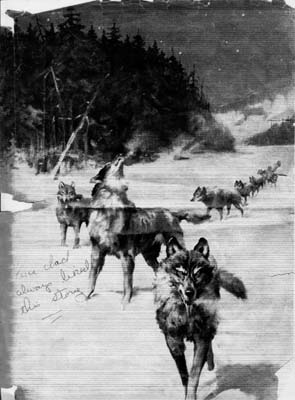 the
title page artwork, and ... the
title page artwork, and ...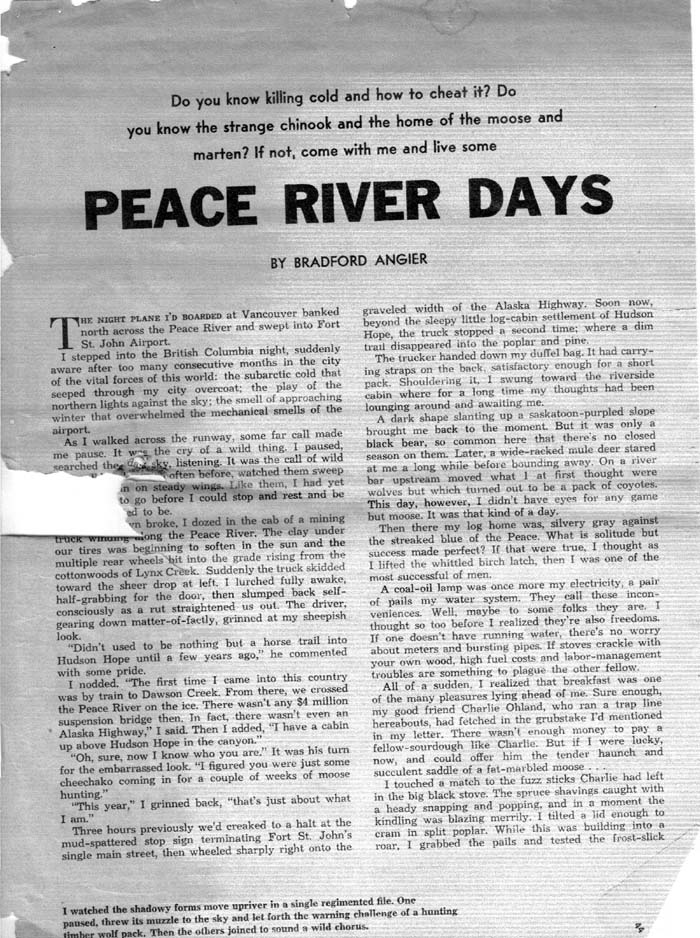 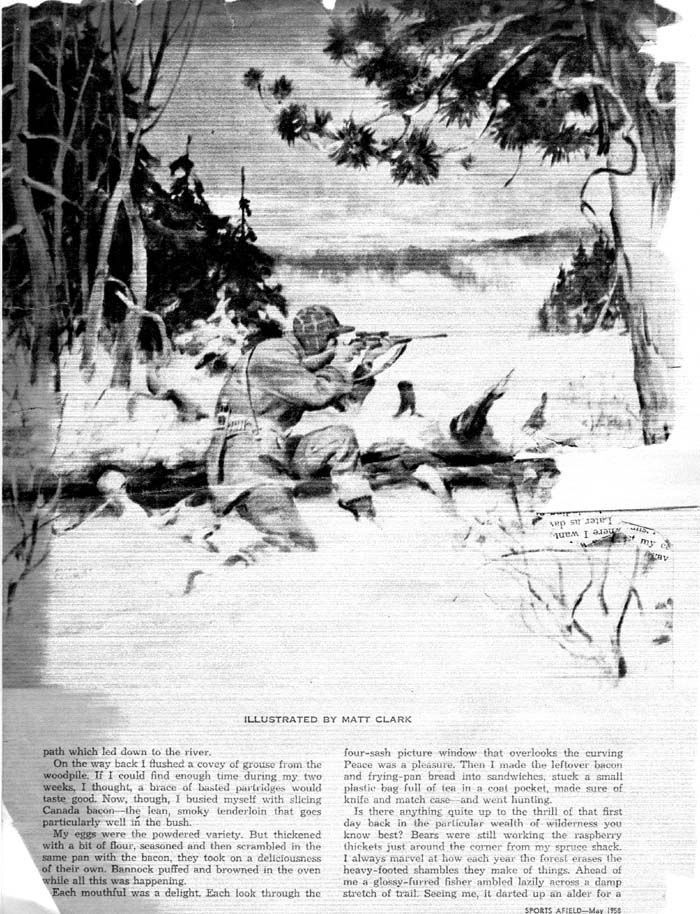 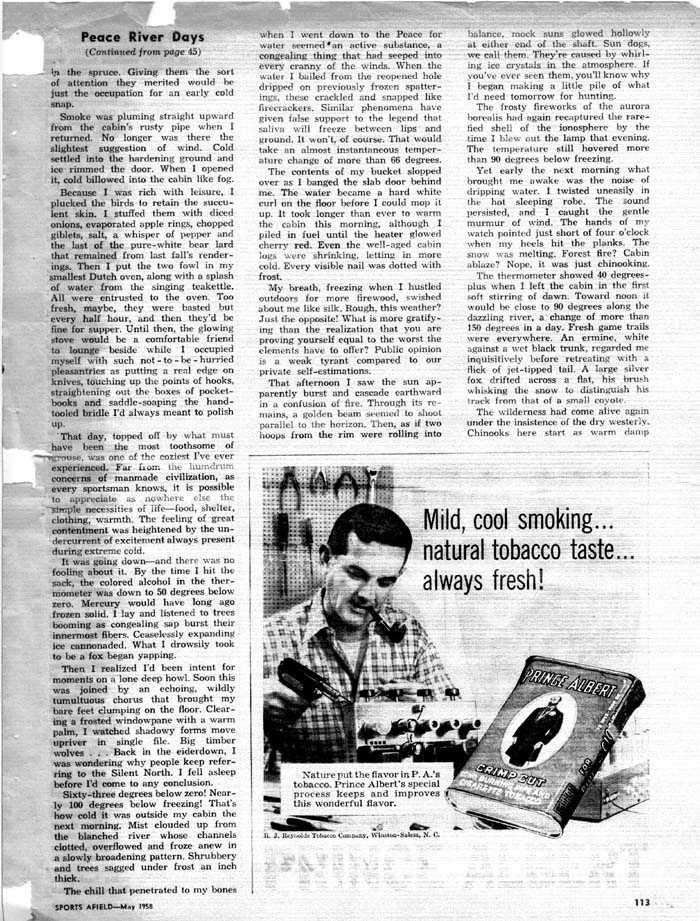   Note from Larry Steinkraus,
2010: In the summer of 1974, my wife, Sue and I drove
the Alaska Highway from Indiana to Fairbanks. Having read
one of Bradford Angier's books, we stopped at Hope, British
Columbia and asked at the post office for directions to his
cabin. They obliged with directions and Sue and I found
the cabin in the woods. We parked our vehicle and walked a
short distance to the cabin. Although we were unannounced
and uninvited guests, Bradford and his wife Vena invited us in
and were friendly and hospitable. There was one other
gentleman there, also. I do not recall his name, but he
appeared to be about the same age as our hosts. We had a
brief and friendly conversation, and were on our way.
Before leaving, we did take a drink from the waters of the Peace
River. In his book, Mr. Angier mentions a legend that says
that anyone who drinks of the Peace River will return there
someday. So far, we have not, but actually are considering
a trip back there from here in Indiana, when we retire.
Maybe there is something to the legend, after
all. We'll see. Note from Rhonda Rosie, 2009:
In 1968 we moved to Dawson Creek, B.C., with the
intention of "living off the land". I had been reading
[the Angiers'] books for several years previously while living
in Boston, Montreal, and Toronto. (I'd always wanted to
live either on a farm or in the wilderness.) We were
looking for a place to settle, and went to Hudson Hope to see if
they were there and had any advice for us. They were
staying in town with a fellow called Joe (Barkley?? can't
remember after all these years), and Bradford came out to talk
to us for awhile, and was very gracious considering our
imposition on his time. As it turned out, we did build a
cabin out near Puggins Mountain southwest of Dawson Creek, but
ran out of money, and while working in town to get more, we
decided to move farther north to "real" wilderness. We
wound up in the Yukon, near Frances Lake, accessible only by
foot or airplane, and have been here since 1970. We followed
Angier's instructions for cabin-building, among other things,
when we built our first few cabins. We still have a few of
his books here. Note from Tom Anderson,
Summerland, BC [2006]: I was already ”living off the
land” when I came across one of Bradford Angier’s books in
Berkeley and took it back with me into the mountains. I
read it whenever a High-Sierra rainstorm kept me in my tent. I
wrote to Angier while still camped in the Sierras and received a
surprisingly prompt reply : Note from Bill Hunt: I read several books written by the Angiers about 30 years ago and recently got interested in them again. I've become curious about what happened to the Angiers. If you have any information about them or any leads, I would appreciate receiving them. Note from David Belanger , Lincoln, Vermont: I, too, have been very curious about what ever happened to the Angiers. With the quantity of books that he wrote I find it amazing that there is no real biography, at least not beyond their days in Hudson Hope. I did hear years back that they had moved back to Boston. While doing a web search I found your page. Have you heard anything about them? ... [a couple of days later, David sent this]
Newspaper article from Weymouth, Massachusetts,
apparently, on Vena Angier turning 90. *** Note from Jack Jordan: I
read on the website that someone was wondering what happened to
Bradford. I provided some services for him prior to his death
while they lived on the eastern edge of Tucson, Arizona, he
autographed several of his books (that I had already owned)
during one of my visits to their home. This was 1987. I
recognized his name because I had grown up on his books. When I
inquired if he was "THE Brad Angier", the Angiers were very
gracious and always welcomed me warmly. He was still very
engaging and vibrant and eager to show a young confused kid (me)
things from his life, a compass collection, some knives, etc.
I did not want to impose on their life so didn't make myself a nuisance, I remember his wife saying how much he appreciated my visits and interest. A truly Great Man, I owe part of what I am now to his teachings. A weird coincidence, I was back in Arizona, drove near their house from that era, when I got back home, I pulled out my tattered copy of "How to Stay Alive in the Woods" and re-read it. And most of his advice still holds true, for those of us interested in the wilds. He references Peace River frequently. I felt compelled to find out if anyone out there still thought about him, this is nice to know that you folks are out there. Note from Alann B. Steen: A dear friend of mine sent your article that included Bradford and Vena Angier in "Vanishing British Columbia." My name is Alann Bradford Steen, named after Bradford when he and my parents were very close in New York in the late '30's. When I lived in California in the mid-60's I was able to meet him when he lived in Cambria. After that I moved all about, and we lost contact. I was sorry to read of his passing, but was happy to learn that Vena was living in Massachusetts--in Rockport, just a few miles from where I graduated from high school. Note from Martin in Dorset, England: Hi there I read the note on your website about the Angiers. I only discovered them a few months ago though the books that they wrote. I got my first book, How to build your home in the woods, from a search on Ebay. I was instanstly hooked and have now collected most of the writings that I have found. Note from Laura Janes:
Ran across your article while looking up info on Vena and
Brad Angier., and wanted to share a little of my story with you.
My mom, Ada Guarisco was a avid fan of Brad and Vena, so in
1960, she resolved that we would take a trip to Hudson’s Hope to
see for herself this pioneer land that she had dreamed of.
Needless to say, she was also a great Thoreau reader. We
got to meet so many of the townspeople described in the
book and many more. We camped at Lynx Creek for several weeks,
and became friends with the Neils, Mel and Bina and their
daughters . For several more weeks we camped in the Glen where
we were befriended by Bob and Harriet Birosh. Yes, we also knew
Uncle Dudley. After we came back to California where my mom was
an aerospace engineer, we started making plans to move to
Hudson’s Hope. We left California in 1964, and settled in Lynx
Creek at the bottom of the big hill and next to the Peace River.
After settling in, Mom starting negotiations on the parcel of
land she wanted very much, the property out at Chinaman Lake.
Note
from Wes Harden: I was glad to see the update on the
Angiers. My mom, who died in 1995, purchased “Wilderness
Wife” in 1977 and read it the last time again in 1992. She
loaned the book to me after she read it the first time. I
then found “At Home in the Woods” and read that a couple times.
This week I am sitting in my cabin (Minnesota) with night
temperatures getting down only to -15 and have been reading
“Wilderness Wife” again. I have a nice warm fire in the
fireplace as well as “off peck electric” heat and a backup
propane furnace, not as primitive as the other people who wrote,
but I am in the woods. I read “At home in the Woods” a second time a few years ago on a business trip to New Mexico. They are both great reading. I have shared them both with my daughter and friends. I am going to order one of the other books I see listed by Angier. |