Return to main Vanishing B.C. page Return to home page
Page last updated August 24, 2020
© Michael Kluckner
|
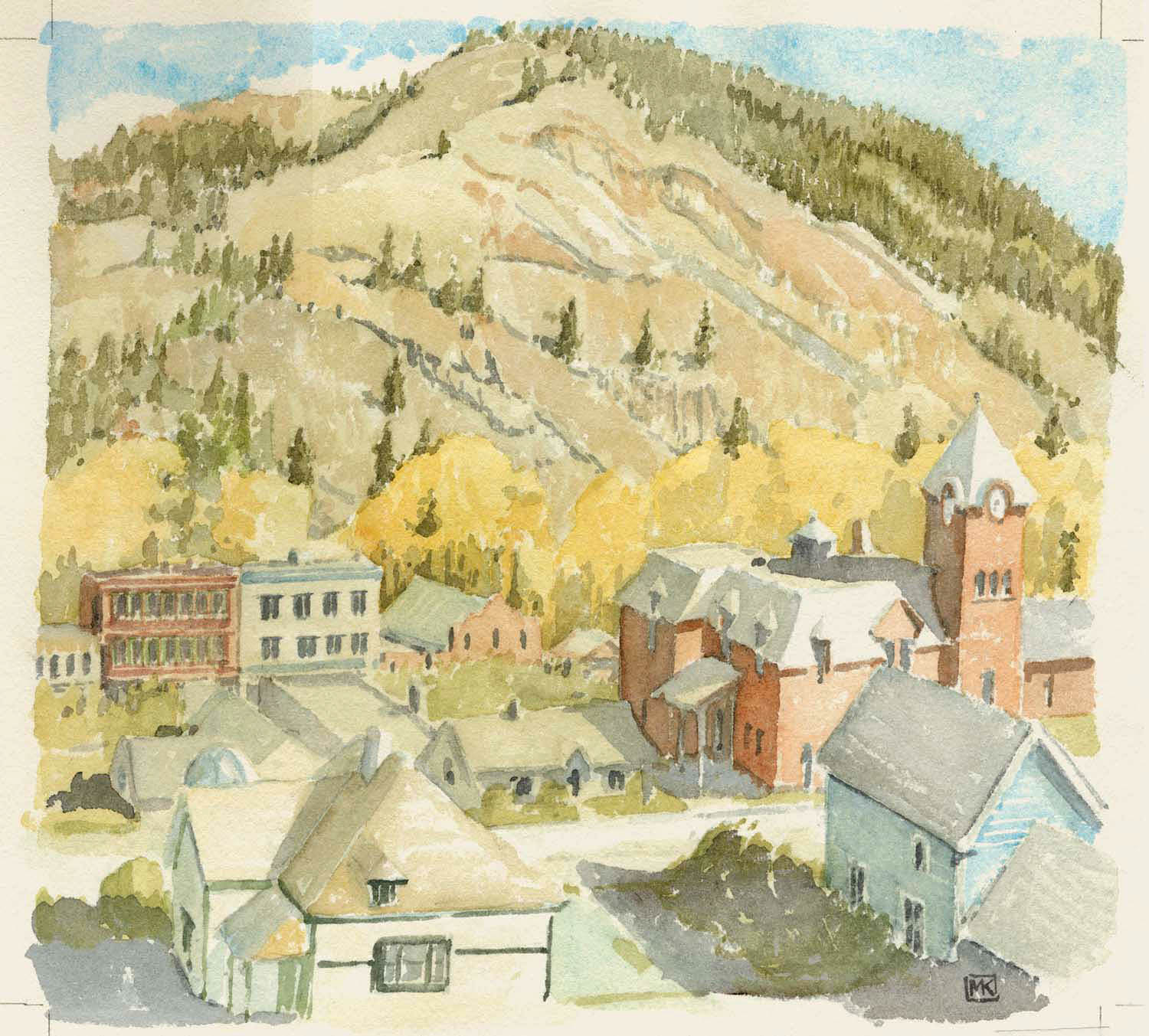
Written/sketched 2002: The view of Greenwood from the steep hill on the south side of the narrow valley. The line of yellow aspens behind the buildings defines the route of Boundary Creek, beyond which lies the roadbed of the old Columbia & Western Railway, now part of the Trans Canada Trail but in use until 1990 as part of the Canadian Pacific Railway's Kettle Valley line. It is easy to imagine prospectors coming through this area in the 1880s and spotting rich ore in the rocky outcroppings for, as Robert Louis Stevenson wrote of the Cevennes (in Travels with a Donkey], "the stony skeleton of the world was here vigorously displayed to sun and air." The three buildings on the extreme left sit on South Copper Street--Highway 3, in fact, which is the main street. They are the two-story Guess Block, built in 1899 and now home to the Copper Eagle Cappuccino and Bakery; next to it, the red-brick three-story building is the Greenwood Inn, originally the Windsor Hotel, also built about 1899 and home to the town's pub and cafe today; the white three-story building was the Pacific Hotel, built in 1907 and, during the Second World War, #1 Internment Building housing more than 200 Japanese-Canadians. The 1902 house in the left foreground sits on South Government Street and was the home of W.E. McArthur, Sr., the mayor of Greenwood in 1942 who welcomed the opportunity to house almost 1200 Japanese-Canadians in the town's many empty buildings. The large turreted brick building is the post office and federal government building, erected about 1913-15, a few years before the collapse of copper prices that closed the local mines and smelters and sent the town into a tailspin. The courthouse (now City Hall) illustrated below is a block to the north (right) of the post office. Greenwood's landmark smokestack – the one relic remaining from the B.C. Copper Company's 1900 smelter – a few hundred metres south (left) of the hotel and main street. |
|
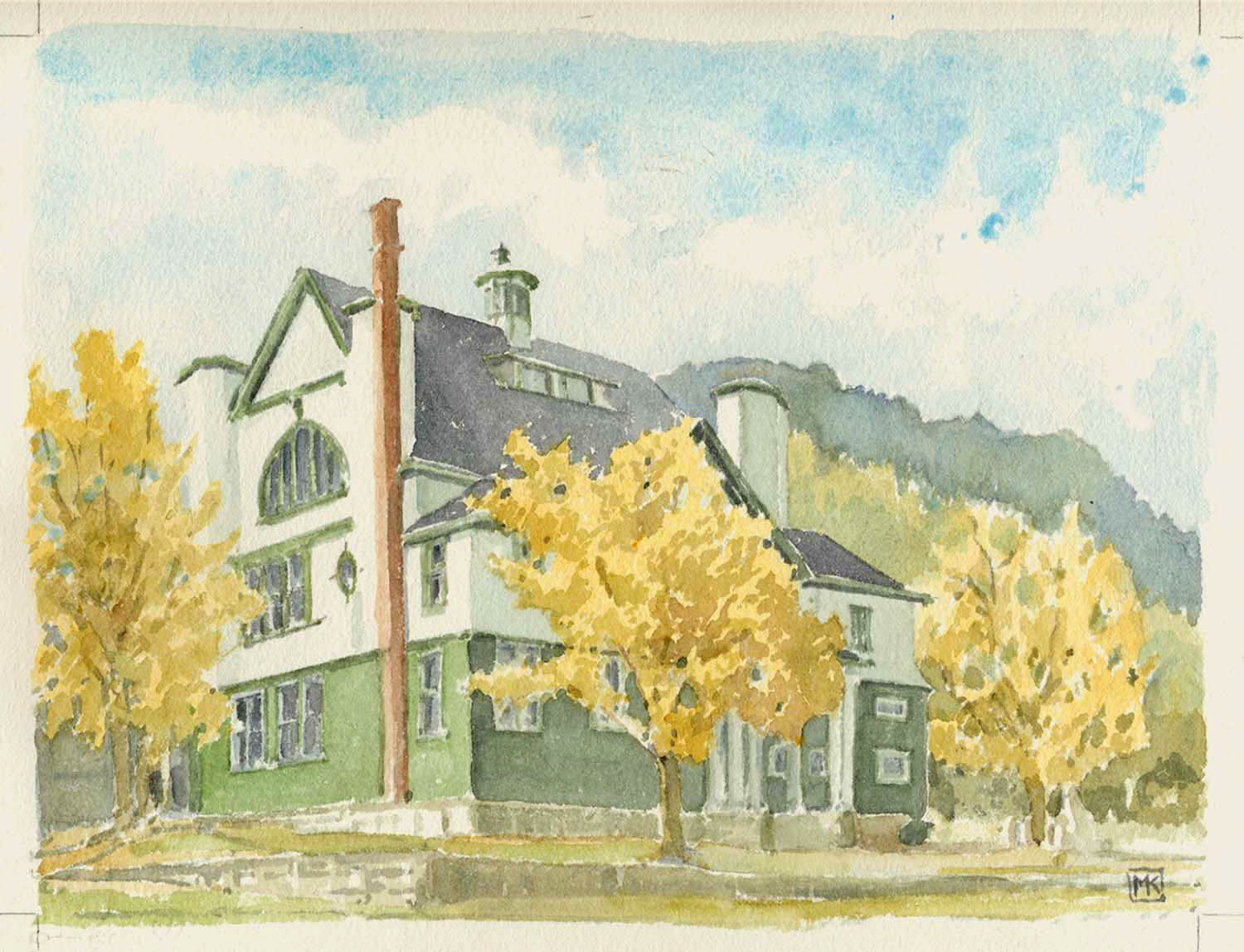
Greenwood City Hall, built in 1902-3 as the provincial government building and courthouse. It was designed by George Dillon Curtis, an Irish-born architect who established a practice in Nelson in 1897 and designed public buildings there and in Rossland, Fernie, and Greenwood. (The well-known courthouse in Rossland was in fact designed by Curtis' future partner, John James Honeyman.) [source: Honeyman and Curtis, by Paul Mackenzie Bennett, in "Building the West: The Early Architects of British Columbia, ed. Donald Luxton, to be published in 2003] The building originally housed the gold commissioner's office, the chief constable and the mining recorder, as well as the functions of the county and supreme courts. There are three jail cells in the basement, one of which was part of the original design. The City of Greenwood bought it to use as its city hall in 1953, toward the end of the 14-year tenure of Mayor W.E. McArthur, Sr. [Source: Greenwood Heritage Walk brochure published by the Greenwood Heritage Society, 2001] Note from Christine, 2009: My husband and I purchased one of the two turreted houses in Greenwood. We are hoping to restore it and as I was looking at your web site there was a view that looked like it might have come from the second floor patio of our new house. We purchased 432 Long Lake Rd, would you happen to have any photos of the house? I have managed to get the list of all the owners of the house but so far no photos have been found. Our new house once held 15 children and families during the interement. The architect for our house is also the same man who designed the post office (the only two he did in Greenwood). I would appreciate any additional info/photos you may have on our new home. [Email me if you know and I'll pass it along] From Dixie McLean, 2020, about 432 Long Lake Road: I was
looking online for pictures to show my friend of my house (you
notice I say MY house as it forever will be LOL) and
I saw your very dated request for pictures of the house. I loved
that house - I lived there with my family - mom and dad and 5
kids from 1968 (?) to about 1973-4. When it stormed, all us kids
went up into the tower on the third floor and loved the shaking
from the thunder and lightning and one year my dad in a
misguided effort to clear the brush around the crab apple trees
and surrounding area, set the hill on fire. We had water
bombers and all the fire trucks. It was awesome. I
do have pictures but they are at my son's home and they are from
around 2003 maybe. I even looked at buying it but one of
the owners at that time had really damaged it. I had the master
bedroom with the window seat and spent many many hours watching
the comings and going of the great metropolis of Greenwood. Some
of my best memories were of that house. When we moved in,
there were many treasures someone left for us. Canned crab
applies, drawings of period clothing, rock collections. Amazing.
Absolutely wonderful house. Note from Joe & Terrill: I lived in Greenwood in the early 60s' and knew many of the Japanese people there. Mr. Tasaka the barber told me that while his family was interned, they received 1 blanket per person. My daughter in law says they were given 2. Can you tell me which of us is correct? |
|
From Mareth Curtis-Warren, 2012: In searching for
information about my architect grandfather, George Dillon
Curtis, I came across a webpage
(http://www.michaelkluckner.com/bciw3greenwood.html) from
Greenwood BC. It mentioned him as the architect
of Greenwood City Hall, built in 1902-3. To my
knowledge, our family is not aware of this structure. It
was a great find! I was also impressed with the watercolors of
the town because George was a wonderful watercolorist and they
look very similar to his work. [Greenwood has always been one my favorite places and, for what it's worth, Christine and I once fantasized about moving there. I wrote the piece on Greenwood as one of Canada's 10 Most Beautiful Towns in 2002 – the one that is referred to on a number of the Greenwood and Boundary country websites. I really like the area and the people. The town itself is compact, with many interesting buildings and opportunities, both residential and commercial, to entice a couple of fogeys like us in need of a mid-life adventure . . . . Maybe the valley's a little too tight and there isn't enough sun on the town in winter, but who knows?] |
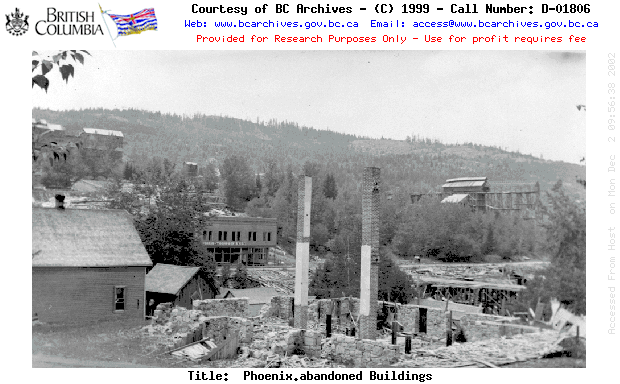
Phoenix, in the mountains due east of Greenwood--photo from the 1930s by an anonymous photographer.