Return to main Vanishing B.C. page Return to home page
This page last updated June 16, 2022
© Michael Kluckner
|
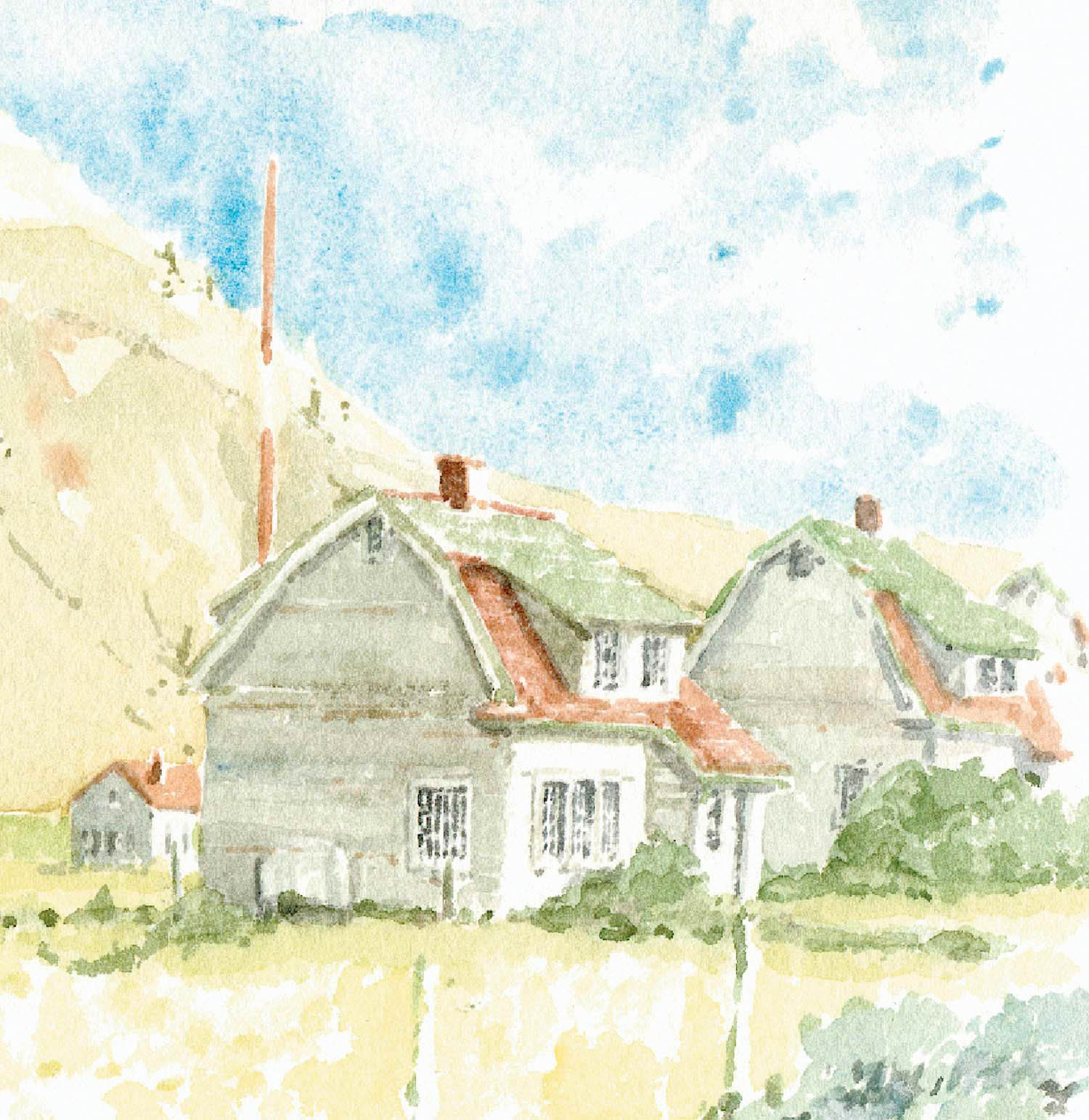
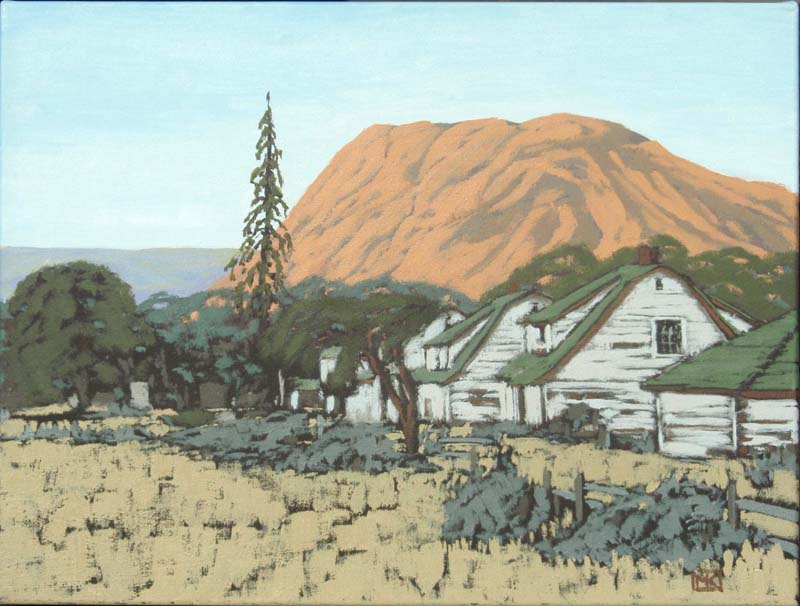
Written in 2000, painted in 2013: The idea of a forestry camp on the almost treeless, arid benches near Ashcroft seems like a joke. For the more than 40 years I can remember travelling the Trans Canada highway, I've been intrigued by the rather military quality of this collection of buildings, with orange-and-white-striped pylons holding, presumably, radio antennae, next to Ashcroft Manor (just west of Cache Creek). DESTROYED BY FIRE, JULY 18, 2014
There are two distinct styles of buildings: first, a row of gambrel-roofed houses with prominent shed-roofed dormers that face the highway; and, a handful of simple gabled buildings arranged more randomly among the pylons behind the other houses. Apparently, according to the Ashcroft Museum, the site was originally a forestry camp, but became an army station during the Second World War – a communications station, presumably. Now the site is completely abandoned, the buildings boarded up, and I wonder every time I drive the Trans Canada whether they'll still be there. The gambrel-roofed designs of the houses facing the highway (on the right above) are almost certainly those of Henry Whittaker, BC Provincial architect, about 1918-1919. They showed up in returned servicemen's housing in South Vancouver, and in provincial police buildings such as the former lock-up in Burns Lake, a larger building. The standard forest-service buildings, and many of the small ambulance crew buildings scattered around the province, appear to be evolutions of this basic design.
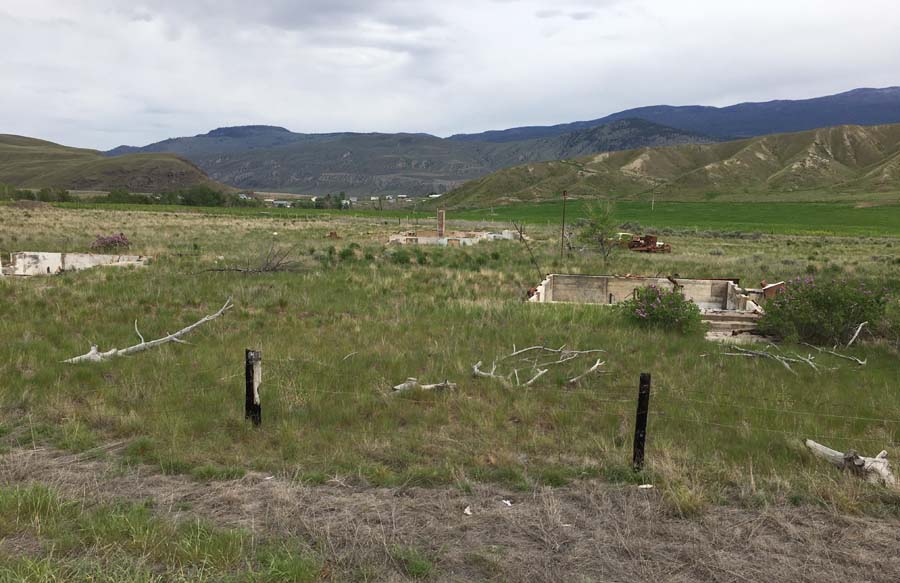
This is what the site looked like in the Spring
of 2022 Note from Vashti Fisk, 2009 [née Parker, whose mother DeeDee was one of the Cornwall daughers from the Manor]: "The DOT buildings near the Manor were originally built for a Radio Range Facility for the DOT about 1944 until that was phased out and the site was turned into a weather station in the 60's.This lasted a few years before it was briefly turned over to the foresty. It was sold sometime in the early 70's.....the dates are hazy offhand but we do have records somewhere I believe. We don't know the name of the present owner. It is so sad to see it as it is now. It was once so well groomed and cared for. The original inhabitants were really wonderful neighbors but we have lost touch over the years." ************* From Sheila Smyth, 2019: I worked at Ashcroft Manor as a
general helper in 1962. From Gerald Houbregs, Abbotsford, 2016: Just a history
note regarding the Ashcroft Manor and the adjoining Govt
Communications station and radio range....I had the privilege of
working at the Radio Range Station, as it was called, in 1964,
for approx 6 months.as a Radio Operator for the Federal
Govt....As a single person at that time i roomed and boarded at
the Ashcroft Manor...I had a single room at the back of the
Manor on the ground floor..The houses at the Radio Range Station
were for the married personnel. Trav was busy at the time
overseeing rental cabins being built next to the Manor...Vashti
did a lot of the cooking for me...the Parkers were still around
also....After Ashcroft i went to work for 6 years at Smithers
Airport as a Radio Operator and then moved to Abbotsford, where
i still live today, and worked for 25 years at the Abbotsford
Airport...And have been retired since...I stopped in at the
Manor at times in the 60s when i commuted from Smithers to the
Coast on vacation....I see Vashti sent a note re the Manor a few
years ago...I don’t know if her and Trav are still around...I
don’t get up that way any more. From Margaret Durrant, 2015: I read with great interest
the article about the former forestry camp in Ashcroft and
devastated to read that it had been destroyed. I first saw those
houses when I was about 10 years old and I am now 69 years old.
We travel through the area twice a year and I will miss
seeing them. The paintings in the article are wonderful. Those
houses were always kept immaculate when I was a kid and it was
sad to see they had fallen on such hard times. I assume you are
aware that one was used in the Robert Redford/Jennifer
Lopez/Morgan Freeman film ”An Unfinished Life.” From Barbara Roden, Aschcroft, 2014: As an admirer of your 'Vanishing British Columbia' series, and local amateur historian, I thought you might be interested - and probably saddened - to know that the buildings at the former forestry station in Ashcroft, on Highway 1 beside Ashcroft Manor, burned down last night (18 July). I live in Ashcroft, and my son - who's a volunteer firefighter - got a call around 11.30pm to attend a fire there (I just picked him up; he's one tired 16-year-old). No word on how the fire started, and the firefighters managed to save the Manor, Teahouse, and cabins around the Manor, but all the buildings on the forestry station site are gone; there's nothing left standing but the brick chimneys. There's no word yet on the cause of the fire, but high winds last night, plus tinder-dry conditions, meant that once it got hold there was nothing anyone could do to save the buildings, and efforts were concentrated on keeping the fire from spreading (it kept jumping the highway) and saving the Manor buildings. From Michael Taylor, 2011: Am proud to tell you the houses and garage were built by Taylor & Son, that's my grandfather John (Jack) C Taylor and my father Clifford Taylor (Kamloops pioneers since 1907). Understand they were built in early 1940's after Cliff &
Jack had built housing at Bralorne mine site in 1935-37.
Taylor & Son also built wartime housing in Kamloops in late
1930's and early 1940's. |
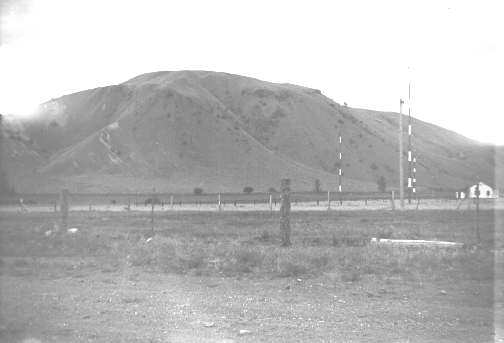
Photo by Ken Sigfusson, 1946, showing the edge of the site.
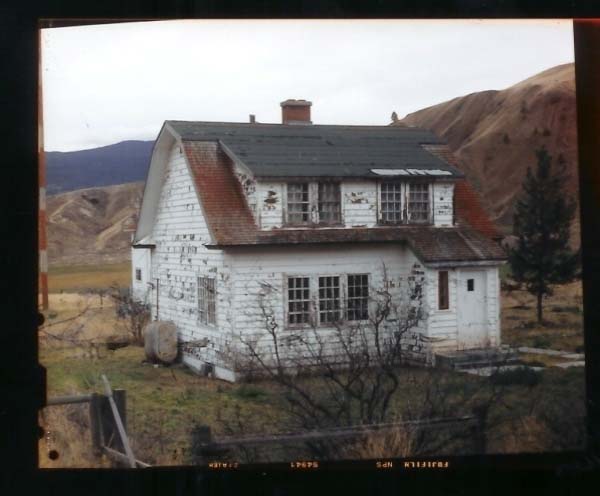
A 2008 photo of one of the houses by
Bill Grulkey, Vancouver
His photo collection can be viewed at: www.altphotos.com
( keyword search: grulkey )