Return to main Vanishing B.C. page Return to home page
Page last updated January 18, 2022
© Michael Kluckner
There's a second thread of info here about the steep winding road down the back of Pavilion Mountain on the way to Kelly Lake and Clinton
|
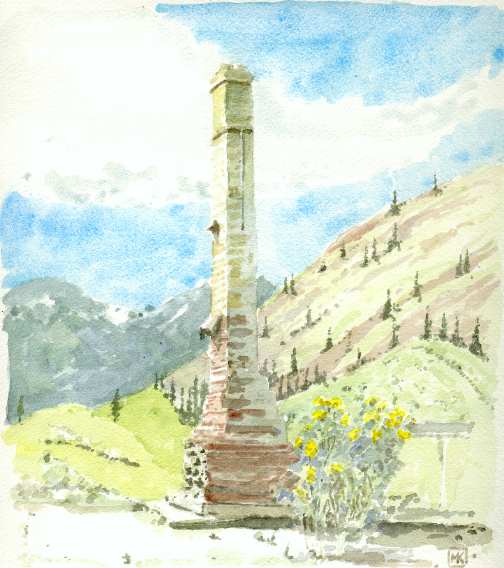
Written 2002: The "oldest operating store in British Columbia," apparently established about 1861 in the early days of the Cariboo Road and the Gold Rush, burned down about two years ago. The Pavilion General Store stood beside the wagon road on the stretch between Lillooet and Clinton (now the highway goes from Lillooet through Marble Canyon to Hat Creek Ranch near Cache Creek). The store stood on the north side of the road, across the road from the PGE (BC Rail) tracks and the "Pavilion" siding, in a landscape opening out into grasslands and benches. The store building was a 1920s or perhaps 1930s structure, which may have contained elements of an earlier roadhouse, most likely the fine old stone-faced fireplace. Interestingly, there is no historical information on the store in either the Lillooet Museum or the BC Archives, and it does not appear as an historic roadhouse in Branwen Patenaude's Trails to Gold (Horsdal & Schubart, 1995). Apparently, the claim that it was the oldest operating store is a bit of a canard – it was the successor to businesses started there in the early 1860s. |
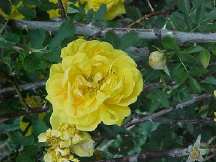
| I went past the store in the fall of 1999 and stopped for an ice-cream. There were a number of people about and, as it was late in the afternoon and I wanted to get to Ashcroft that evening, I went on without stopping to paint it. So I was astonished to go again along the road in June of 2002, with every intention of stopping and painting, and to find only the chimney standing against the sky, with a rubble of rusted metal roofing, contorted by the heat of a fire, lying scattered about on the ground. I talked to a couple of people in the nearby Indian village of Pavilion, but they could add little detail to what was obviously a tragic accident. All that was left, other than the chimney, was a yellow rosebush blooming in the dusty wind and the gravel. I took cuttings for my wife, Christine Allen, to grow to add to our collection of rustled roses from historic places; she identified it as a rose known as Harison's Yellow (unfortunately the cutting died). |
 |
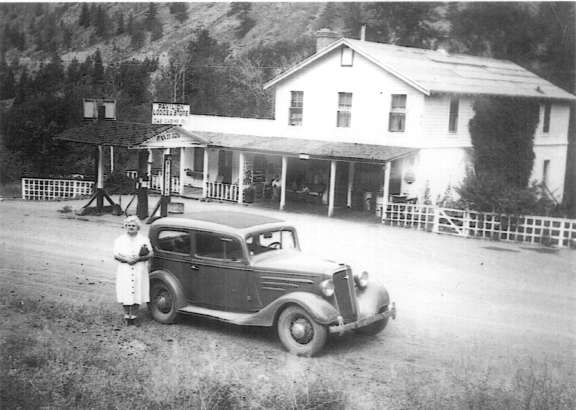
The Pavilion Store in the late 1930s or 1940s. Photo courtesy of Lillooet Museum.
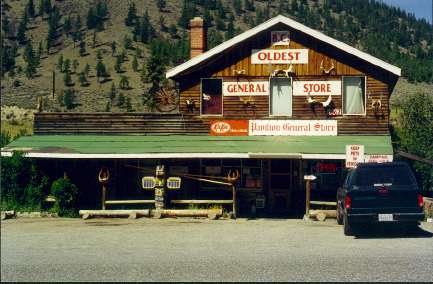
The store in 2000. Photo by Lesley Keith
|
From Lynn Waterston (Johnston), 2022: This set was
given to me by my Grandmother on one of her trips to
visit us at West Pavilion.
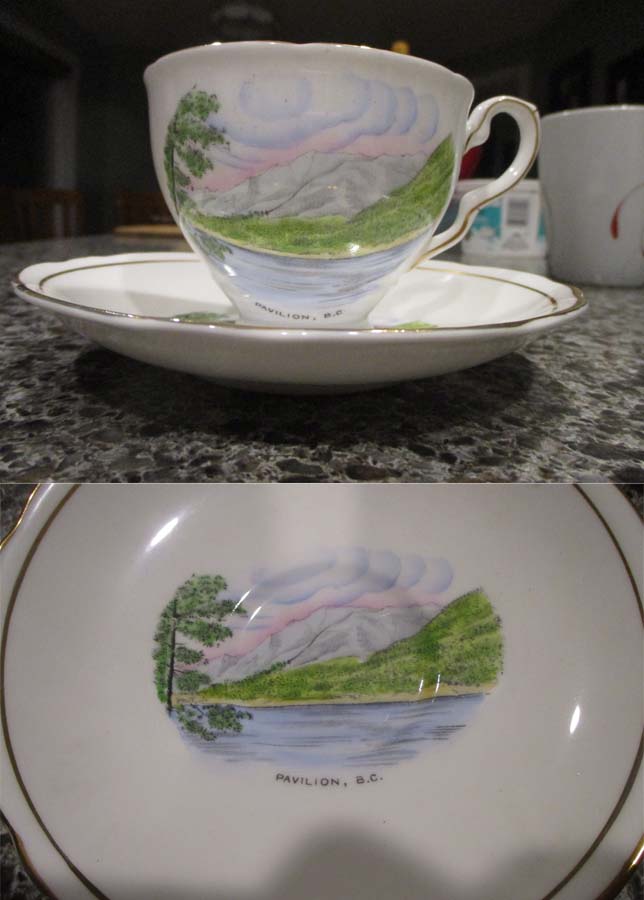 As a resident of West Pavilion from 1959 to 1973, I also have fond memories of Andy and Flo Hayes and the wonderful store. As a young girl I spent one week with Flo and Kathleen in the Summer of 1970. The store was our closest shopping centre for supplies, coming from our ranch on the westside of the Fraser River. Schooling was a one room school at the top of the hill above the cable ferry From Barry Smith, 2019: I believe it was in the summer of 1999 that I called by the store at Pavilion. With my few purchases I sat outside, shaded from the dead calm shimmering heat, wearing my new Pavilion General Store t-shirt and enjoying an ice cream. Thirty years on, and it still holds a vivid memory: a good place, somewhere that had defied the trials and tribulations of history. At ease after travelling endless dirt roads, but all too soon my thoughtlessness disquieted by a restless nostalgia and disquieting drifting intimations about times to come. Moving on, I could only look over my shoulder for a last look, hoping foolishly that beyond my gaze it would last for ever. Just a few months later it was destroyed by fire. 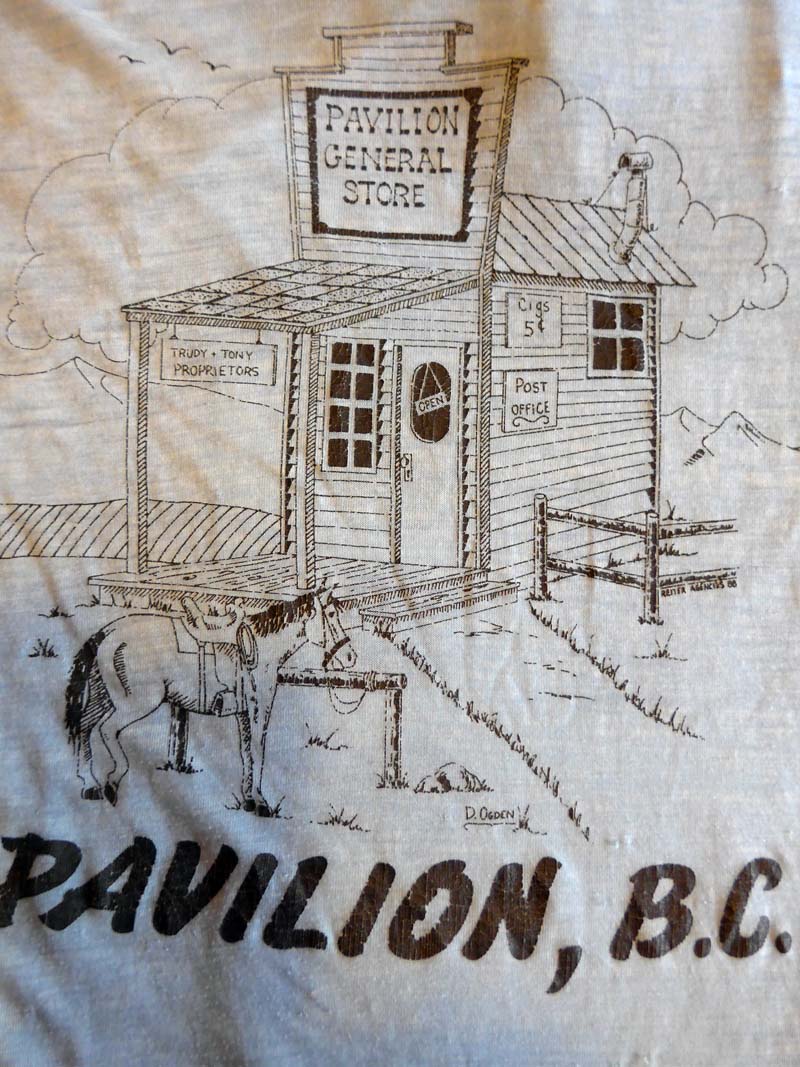 From Alf Pramberg, 2015: While browsing the internet I noticed one of your paintings of a chimney; the only thing remaining from the Pavilion Store. It brought back some fond memories. As a child (pre-teen) in 1959 our family lived for a year in one of the houses that was adjacent to the store. I believe the house was owned by the store owners. There used to be a one room school house on the other side of the tracks. There were students in the school from grades one to six all taught by the one teacher. It was quite the experience. From Dan and Dawn Lukoni, 2014: My husband's grandparents Jessie & John Leavens moved from West Van to a Hat Creek farm in the 40's & at some point they bought the Pavilion store which they ran until the 60's (we think?). They had a partner John Moss and we think they sold out to him? They then moved to the Yalakom on another farm. My husband was raised in Lillooet and after some many years away we have just moved back..... I remember coming back for a visit and seeing the store burnt down, we stopped and I was able to get some photos.... The sight of the fire really saddens us, it was such a huge part of our family's history..... We do have old family photos of the store & if you're interested I would be glad to share them (when we find them...hahaha) I also wanted to share that my husband remembers the yellow rose bush as a child, wouldn't it be neat if his grandma planted it..... From Henry Steen in Tuktoyaktuk, 2014: I worked for the Ranch as an irrigator in the early 1970's for 2 summers and we stayed at the ranch hands' house just past the Pavilion Store and further down the road. Bud lived there in his house at the Lower Ranch that it was known as. I remember Kathleen the store owner and still recall her "Auzzie" accent. I was a young student from Alberta hired by the ranch in 1971 0r '72 and the following summer after that. I must have been just 19 and 20 years old then. Bud was our foreman at the Lower Ranch. My partner, or co-worker then was another young man from Edmonton as well. I don't remember his name, but he drove a red Volkswagon Karmen Ghia and it was almost totaled when we ran into a cow at sunset on highway 99 heading back to Pavilion after spending some time off work at Cache Creek and Ashcroft. I was saddened to read of Kathleen's passing after such a short time that Bud and she were married. I saw what still remains of the store while I was browsing through the photos on Google Earth and saw Roy's photograph of the ruins and find it a sad event to read about. From Jennifer O'Halloran, 2013: I thank you for continuing to post information on the Pavilion store and history of the area. I am planning to try to do a visit to that area next summer. My great grandfather and grandmother.... Cornelius O’Halloran and Bridget Hawkins O’Halloran – had a ranch.. we believe it was Mile 18 ranch.. so close to the store. They had two children.. boy and girl born in Clinton and 18 mile house. Records show Cornelius was listed on the voters list of 1875 – and address suggests Mile 20. He homesteaded and then went back to Ireland to bring out Bridget.... From Karen Kjarsgaard, 2013: My sister Crystal sent me your web page and it was good to see so many memories spring forth. I just wanted to add that I also visited the old site just to get cuttings from that yellow rose. I recall that before the fire it was very large, growing down a length of a split rail fence north of the store. When in full bloom, it was an amazing mass of the brightest yellow I have ever seen for an old rose. Glad to finally know its name. I took my cuttings in the spring from softer green growth at the bottom of the bush and now have a fine bush of my own at my cabin in Lillooet. A word to anyone else thinking of doing this – take very good gloves as this is one of the most thorny roses I have encountered. And, once you have it rooted in a pot, plant it in a quite sunny and dry location against a wall or rocky area so that its roots can be protected from the elements. From Rita Bryson Morrison, 2013: I have done the History of Pavilion B.C My great grandfather was Robert Carson the Carson Ranch on top of Pavilion mountain My grandfather was John Bates Bryson married Minnie Carson owned the Grange from 1901 to 1949 I have done all the pre-emption from the 19 mile to the end of Pavilion from around 1852 If I can help with information I would be glad From Ken Havinga, Mahone Bay, N.S., 2012: I used to drive trains (locomotive engineer) for the now defunct BC Rail. I happened to be working the night the store burned to the ground. As I drove into Lillooet from my home in Kamloops that evening (yes, that's right; a two hour commute!), I passed by the store in my 1990 Volkswagen Jetta, as I had done hundreds of times during my career. No hint of any fire as I drove past the historic location, I probably 'tooted' my horn as I often did during business hours, just to say 'hello', as I was a frequent customer in the store. Fast forward roughly two hours; Now operating
a northbound (Lillooet to Williams Lake) freight
train on the Lillooet subdivision, the conductor and I
noticed the very prominent fiery glow ahead of us, in the
Pavilion Valley. Our patrol vehicle (a hi-rail truck that
preceded every train between Kelly Lake and Lillooet to ensure
clear/safe passage on the rock slide riddled 'Kelly Lake Hill')
alerted us to the burning store ahead. Given that
the train I was operating was carrying 'empty' tank cars that
previously contained flammable substances, I took the
appropriate action to stop the train before passing the site of
the now fully engulfed store, which sits no more then 100
feet from the railway tracks. We sat for two hours watching
the store burn to the ground as many volunteer firefighters
(from Lillooet and Cache Creek) did their very best to control
the inferno. Alas, their efforts were to be futile as the very
dry structure burned very quickly to a smoldering ash
pile. A very sad sight indeed!
Now living in Nova Scotia, I happened upon your page and your
painting of the chimney left behind that night. A sad memory,
but in a strange way I felt somehow privileged to be a
witness to the store's unfortunate end. Nothing morbid
I assure you, just an intimate moment shared between human and
history.
From Debbie and Maurice Couturier, 2012: Hi just wondering how I could find any history on a couple of grandparents who lived in Pavillion in about 1930 or 31 ish ones name was Ferdinand Tremblay and the other was Lewis King, I believe they may have worked as supervisers on the PGE
Note from Bernard Schulmann, 2004: I thought I would let you know what happened to the store. In January 2000 the building had an electrical fire on a Saturday night. Shirley Alec was at work and heard some odd cracking noises in one of the walls. She went and looked around and saw nothing. She closed the store and went home. At about 11 pm the building was seen to be on fire, the Pavilion Band Fire Department came and tried to put the fire out. The first truck of water and foam was getting the fire under control, but it was not enough. Ronson Ned had to go back to get the truck refilled and by the time he got back the building was in full flame. It seems clear now that the 1920s wiring (with bakelite insulation) within the sawdust insulated walls had caused a short and a fire. Over the previous five years there had been several problems with wiring, but the cost of renovating was too high given the value of the property (the Regional District had not zoned the property commercial and therefore the building was not in conformity with the zoning and the site was officially not acceptable for highways due to the access to the highway). Note from Catherine and Keith Quirke in New Zealand, 2007: My husband and I have found a suitcase of old letters one of which is possibly a cousin of my husband. She wrote a letter in 1974 saying she was a storekeeper at the Pavilion General Store. Unfortunately we only have a first name of Kathleen. Can you give us any possible leads to tracing this person? Roy has a recent photo, July 2006, of the still-standing chimney at www.panoramio.com/photo/9157168 Note from Bud Hughes, 2008: I was a resident of Pavilion and area between the years of 1952 and 1980. I was made aware of your site by my sister Shirley Allen who will be contacting you as well. With regards to the trees that the wagons and early cars used to brake their decent on the north side of the Pavilion Mountain road, I recall seeing a pile of trees along side the road near the bottom,on the Kelly Lake side, in the early 1950s. I also recall seeing a few years later a fellow with a power saw cutting some of them up for firewood. I believe that sometime in the late 50's or early 60's the Dept. of Highways altered the road near where it joins the Kelly Lake road and I think they burned the rest of the trees at that time. Regarding Mr. Schulmann's explanation of the fire that destroyed the store, while the story is probably true, some of the facts are not. Specifically, the wiring in the building and all cabins had to be updated to code before B.C. Electric would hook them up to the new power system when it came in in 55 or 56. Prior to going on to hydro power the store had its own gas powered generator and, prior to that, a pelton wheel-driven generator system. I have some information of interest for Catherine and Kieth Quirke. "Kathleen" Essex was the owner of Pavilion store between 1971 and 75, she sold the store in the spring of (I think 1975). Kathleen and I were married in Oct. 1976. She died in Sept. of 79. She has a son Jeff, now living in Alberta. I am still in contact with Jeff and can provide them with his address, phone number and e-mail address. Note from Shirley Allen, née Hughes, 2008: My father moved his wife and four children from Vancouver to the 19 Mile Ranch, one of the Diamond S ranch sites belonging to Colonel Victor Spencer, in 1952. For me it was the best move my father could have made. An asthmatic, I could barely breath when I arrrived in Pavilion on Jan. 2, 1952, but a few months of that country air and the fellowship of Pavilionites and I was exceptionally healthy, never to have another attack. The one room school at Pavilion had only 12 students when I started there in grade 6. Many of the native children went to the Indian Residential School in Kamloops. I had to leave Pavilion to attend high school. My younger sister, Jean, and brother, Jack, went through grades 1 to 8 in that school, Mrs. Nicholson being the only teacher during that whole time. It was a great community, with annual picnics at Pavilion Lake, skating on the lake during winter, fishing in the creeks, Christmas concerts in the community hall, some of the Natives would bring pelts of smoked salmon and pass them around for folks to pick off a piece and snack on, box lunches in beautifully crafted boxes, auctioned off for fun and then dancing. We then went to live in what was known as The Villa, a small house behind the Pavilion store and right beside a swift-flowing creek. My first job at the age of 14 was as a clerk at the store, working for John Moss. There was also a post office in there and I was not allowed to work in there. I did sell general merchandise, as it was truly a "general store", clothing, shoes, food, hardware and some medicines and horse linament. There were old gas pumps that I had to pump gas into a resevoir to the ten gallon mark. The gas was then gravity-fed into a car's gas tank and the amount of gallons assessed on the marked resevoir and charged at fifty cents a gallon. I was paid fifty cents an hour. My father went to work for a constuction company, Hume & Rumble, that was building a power line from Seaton Lake in Lillooet. 60 men in all stayed in that camp and they slept in tents. My mother worked in the kitchen with John's wife, Lorna, known as Bubby. Mom said they had no refrigeration, used a very large wood stove for cooking meals for the 60 men. They used a large washtub which would hold 3 turkeys at a time and it would fit in the oven. They provided breakfast and dinner and packed lunches. I too, was very disappointed to find the store had burned down, leaving only the chimney standing above the old fireplace that was in the living room. I love the painting that you did of it. It really seems like a ghost town, without the buildings. One would never know it had been a vibrant small community with lots going on. So sad! Note from Marilyn (Murray) Allison, 2008: I have very much enjoyed your website and have forwarded it to a few of the 'old timers' that shared the Pavilion experience with my family and me. Florence and Andy Hay who owned the store from the mid fifties until the late sixties or early seventies. They were my "step grandparents", in other words, Florence Hay was once married to my Grandfather. My Dad, Adam Murray, my Mother Florence and my sister Pam and I were invited to come to BC to start a new life after my Mother and I were hospitalised with TB. Florence and Andy Hay gave my father and mother the opportunity to help with the store and very large garden and provided us with a cottage next door to the store. It was a wonderful General store selling everything from china tea cups to cowboy hats. It served as a Postal Outlet as well as a gas station, bed and breakfast, five table restaurant frequented by hunters, a stop over for travelling salespersons, and travellers alike. It was a busy road from Lytton- Lillooet to Cache Creek and North.. It was very much a community-minded hamlet and Florence and Andy Hay at the Pavilion Store were the Hub of the Activities. My Sister Pam and I attended the one-room school house which was attended by twenty three children from Grades one to eight made up of half dozen Caucasian children and the remainder being Aboriginal children from the local reserve. Teacher, Mrs. Ella Nicholson and her husband Nick lived at the school in the quarters provided. The older children assisted Mrs Nicholson with the younger children. The Hughes Family, Clarence and Alice and their children, Bud, Jean, Jack and Kaye and their dog 'Pup" lived in a cottage below the store. Shirley, the eldest daughter attended school in Kamloops. Eventually my family and I moved to what was referred to as the 'Carson Ranch' but bought out by the Spencer Family of Vancouver and became the "Diamond S Ranch" located on a beautiful plateau on top of Pavilion Mountain. We worked for Colonel Spencer. The Diamond S spread also consisted of four other ranches in Pavilion area, each with living accomodations for the families that worked for Diamond S. The road from the bottom near the Pavilion Reserve to the "Top Ranch" where Colonel Spencer had living quarters, had eight 'switch backs' to the top. A very treacherous road. For the first few weeks of travelling up and down the mountain, my mother walked the road, frightened to death to go by car. The road down the other side of the mountain to Kelly Lake and Clinton, equally as treacherous. I do not recall actually tying a log to the car to save on brakes but it was a slow journey in first gear. Note from Jeff Essex, 2009: I am the son of Kathleen Essex (nee McElwain) who was the owner/Post Mistress and Proprieter of Pavilion General Store approx 1968-1974 or 1975. I have a few photos of the store (polaroids), and a lot of fond memories. My Mother had purchased the store from Florence Hayes, who had it for quite a time before us. I now live in Wainwright Alberta but do frequently visit Lillooet and area as I do consider that area my Home town since I did the majority of my growing up there. Note from Maryann Brandon Giesbrecht, 2009: I was so pleased to find this article re Pavilion, B.C. as I had the great experience of staying there for a week back in the summer of 1960. At that time I was a young missionary with the Canadian Sunday School Mission and had been sent there to organize and run a Vacation Bible School. We, an older woman and I, were provided with a very old car that barely made it there. I am sure that is part of the reason that the owner of the store, I believe it was Florence Hayes, invited us to be her guest and allowed us the use of a room upstairs. Her kindness and friendliness made our stay so enjoyable that even today I enjoy the memories of that place. Our first job was to find a place to hold the Bible School. Again we were given the use of the little building across that road. We then visited around the area and quite a few of the native children arrived that first day and remained throughout the week. I still have some pictures of the children. * * * "Wright's Road" from Pavilion Mountain to Kelly Lake and Clinton
At a talk I gave about 2001 at Crofton Manor, a retirement home in Vancouver, a man told me how in the early days of motoring there used to be a pile of cut trees at the bottom of the steep grade on the old road from Pavilion to Clinton, now a back road. Motorists would cut a tree at the top and tie it behind their car to act as a drag and save the brakes on the precipitous descent down the mountain. Branwen Patenaude, in Trails to Gold (Horsdal & Schubart, 1995, page 78) describes this route as G.B. Wright's Road, constructed in 1862. "Just why G.B. Wright chose such a difficult route for this road has always been a subject for conjecture. A much easier grade would have been the route followed many years later by the Pacific Great Eastern Railway [now B.C. Rail] from west of Pavilion Mountain, north to Kelly Lake and east to Clinton." I went down it once in my old pickup, wondering why I was suddenly going so fast. From Robert MacDonald, Terrace, BC, 2012: Another story to add to your Wright’s Road section... Our family went on a camping trip through the Cariboo and Chilcotin in 1969. Among many other adventures, we took the Dodge 330 over Pavilion Mountain. I believe we stopped at the store for a chocolate bar before beginning the ascent. As we drove up it, my father related the story of his great-uncle Isaac Kerr, who drove a wagon between Clinton and Lillooet around 1900. Uncle Ike, he told us, would cut down a tree at the top of the hill, and use it to slow the wagon on the descent. We took this story with a grain of salt, but sure enough, we noticed few trees at the top of the hill. “Uncle Ike must of been here!” we said. Halfway down the other side, with the brakes smoking and Dad, white-knuckled, keeping his eyes peeled for the truck runaway lanes, we decided Uncle Ike was a pretty smart guy, but it was too bad he hadn’t left any trees for us. From John Coltman, Barriere,
2011: Not long after I arrived in BC I was asked to
organize the Mountain Trials ( a car rally) for the Volvo Car
Club of BC. This was also a great opportunity to see the south
west corner of the province as it was a 3-day event starting in
Cache Creek ( at the "Drive Carefully" sign near the Desert
Motel. It was my job to find suitable roads. So Good
Friday in 1969 found me near Pavilion looking for the ferry road
across the Fraser. The Dominion Mapping Company showed the road
on each bank clearly enough, and some of it could be seen on the
west bank from the east side. I did find what I think was the
correct track down on the eastern bank, but it all looked like
active ranch and private property so I didn't persist too far. Note from Mark Termuende,
2010: I live in Pavilion and recollect the
various keepers of the Pavilion store over the years.
There are some touching comments from those who have actually
lived here over the years, and their stories ring true. ***
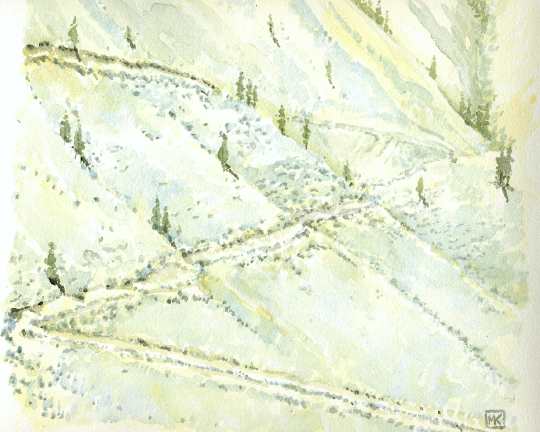
This is the kind of image that approaches abstraction, yet it is so typical of the dry BC Interior and reminiscent of the roads from pioneering days: one bulldozer-blade wide, artfully switchbacking up a steep hill through the sagebrush and scattered pines. I pulled off to the side of the road in the canyon between Lillooet and Pavilion to paint it one day in 2002. There is a similar story in Mrs. B.T. Rogers' diary from July, 1899 (privately published in 1985 as M.I.Rogers 1869-1965, edited by me, that is Michael Kluckner) that is worth repeating in its entirety. Mrs. Rogers, with her husband Ben (owner of the BC Sugar Refinery) and some fellow mining investors went from Vancouver to see a gold mine north of 150 Mile House. "July 5: . . . Made a good trip to Ashcroft – sat on the rear from North Bend up, and saw Lytton and Spences Bridge by daylight. The B.C. Express Company sent [a stagecoach] to meet us, and we went up to the hotel, where we got plastered rooms – about 8 feet by 6 feet. Decided to go via Lillooet. "6: Got up before 5, had a milk punch to sustain us and started off in our 4 horse coach – J. Gillies, driver. We drove through a fine canyon and made Hat Creek [the Hat Creek Ranch, now a B.C. government heritage attraction just north of Cache Creek] for breakfast and change of horses. An inebriated individual made the start rather lively. We drove along the Bonaparte River and Hat Creek, and then entered the Marble Canyon at the second lake, the one that is so magnificently blue. Our near leader [the left front horse], which had been roaring from the start, began to totter, and as we reached a stream, he fell in his tracks. With much exertion and the help of a bottle of whiskey, he staggered to his feet, and managed to get behind the stage, where he fell and died.Then they had to use more exertion to drag him into the bushes, where he would lie, until the Indian sent by the driver could burn him up, according to law. We reached Pavilion Mill (21 miles from Lillooet) rather late, very hungry, and Mrs. Cummings had not much of a lunch to give us. Here we got a couple of X horses and a couple of Indian ponies, who did splendidly. The road into Lillooet is grand but awful. The road is at the edge of a precipice, sheer down to the Frazer, and some of the hills were terrifying. We passed a place where a Chicago man is hydraulicking; near Lillooet, some Chinamen who rent the property from a N.W. Co. are very flourishing. They pay $350 rent and last year took out $13,000, besides raising fodder and vegetables, which they irrigate at night when not using the water in the flumes. Arrived Lillooet and went to the Pioneer, kept by Mrs. Allan, a funny old girl with a false front fastened to her net cap. She gave us a fine dinner – venison, peas and wild raspberries. Ben bought two bearskins, and Mr. Gerbracht one. "7: Got up at 6, and started at 7 – had to turn back for Ben's watch. Retraced our way to Pavilion Mill, walking up the steep hills. Had lunch and started off with a spiked team for Clinton. Taking a short cut up a hill, Mr. Gerbracht got lost, we halloed but got no answer, and after hunting an hour, we proceeded to Carson's Ranch, on Pavilion Mountain [the 26 Mile House, established in 1867], very anxious. Sent out two boys to hunt for him, and a spare pony. The youngster who followed the road found him, coming up with an Indian--he had been all the way down to the Frazer, to an Indian settlement, and paid the klootch $10 for a boy and a horse to go to Clinton. We had dinner at Carson's farm – fine butter – and got a fourth horse. The road to Clinton goes over the mountain. We ascended to 4,850 feet, and then in 3 miles dropped to 3,500 – it was awful, the sharp turns terrible. We had two trees behind to save the wheels and brake. Long before we arrived it was quite dark. Got into Clinton at 10:30, put up at the Dominion."
|