© Michael Kluckner 1998 - 2025
Return to main Vanishing B.C. page Return to home page
Page last updated January 19, 2025
© Michael Kluckner
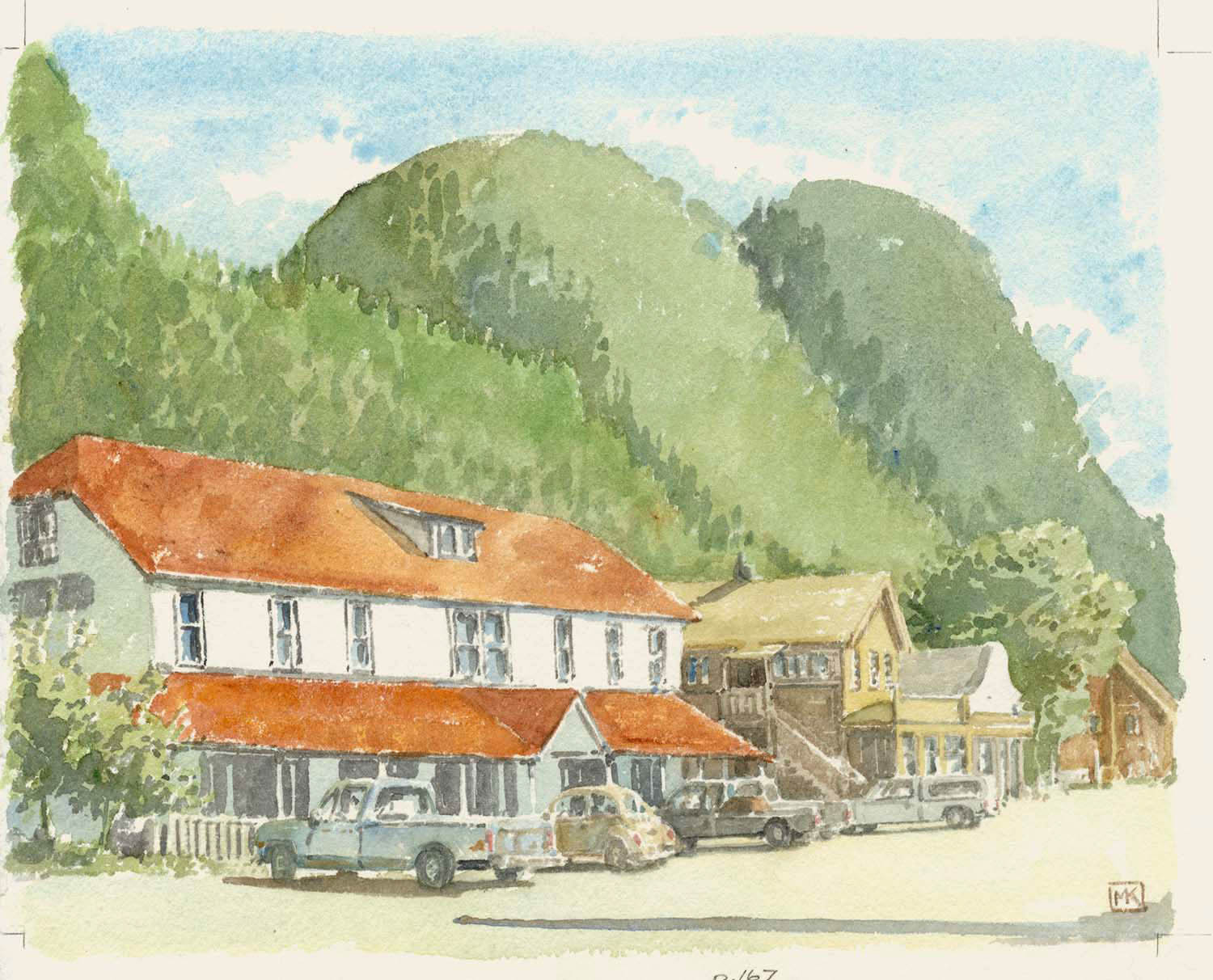
| 2002: Maquinna Avenue, Zeballos, looking toward the inlet, with the Zeballos Hotel, built in 1938 and originally called the Pioneer, in the foreground [it was destroyed by fire in 2008, see the news story reproduced below]. |
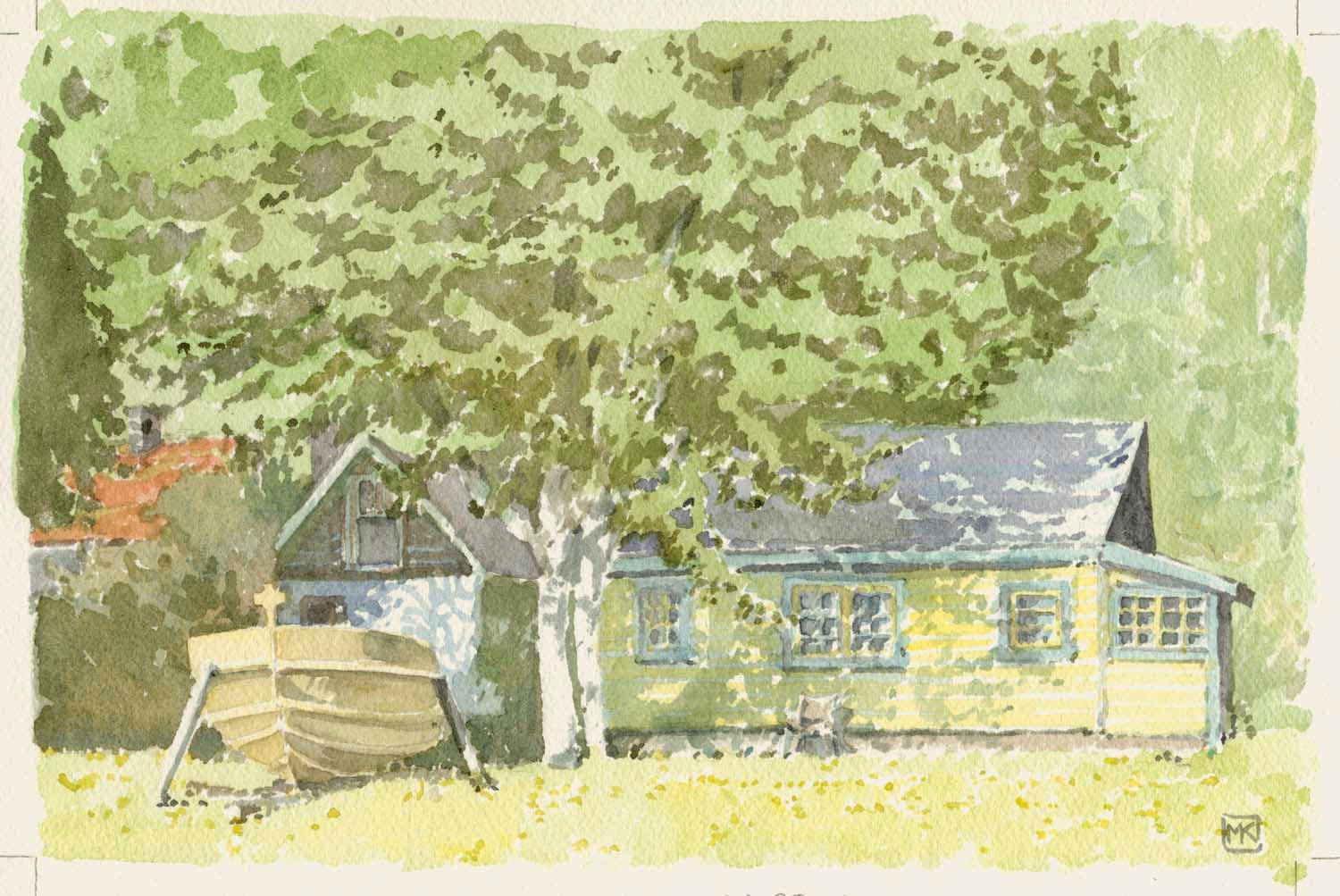
| 2002: The cottage near the
waterfront that used to belong to Adolf Aichmeier--the manager of
the Privateer Mine, the most profitable and long-lasting of the
companies mining gold in the Zeballos valley. According to the
Zeballos Board of Trade brochure, when the Privateer closed in
1948 the town's population dropped from 1500 to 35; it reopened in
the 1970s as the New Privateer, reprospecting its claims, but soon
closed again. Currently, logging is king; Tahsis Company built the
road out to Woss, eliminating Zeballos' outport status in 1970,
and its corporate successor is the largest employer in the town
today. The boom boat is of the type once used to take groceries
and passengers out to the Princess Maquinna, the CPR
steamship that was the lifeline to the outside world in the 1930s
and 1940s; boats such as this made the long run down Tahsis Inlet
to the cannery community of Ceepeecee, where there was a permanent
store, before the gold rush. It was hauled in from Port McNeill
about five years ago by Mike Laffey and painted up. From Garret Vanderberg, 2025: The reason for writing you is regarding the little yellow house on the waterfront in Zeballos. There seems to be some confusion as to its origin. In 1937 my Grandfather Lyle James McPherson, built this house somewhere down the inlet. He had 2 gold mines in the Spud Valley at that time. He built a float and barged the house into the location it's in now, it was beach front in 1937, now there has been much fill added in front. My mother was born there and spend her first 5 years in that house. I have a 1939 picture of her in the house that shows the interior paneling still the same today.It was sold to a German fellow and later , owned by the Kirk family for many years. It is now occupied by Kelly Gordon who also loves the charm of the little yellow house. From Peter Stricker, 2023: I enjoyed browsing through your page on Zeballos, having spent two summers on Vancouver Island, in Port Alberni, working as a college student at the mill there in 1969-70. I'm also an airplane enthusiast, and my friends and I were talking about flying boats the other day, and that reminded me of an encounter I had about 50 years ago. I ran into an acquaintance at Vancouver airport in the late 1970's whom I knew from the UBC sailing club during 1972-75 when I was a grad student there. He was an engineer at H.A. Simons, a consulting engineering firm that worked on pulp and paper mills. He told me about an incident that occurred some time prior to our meeting at the airport, where he flew up to Tahsis on a flying boat to work on a project at the mill. Sometime in the afternoon on the day he arrived, one of the guys at the mill asked if he came up on the flying boat this morning, he said he did, in fact he sat next to the pilot and chatted with him along the way. Well, that same airplane crashed on the way back to Vancouver! He apparently flew into the mountain at the end of Nitimat inlet - apparently failed to make the right turn just before the end of the canyon to get to the east side of Vancouver island. The weather wasn't very good, and the valley he was supposed to turn on was enveloped in fog and he didn't see it. Apparently, people in the area who saw or heard the airplane noticed that the pilot tried to turn around when he noticed his error, but by then the canyon was too narrow and he ran into the mountainside. From Mike Street, a member of the Canadian Aerophilatelic Society, 2022: I'm interested in different aspects of our postal history. My question concerns the text on the handstamp on the cover, "Courtesy of Ginger Coote Airways." While I know that Zeballos had a post office in the 1930s and after, I believe that in those days mail was normally transported to and from Zeballos by the coastal steamer, SS Maquinna. I believe that Ginger Coote Airways would carry mail to Vancouver, as a courtesy, between visits of the steamer. Can you confirm this? Would there be any documentation of it? (I worked at the pulp mill Port Mellon, on Howe Sound, for two summers while in university. I have a good sense of how remote such communities were before the advent of roads.) 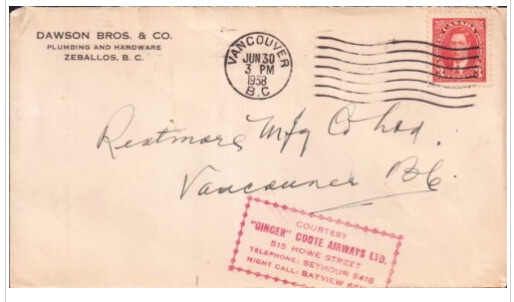 From Rod Mickelburgh, 2018: as a 19-year old in 1940, my father taught in Zeballos. I don't suppose there's much hope, but it would be fun if I could find someone who was taught by him way back then (most if not all might well be dead….born around 1930 or so, I reckon…). From Cheri D, 2015: My father was the base pilot for BC Airlines that was stationed at Zeballos from 1964 until 1967. Warren Betsworth was his name. He very likely flew the Beaver featured in one of the photos. Although I was quite young at the time, I have great memories of my time there. Some of which are Dolly the horse (who used to pull the cart in one of the mines and was left to fend for herself on the islands in the mouth of the river), climbing the bluff across from our house, fishing off the government dock, movies on Sunday afternoons at the iron mine, bringing home hot bread from the bakery during our lunch time from school and beach combing with my family (dad would take us to remote beaches with the airplanes). The more I type, the more I remember. Sigh! Some of the family names I remember are Darville, Forth, Prest. I would love to chat with anyone who lived there in the mid 60's. [Contact Cheri Delainey through the contact link at the top of the page, please] From Darcy Roberts in Grand Forks, 2013: Hello I was wondering if you might be able to help me? I would like to get ahold of the Zeballos Hotel owner that owned it when the fire happen. The owner's name is Mark Whyte who I hung around with in my teens on the Sunshine Coast. If you or someone that has any contact info on him could you send it to me or get him to get ahold of me. From Jacquie Jones, 2012: My parents David (Jack) Jones and Irene lived in Zeballos 1939/1940. My dad helped start the Zeballos Legion, Branch 156. He was a charter member dated May 5th, 1939. I have attached a picture of the harbor that was given to him in 1940. My dad worked at the Riverside Club that burnt down around 1940. Do you have any information pertaining to this fire? 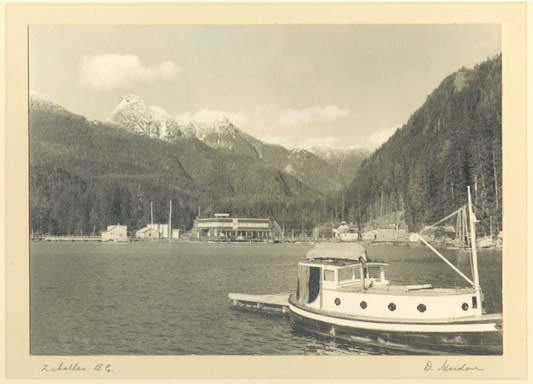 From Charles Ford, 2012: a collection of vintage photographs of Zeballos and other coastal communities; black and whites credited to Elwood White, author of Wings Across the Water; coloured shots are his. As there are so many, I've put them at the bottom of this page. Note from Deanna Armstrong, California, 2009: My Grandparents, George and Anne Tater were previous owners of the Pioneer Hotel in Zeballos. I would love to hear from anyone, by email, who knew them. Note from Al Jones, Almonte, Ontario, 2009: I just came across you website on Zeballos and thought I would drop a line. My family moved to Zeballos in 1948, when I was four years of age, and we lived there until 1969. It was a great place to live and grow up, although I spent the school years of 1959-63 in Victoria so I could attend high school. I certainly remember the hospital. In 1951 all the children had to attend and sit under the ultraviolet lamp because of the constant rain and lack of sunshine and I guess, vitamin D. In that same time frame Kenny Bowen, son of the Privateer mine caretaker, was in the hospital with a broken leg,over the Christmas holidays. Having received a BB gun for Christmas he managed to shoot several Christmas tree ornaments on the large hospital Christmas tree before the staff confiscated he gun. A great place to live as a young boy. Not too many children lived in places where bears were a common sight and cougars were not unheard of in town. I know because I had just entered our home when a cougar walked down the same board walk I was just on. George Robinson the school caretaker who lived behind us shot it as it went up the mountain behind his home. Drop a line, PS: A coincidence. I grew up in a West coast town named after a Spanish Navy Lieutenant and retired in an Ontario town named after a Spanish Army General. Note from Bobbi Sidsworth, 2009: I recently had the opportunity to peruse your website pertaining to Zeballos. It was delightful and brought back many memories, both wonderful and some not so wonderful:-)) My whole family, at one time or another, has lived in the "Z" Zone. A moniker given many years ago because...well our family is OCD about nicknames!! At one point, the hotel was owned by my brother and brother-in-law. Their wives joined them in the kitchen and cleaning the rooms. Hehehe, I suppose you could call them that. I never would have slept in one of them myself. I could go on forever, however, there was a particular reason for writing to you. In reading your article on the very sad news about the hotel. In your article, you show 3 pics of Zeballos, one of them is a home that is near the waterfront. I would like you to know that the cottage is not owned by Adolf, although he was there for many many years....the house belongs to my sister and brother-in-law. All of their children and most of ours as well spent hundreds of hours in that little house. It is absolutely a piece of our history... Two generations of Kirks had the most memorable times of their lives there. [Adolf lived there for a long time, but the owners now are] Brent Gushowaty, Peggie-Ann Kirk, Ariel Kirk-Gushowaty, Myles Kirk-Gushowaty and Zoe Kirk-Gushowaty Note from Jan Morrison, 2009:
I was reading your site while doing research for a piece
of fiction that I am doing. I lived in Zed for a few years
between 79 and 81. I can't say that I relate to much of what
I've read in terms of loyalty or delight towards the place -
however it does have a compelling presence in my memories. I
think I did everything an overly active person could do in the
place. I worked at Tido's restaurant on the wharf, as the cook
and serving person at the hotel, as a 'lackey' in the mess hall
of the logging camp and finally as a choker-bunny - one of the
first women I believe to get that special employment. On the
side - a friend and I published the Zeballos
Miner for fun only and clowned and tried to keep our
kids out of the mouths of cougars and bears. There are a couple of stories I'm trying to find without much
luck and thought you might know - one is of a young man who
drove off the government wharf with two or three passengers. The
driver lived but his pals were not so fortunate. I think it
happened in 78 but am not sure. |
|
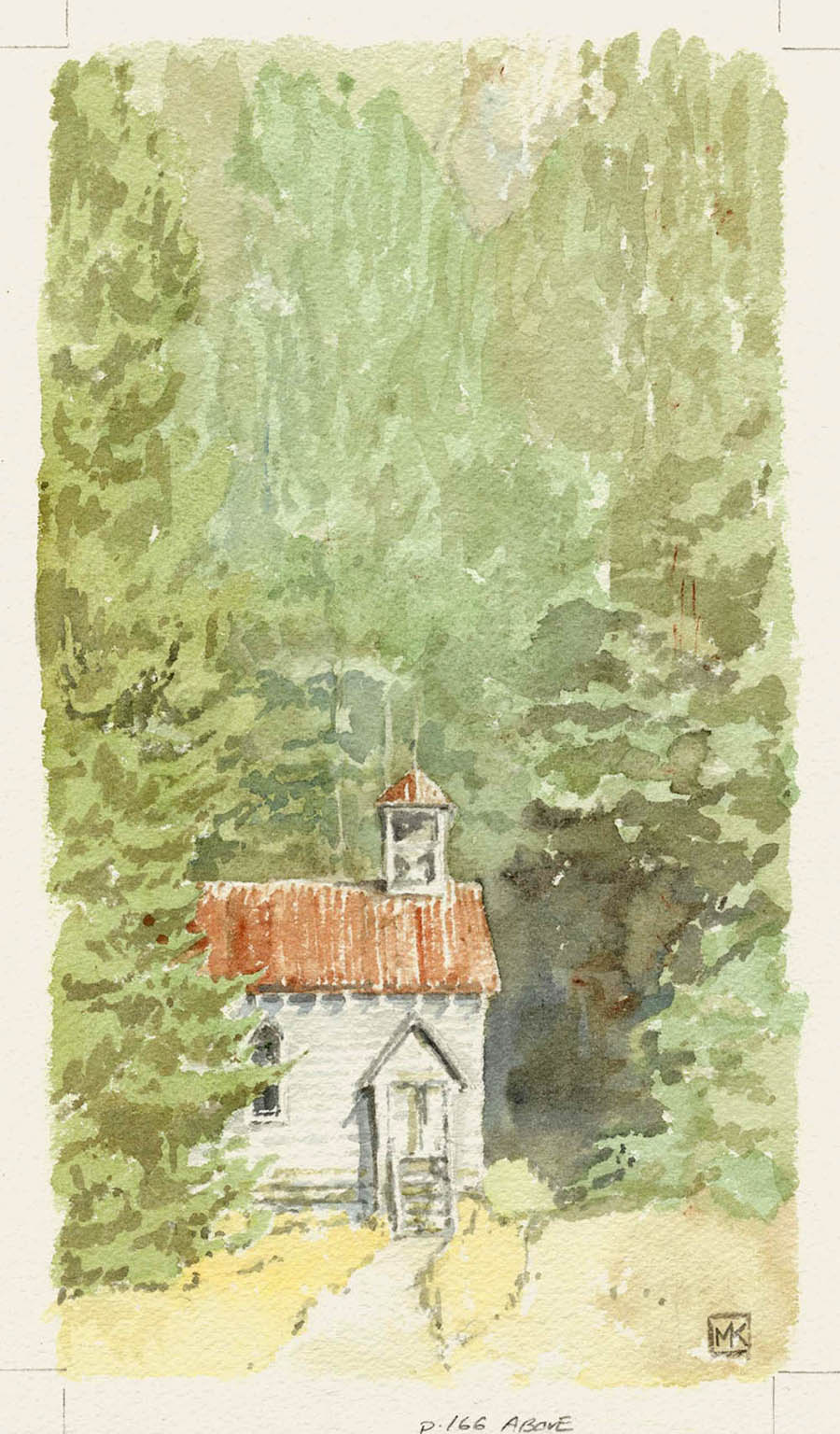
Above: A watercolour from 2003 of St. Anthony's Catholic church, on the edge of town, built on a rise of land against the steep hillside. Built in 1939 by a Benedictine missionary, Father Anthony Terhaar, it is now abandoned and boarded up. Note from Roland Shanks: "St. Anthony's church caught fire in 2002 and its status is currently in limbo. Something will have to be done soon because it's a hazard and the roof will probably come down in a heavy snowfall." Slightly further up the hill is Mason's Motor Lodge, converted from the Zeballos Hospital, which was also built in 1939 and operated by a local branch of the Red Cross Society, formed here for just that purpose, with Maj. George Nicholson as its first president. It closed in 1945, then reopened briefly in 1948. Although its exterior has been greatly remodelled, the interior corridors still look like a hospital's. Note from Heather Darney, 2008: I have just come across
my mother's old autograph book from the 30's and in it there is
an autograph from a woman by the name of Betty Gilmour sign at
the Red Cross Hospital, Zelballos, BC June 30/40. Note from Grace Darney, 2001: "There's an old hotel [in Zeballos], and what is now a newer hotel but that was once the hospital. My brother was born in that hospital, on a night when the town was going up in flames (July 1940). I visited the village three years ago and found it a peaceful spot. The road only came through in the last few decades. When my parents went there, they travelled on the Maquinna. My dad put in the electricity lines to the mine." Note from Mary Ellen Schulz, Black Creek, 2005: My grandmother was a matron in the hospital and my parents met each other there at Ma Hammonds cafe in 1949 and were married there in 1951. Our family moved out in 1966 but when the road was finally built we started to go back there every year to visit, go fishing and explore old mines. Collecting Zeballos information has become a hobby (or maybe I should say an obsession) and I have 4 or 5 photo albums with newspaper clippings and old pictures and a couple of maps with the whereabouts of most of the over 200 old gold mines. Note from Leslie Fisher, 2006: I read the review of
your book Vanishing British Columbia in Bookworld. My husband is
the owner of the Zeballos Hotel and we resided there from June
1986 to June 1996 during which time we completely restored the
building trying to retain as much of the original character as
possible. Just for your own information, we would like to advise
you of what we know on the "adjoining two storey building that
housed one of the town's brothels". There is not an adjoining
two storey building...it is small original one storey house that
we previously owned [this appears to be only in the BC Bookworld
review]. The building next door to this house is two storey but
my understanding is it was always a store with an owners'
residence upstairs. (My mother vacationed in Zeballos in 1938
and shopped in it). Because brothels were frowned upon (actually
never legal in BC), the "Goat Ranch" and other brothels of
Zeballos were situated on the gravel road leading out of
Zeballos past the cemetery in an area that is now, most often,
underwater. |
| Fire
destroys historic Island hotel Inn was built for goldrush in 1939 Dan MacLennan/Courier Islander, Canwest News Service Published: Thursday, October 09, 2008 The Village of Zeballos on Vancouver Island's west coast lost a piece of history Tuesday when fire destroyed the Zeballos Hotel. "It was all rolling out in big sheets of flames out the top," said Dianne Webber, a Campbell River resident who was visiting the rural community at the time. "The flames were shooting out the upper windows. It was pretty spectacular. I had never seen anything like that." With the power out due to raging wind and rain storm, the 70-year-old hotel caught fire early Tuesday morning and burned to the ground within a matter of hours. Bill Moore, past volunteer fire chief, lives four doors down from the hotel. He said the power had been going out and coming back on a few times as the storm raged. It went out again around 3:15 a.m. He heard the fire call at 4 a.m. "I looked out the window and I saw a great big orange glow to the north of me," he said. Webber, an industrial hearing tester, was overnighting in Zeballos when she got an early morning phone call telling her about the fire. She and a small group of others gathered in the storm to watch the hotel burn. "It was a huge fire," she said, adding that people were worried a couple of large propane tanks behind the hotel could explode in the heat, but that didn't happen. Zeballos thrived in the early part of this century with the discovery of gold but its population later dwindled when the mines closed. Now about 230 people live in the community, mostly employed in logging. Built in 1939 for the Zeballos gold rush, the old hotel and pub went quickly. There was little the fire fighters could do but try to contain the blaze. "We couldn't tackle it from the inside because it looked like it was half engulfed by the time we got going and in about 20 minutes it was fully engulfed," Moore said. "We just made sure that the little house next door didn't (burn). That's all we could do. Once we saw the flames rolling right through the building. There wasn't a chance of getting anybody in there for an attack at all." Members of the volunteer fire department spent hours on the scene. "We had four or five hoses out and the truck was just a going," Moore said. "(We) went through a 52 gallon tank of fuel for seven hours of pumping." Fortunately, the hotel/owner operators were up early and smelled the smoke upstairs where the rooms were. "Very fortunate," Port McNeill RCMP Sgt. Phil Lue said Wednesday. "The owner was able to wake everybody up and get everybody out. There weren't a lot of people in there. Including the owners and operators I think there might have been a dozen people maybe. They got everybody up and out and everybody was safe, which was good." An investigator from the BC Fire Commissioner's office was on the scene Wednesday combing through the ruins, trying to determine a cause. "We don't know the cause of the fire yet," Lue said. "At this point the RCMP do not consider it suspicious." Moore said BC Hydro was investigating as well, given the ferocity of the storm and the related power failures. "We don't know if it was electrical or not," he said. "Who knows if wires arced against the building or if they got stretched by the wind, or the power surges, who knows?" What is certain, is that the village has lost a piece of itself. "A piece of history, centre of town," Moore said. "A lot of people have gone through there over the years. A lot of tourists too." |

Photographer unknown, c.1940. Boardwalks, board roads and mud in the rainforest
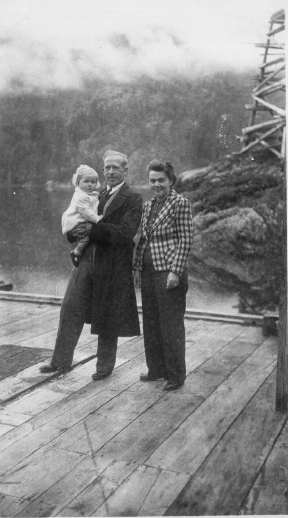 |
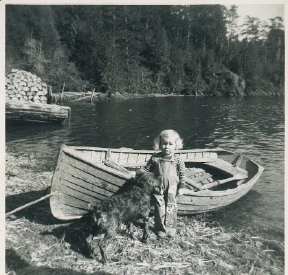
Jack Crosson, his wife Anne and daughter Charlotte about 1946, waiting for the Princess Maquinna. Above: Charlotte on the beach at Kyuquot in front of her father's postwar shack, with Snappy the dog. Jack Crosson was one of the early arrivals at Zeballos in the 1930s. His book Jack's Shack, published by Whistlepunk Books in 2000, is an excellent memoir of life on the west coast. |
 |
 |
|
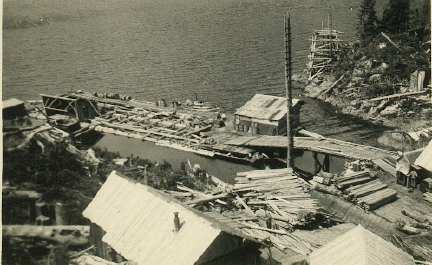
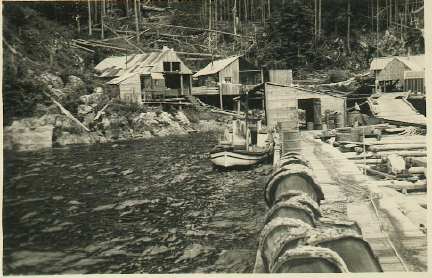
An unidentified west-coast waterfront in the late 1940s, perhaps Ceepeecee. Can anyone identify it exactly? Photos courtesy of Charlotte Crosson Granewall Note from John Ponsford, NDQAR
Victoria, 2008: The unidentified west coast village on
your web site is not Ceepeecee. It is Deep (Amai) Inlet near
Kyuquot. It was the site of a small gold mine that was run
by Jack Crosson, Gordon Ponsford, Bill Patmore, Adam Thompson
and others about 1944 -1947. Adam Thompson continued to
work a claim there until the 1950s. Note from Harriet Boman, Nasaker, Sweden, 2008: I saw a picture of Jack Crosson and his family from 1946 and I hope that you can help me. My grandfather's brother named Alfred Bloom was together with Jack Crosson in Zeballos in 1937. He should follow Albert to stake claims. And in his book Jack´s shack have I read a sad story about my relative. My question is if Jacks daughter Charlotte is still alive. Do you know if there is many other pictures of gold miners in any museum. I have no picture of Albert Bloom. He was born 5/19 1887. ***
Zeballos is one of those places engendering a lot of loyalty from anybody who has or does live there. There was a reunion in the town in August, 2002, not long after I was there. I'd be interested in anyone's stories the town, or about mining in general. Thanks to Roland Shanks at Zeballos.com for information and clarification. |
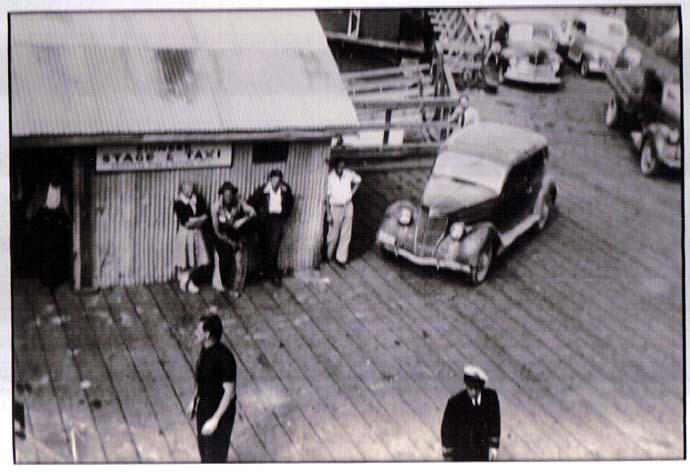
| Wharf in Zeballos,
photographed from the deck of the Maquinna.People under the sign
from left to right, Shirley Morrison, Jack Morrison
and Dave Morrison (Dad's brother) Note and photo from Grant Morrison, born in Esperanza (Ceepeecee) in 1953: My father waded ashore at Zeballos when he was about 19, before the wharf had been constructed. He became involved in many occupations, including working for a trucking venture run by Allan Ford. My mother arrived at the tender age of 22, by which time the wharf had been built. My mother's father was a minister and had shown her a protected life -- she'd never seen the likes of Zeballos in all its boom-town glory. Once when they were walking around, before they were married, my mother asked my father about a building located a ways from the others. "That's the goat ranch," he told her. "A few ladies raise 'em there." One year there was a flood in Zeballos, creating a real mess. One of the big concerns, especially of the single men in town, was to rescue the "goat herders," which was done in boats, by flashlight, with a degree of luck. The men brought their wet and frightened cargo back to a dry hall and served them coffee. As she handed out the mugs, she asked the Madame, "did you train your goat herders here or elsewhere, and can I come up sometime and watch them work?" Note from Marie Cox-Rogers, 2008: Zeballos holds some exciting memories for me, even though I only spent two years living there. Our family arrived when I was entering grade two and we left when I was entering grade four, so the years we lived there were 1966,67, and part of 68. The old hospital left me with some interesting memories, particularly the morgue area. As children we would go exploring in the building. There was one flash light between six or more kids, so unless one wanted to wait upstairs in the dark hallway alone, one would definitely have to catch up with the group using the flashlight to explore the lower level! Do you have any photos of the hospital exterior and interior prior to the building becoming the hotel. I doubt that I would ever be comfortable sleeping over night in that place. I could hardly stand walking past it as a child at night time!!! I whistled loudly and practically ran!!!! Photos submitted by Charles Ford, 2012 ZZO was shorthand for Zeballos. The black and white photos are from the collection of the late Elwood White, author of Wings Across the Water. The color photos were taken from 1962 to 1964 by Charles Ford. BCA [BC Air Lines] had a/c based in ZZO and when the Iron mine was running had a direct VR-ZZO flight in the afternoon. This is a brief history of BCA
http://1000aircraftphotos.com/Contributions/FordCharles/FordCharles.htm" |
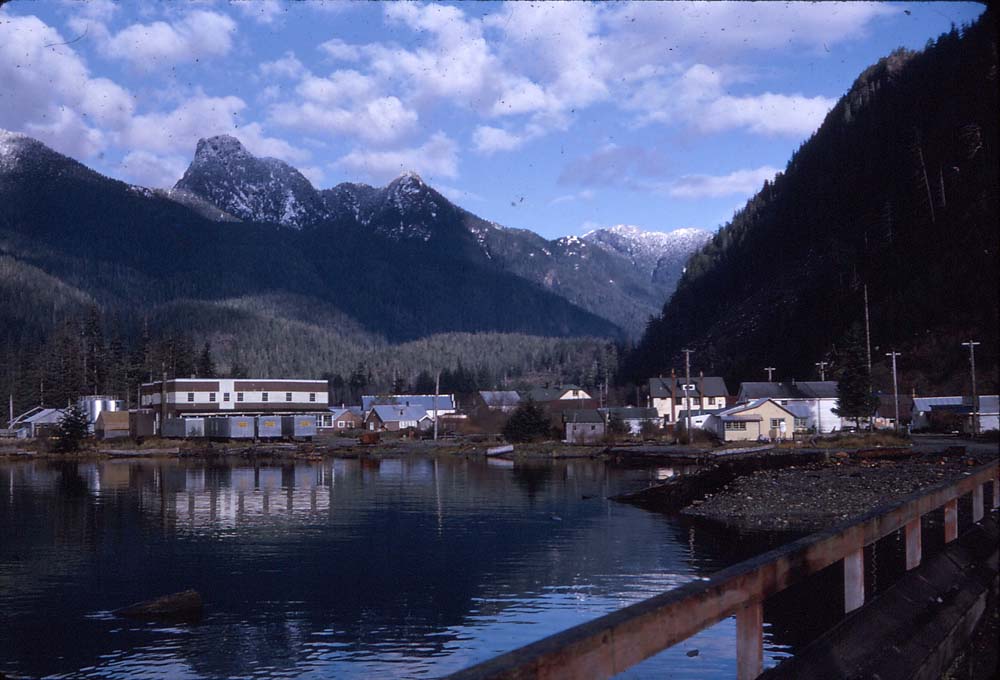
Zeballos 1963
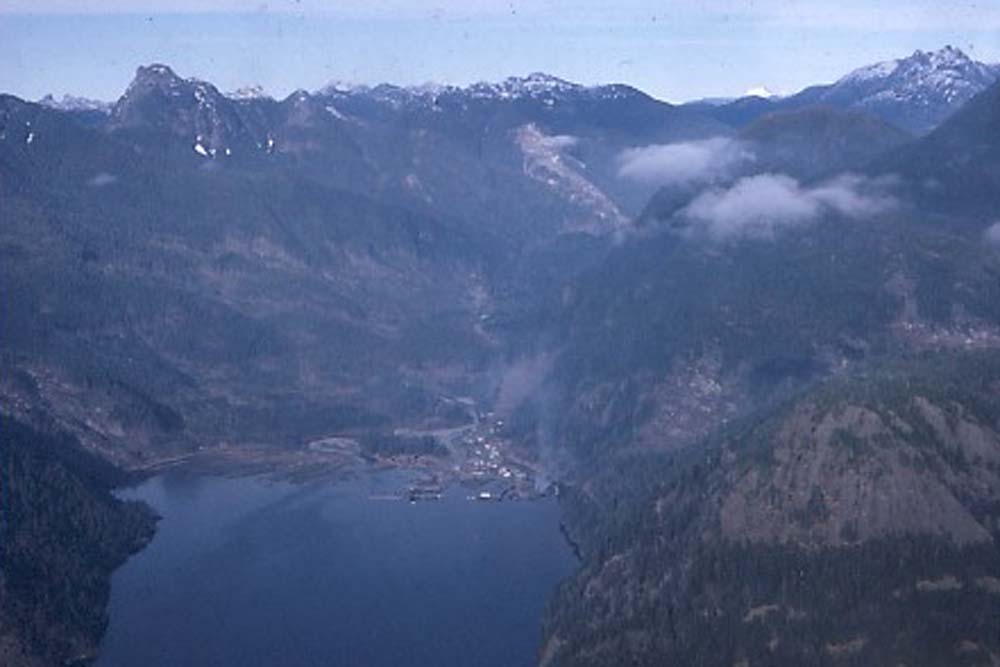
Zeballos from the air, 1960s
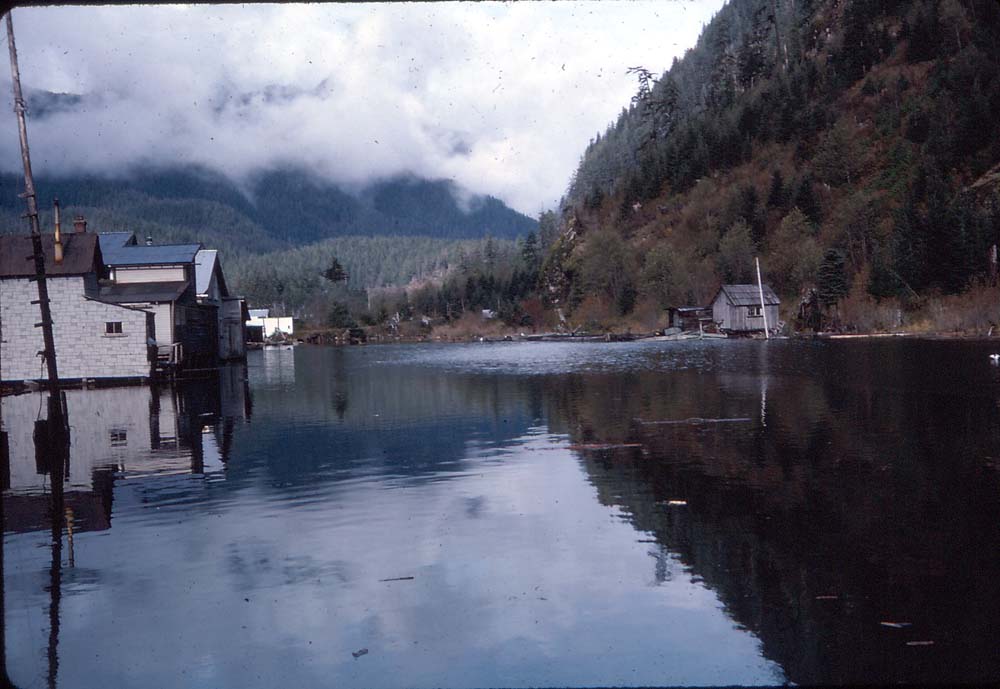
Zeballos high tide, 1960s
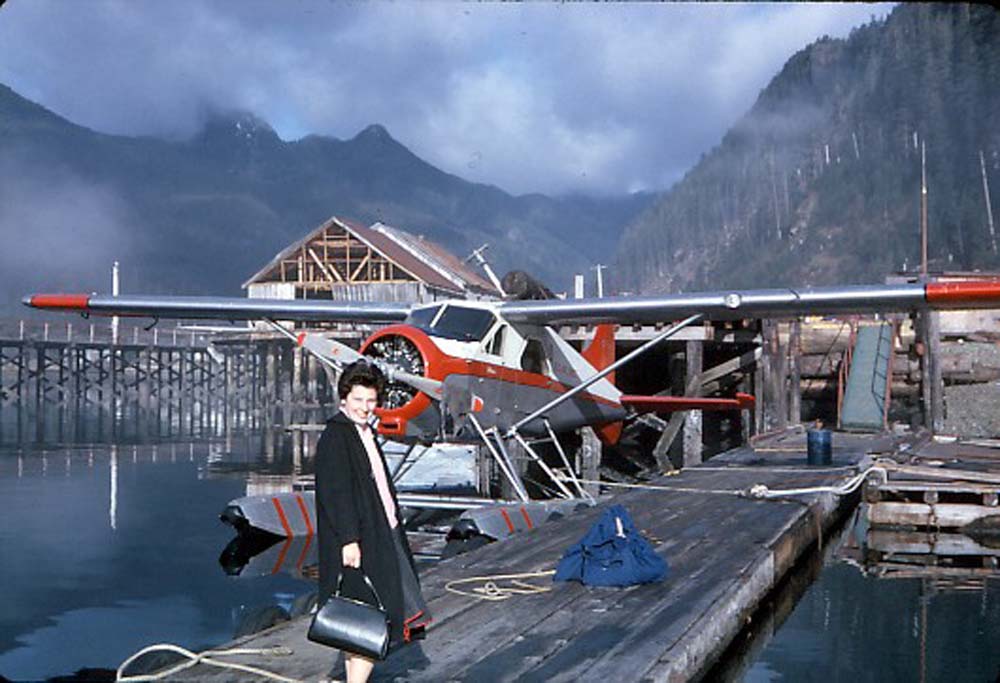
"Beaver at ZZO," 1963
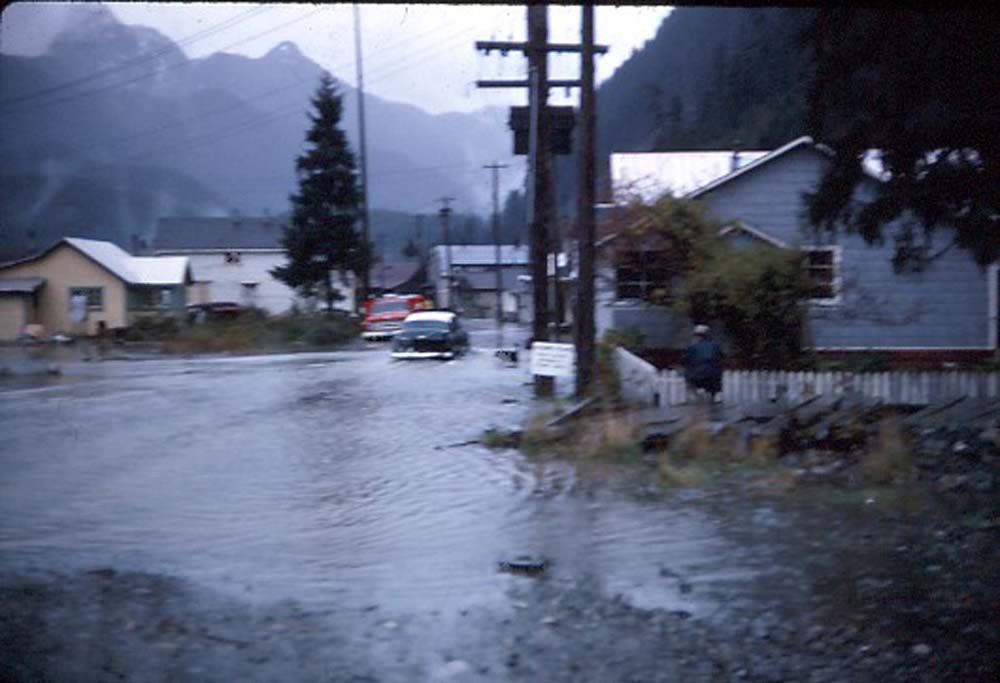
High tide in Zeballos, 1963
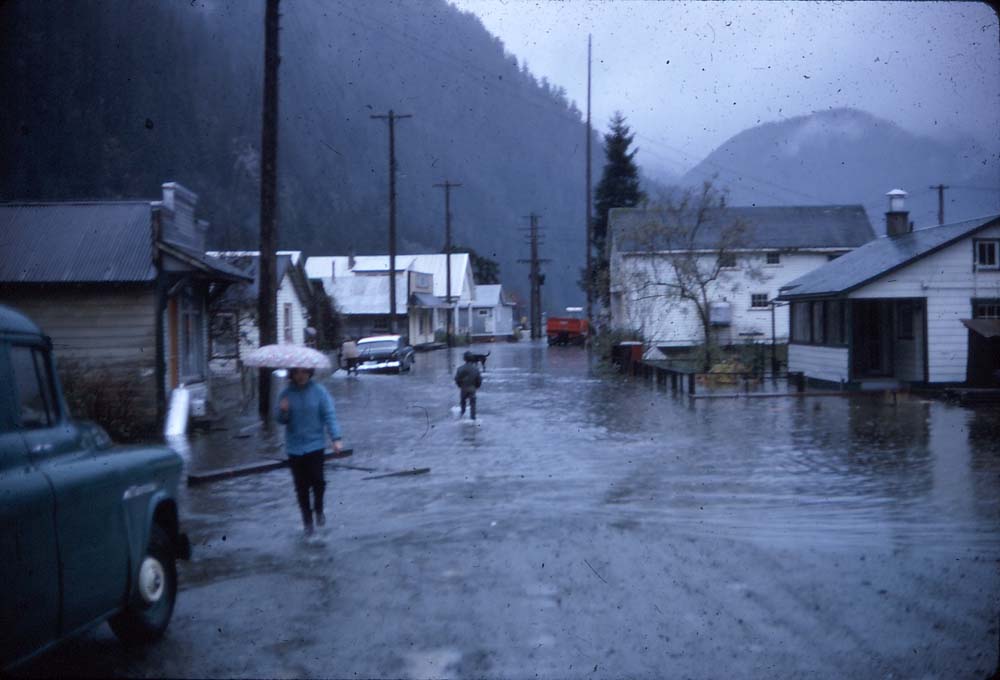
High tide on Main Street, Zeballos, 1963
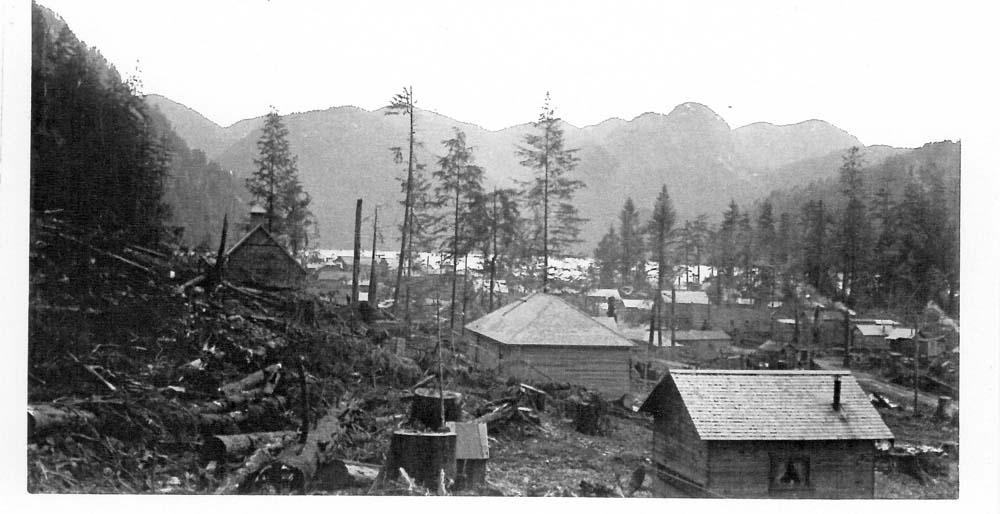
Zeballos main street in the 1930s, looking west
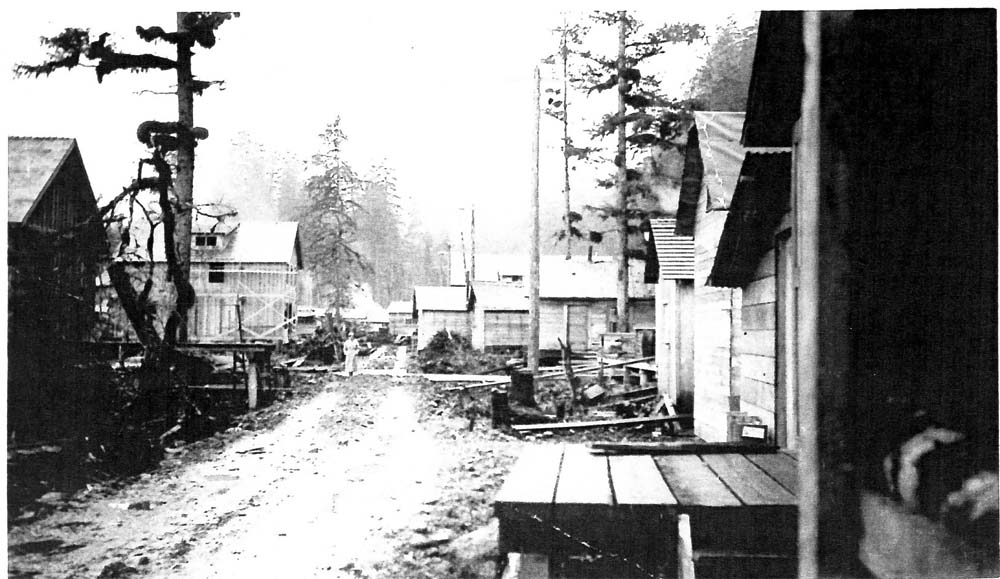
Zeballos Main Street 1930s
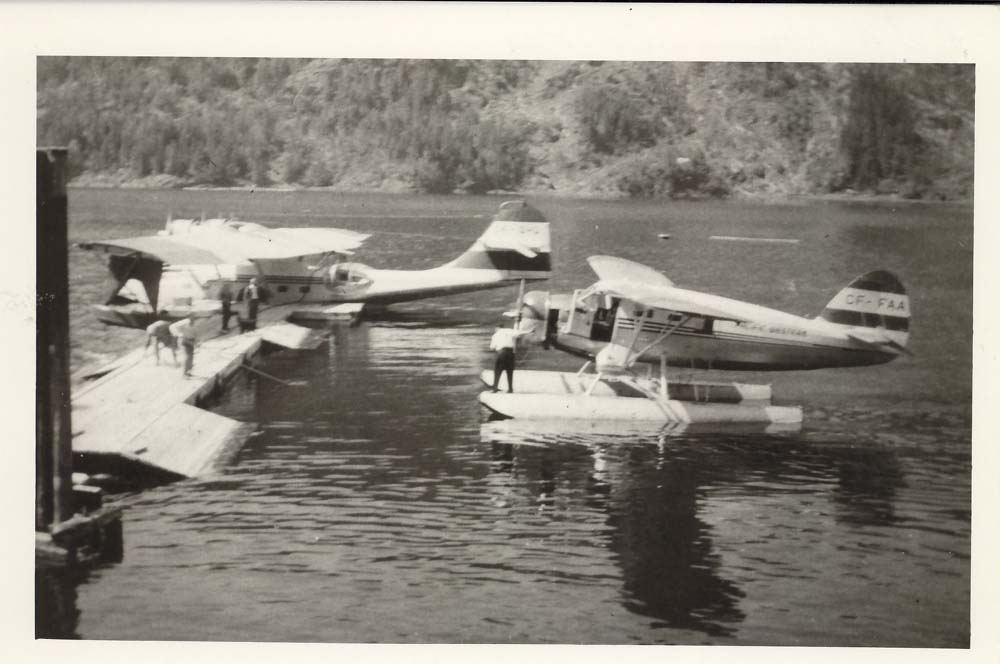
British Columbia Air Lines Canso at Zeballos
|
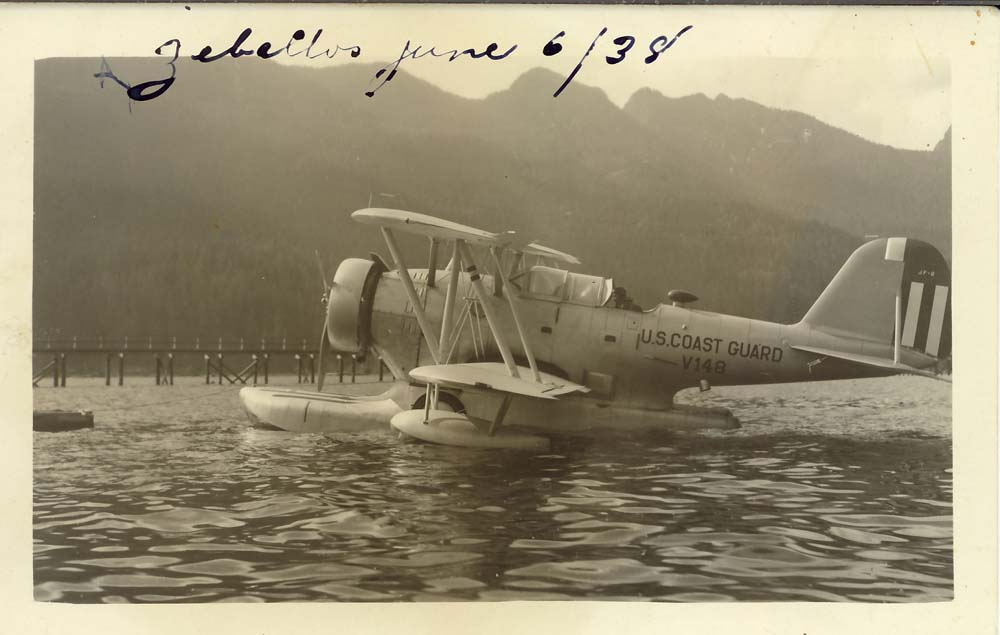
"Px of Grumman Duck was during search QCA Norseman missing Gold River Tofino carrying wife of Gearge Nicholson Agent of everything in ZZO." – Charles Ford From Shaun Mullins, 2019: Enjoyed finding your photos on your blog, but I must point out an error on a caption. A guy in England named Alan Beardmore shared your Grumman Duck photo on a Facebook group called 'The Anorak's Aerodrome' and I did some research.Re: Your photo of Grumman JF-2 Duck USCG V148 (Model G-9 c/n 267, ex V174) - Queen Charlotte Airlines did not even begin operations until 1946, and the crashed aircraft being searched for in June 1938 was not a Norseman, but Fairchild 51A CF-AUX c/n 769 carrying Mary Nicholson and three others. The wreckage was found with the remains of the four occupants nine months later. Please see Johan Visschedijk's writeup at http://1000aircraftphotos.com/Fairchild/4534.htm |
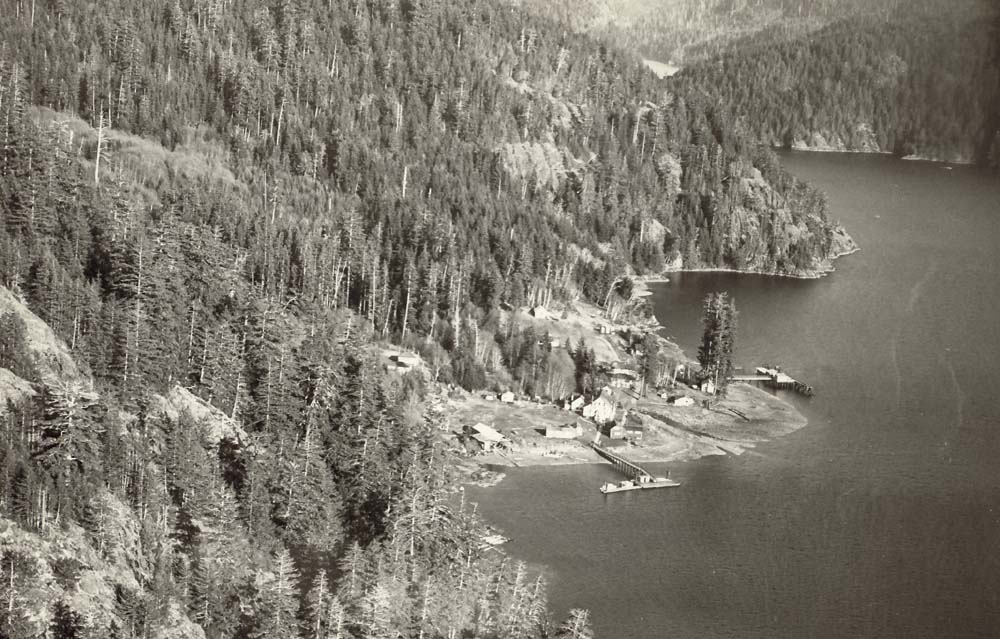
Esperanza Hospital, 1930s
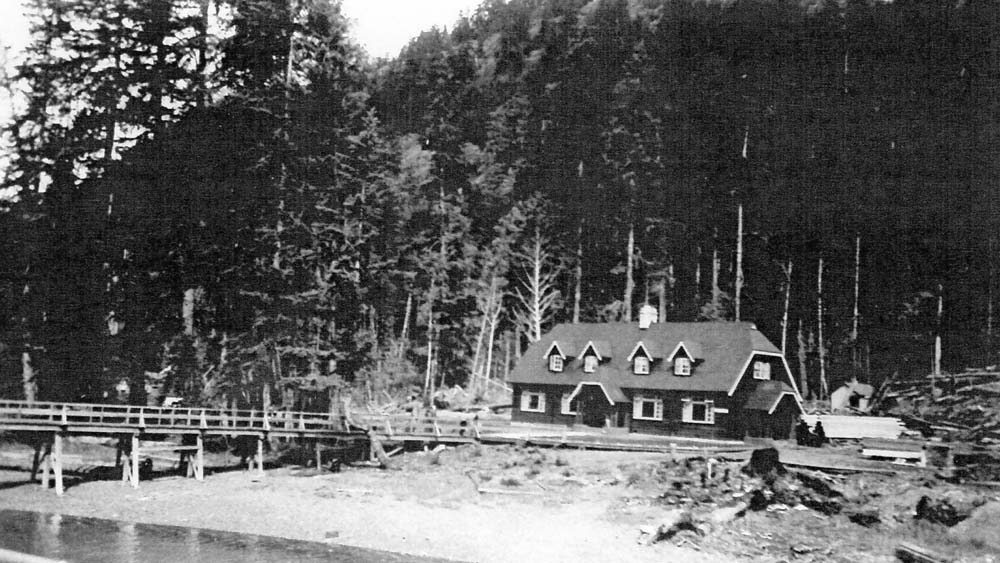
Esperanza Hotel, 1930s
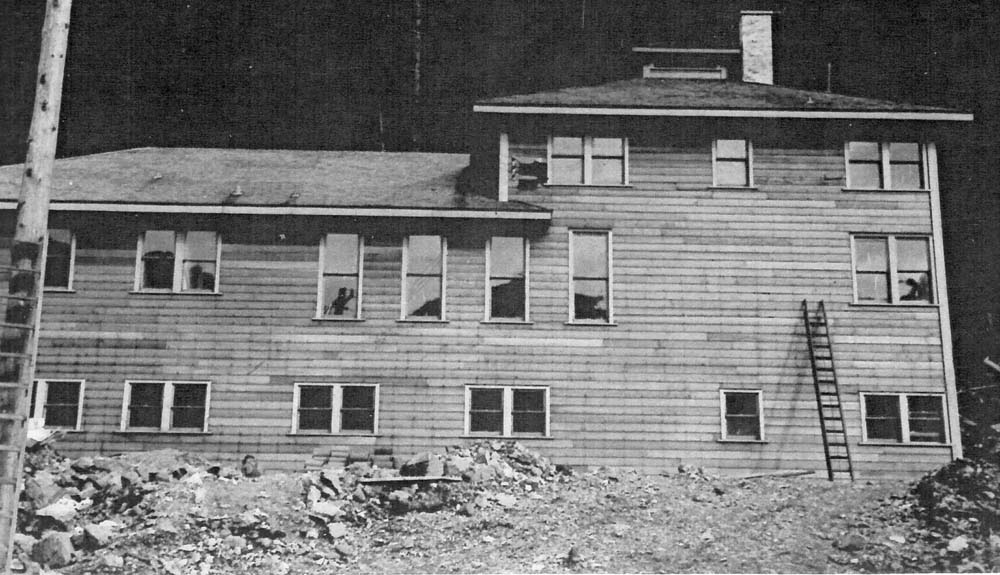
Zeballos Hospital, 1930s
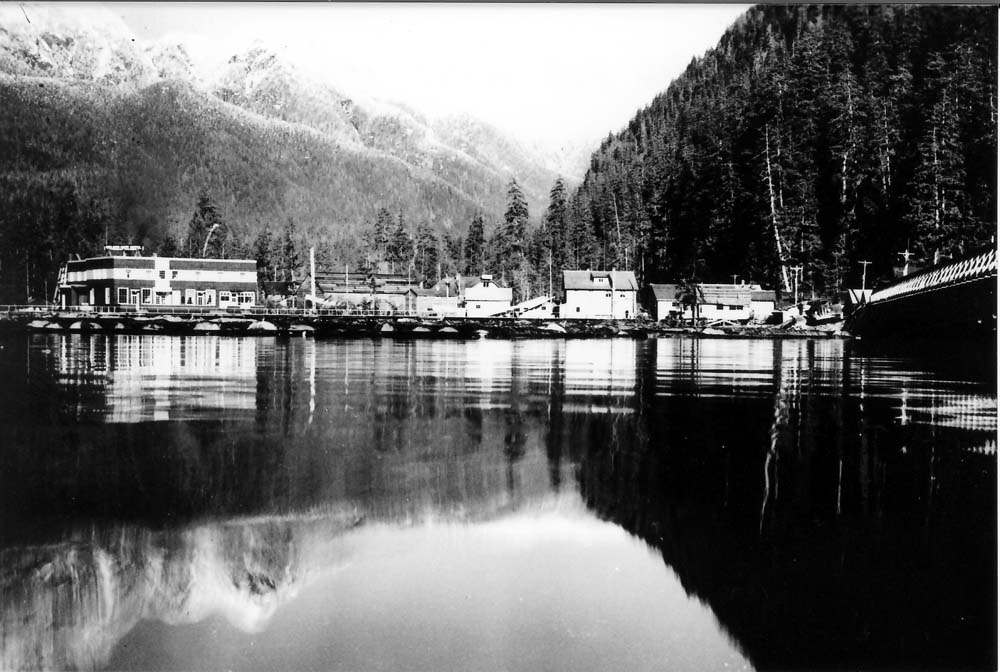
Golden Gate Hotel, Zeballos harbour, 1930s
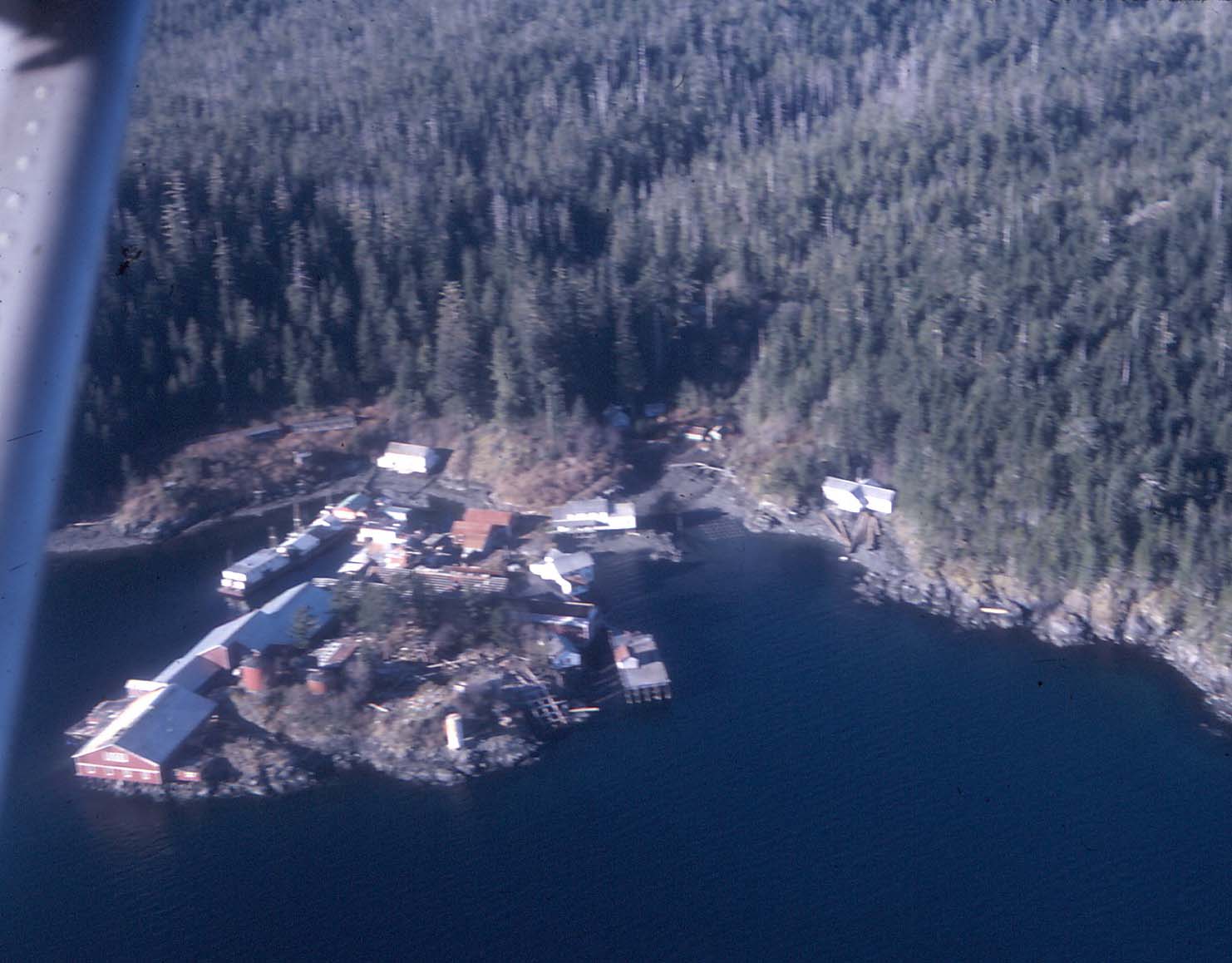
Nootka Cannery, 1963
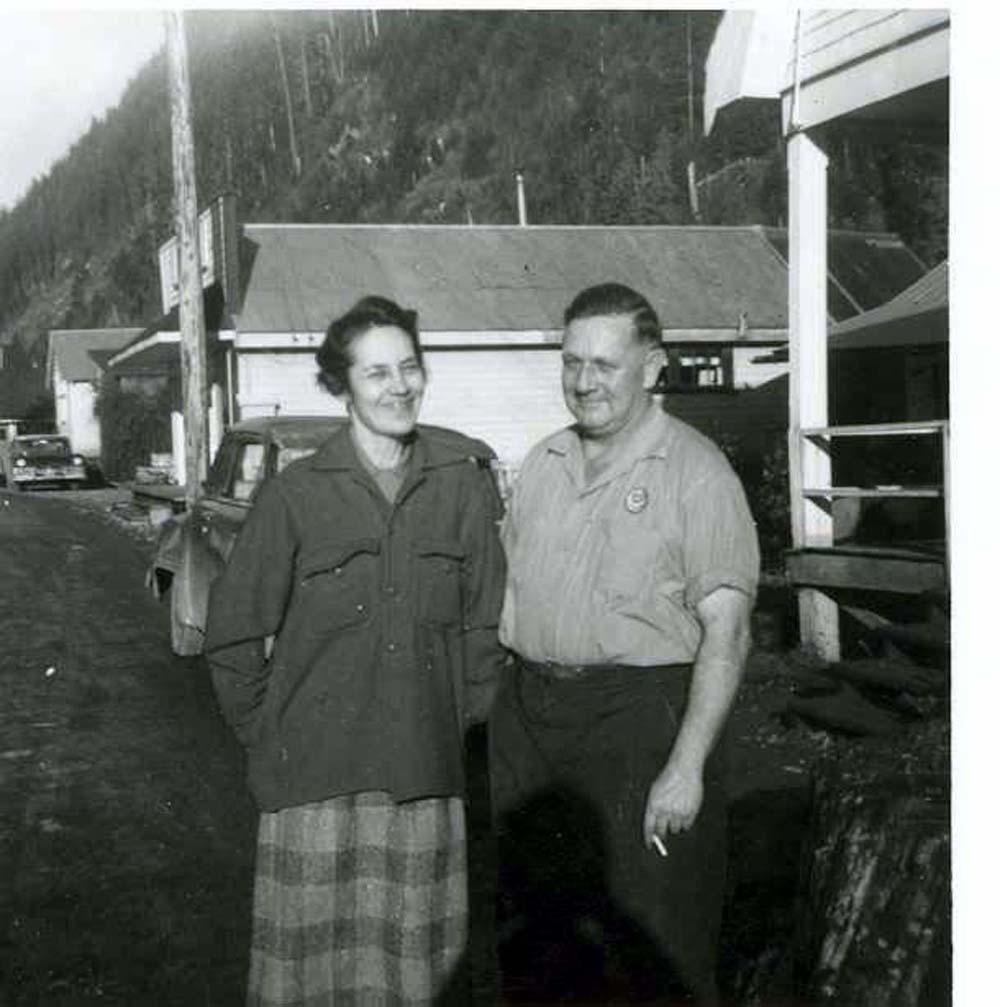
The Suttons – BC Air Lines agents at ZZO