Return to main Vanishing B.C. page Return to home page
This page last updated September 24, 2025
© Michael Kluckner

|
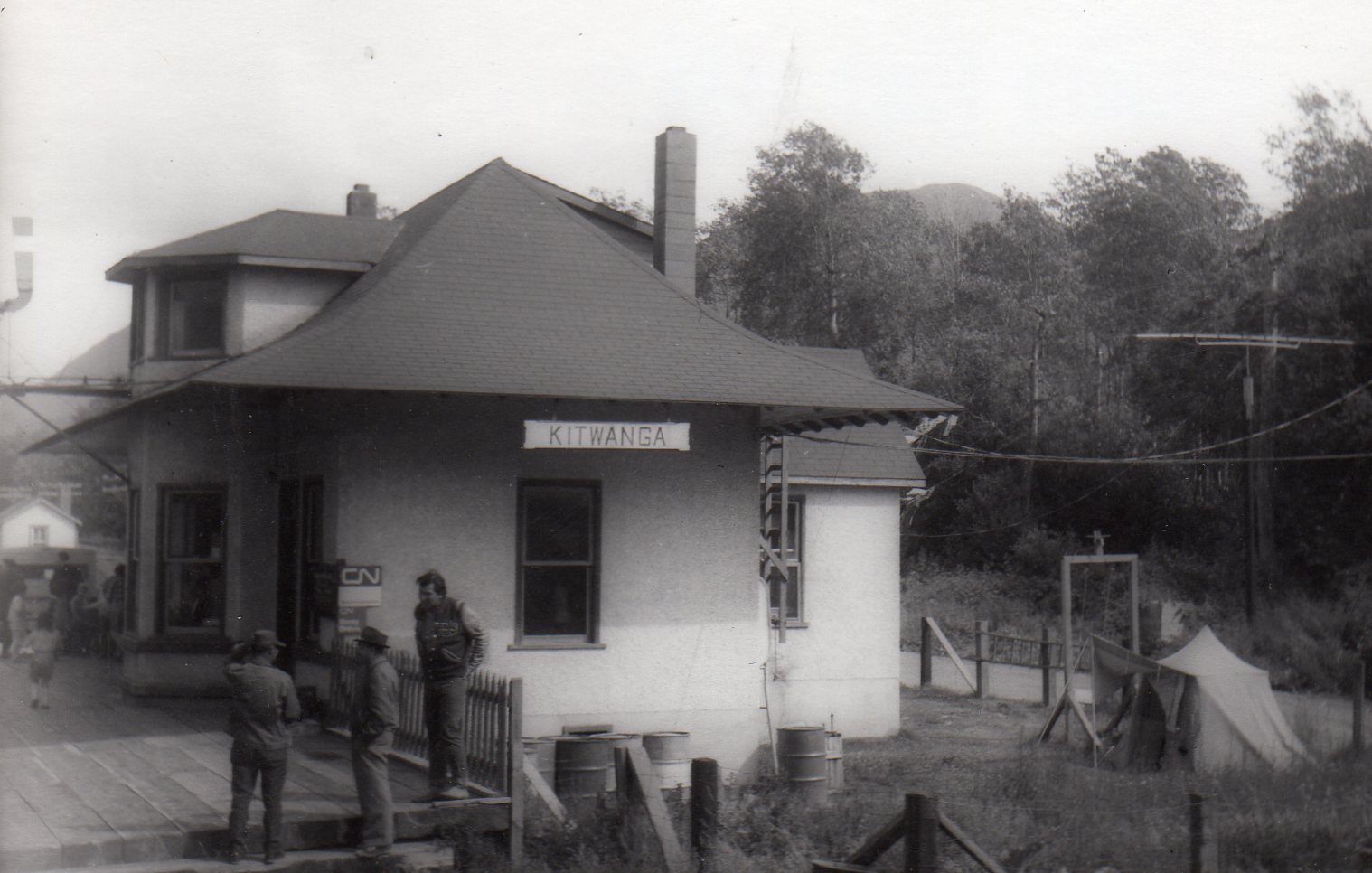
Written in 2003: At villages and whistestops across northern B.C., the little stations of the Grand Trunk Pacific Railway once provided a connection with the outside world. I had believed there was just one left – the Kwinitsa Station that was moved about 70 km. west and restored to provide a museum building on the Prince Rupert waterfront (ironically, not far from the main GTPR station). Then, one day in the winter of 1998 when I was in Kitwanga looking at totem poles and old churches (as part of my Canada book travelling), I came across this station, towed away a little distance from the railway tracks onto a bare patch of ground along the road, roughly boarded up and scrawled over with graffiti. It burned down in 2003 – when I went through Kitwanga in June, there was still a pile of burned boards and metal on the ground across the road from St. Paul's Church. I subsequently discovered that an identical station at Dunster, southeast of McBride, still exists in good condition – the community has restored it very close to the tracks – so it qualifies as the least-altered of all the small GTPR stations in BC.
Kitwanga Station in 1967, photo by Sharon Negraiff (2003 continued): These are Type 'E' stations; according to Hal Kalman's "History of Canadian Architecture," vol. 2 page 483, more than two-thirds of the Grand Trunk Pacific's stations were built to this plan. "Almost all were placed on the north side of the track with the waiting-room end towards the east (probably so that the uninsulated buildings could take advantage of the morning sun)." On the prairies, Kalman wrote, the GTP laid out all its towns on a uniform plan, like the CPR and the Canadian Northern railways before it. There is one other station I know of, slightly larger than these ones, at Fort Fraser, now moved and renovated, with stucco siding and new windows in new positions, as the Last Spike Pub. ************ |
|
From Ralph Hartfeil, 2025: I recently found an abandoned
farmhouse that was the Fallis, Alberta GTP station.
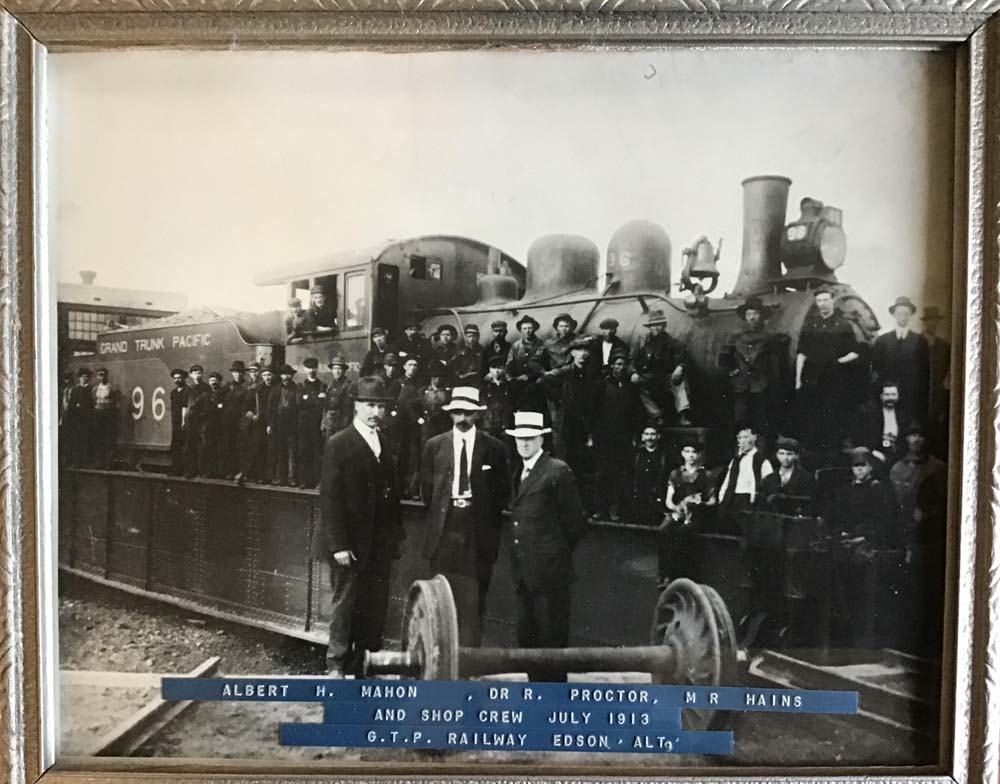
From Albert L. Mahon (grandson), 2022: Albert H. Mahon, Mechanical Engineer, in charge of Grand Trunk Pacific Railway construction from the West Coast heading east, and was a dignitary at the driving of the last spike. The Mahon family at times lived in a boxcar, such as at Prince George. Mahon later became Superintendent of the Edson Alberta rail yards. Edson was the junction of the rail spur line that lead to the source of coal, at Coalspur, SW of Edson. The coal was used to fuel mainline locomotives, and to energize the rail yard. Edson was the junction of the spur line that was the source of coal, at Coalspur, SW of Edson. the town named for Edson Chamberlain, GTPR president.
*************
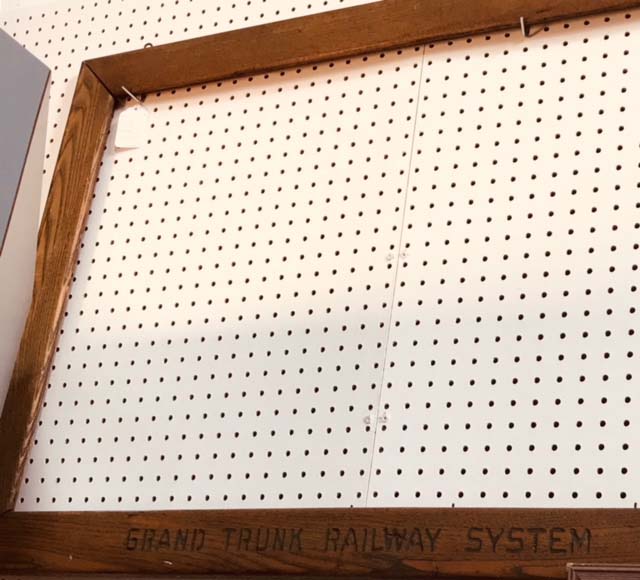
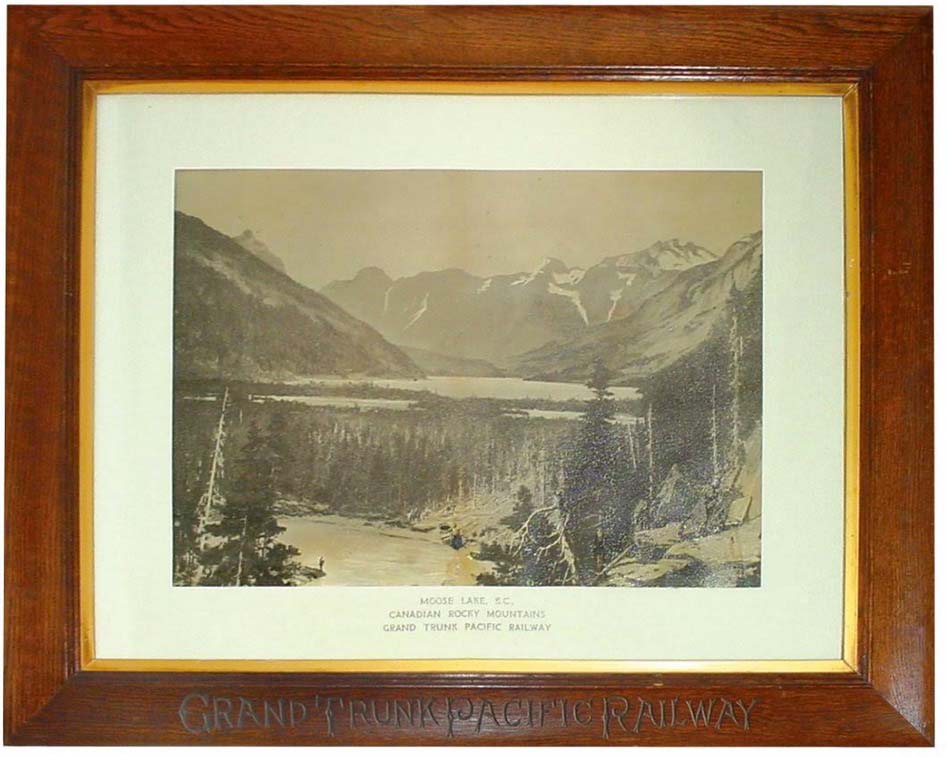
From Jonathan Esar, 2018: I was wondering if you could help identify this GTR wooden frame . I’ve seen others but not in this font. From Lorne Wasylishen, 2015: I bought this at an online auction in Waterloo Indiana (amazing how much of our stuff ended up in the USA) and it now hangs, securely locked to the wall in the Smithers station. All original with wavy glass, a picture of Moose Lake B.C at Redpass Junction (45miles west of Jasper) where the GTP diverged northwest towards Prince Rupert and the Canadian Northern continued southwest to Vancouver. I managed to acquire another with a slightly different style of frame containing a picture of a Saskatchewan wheat field from a lady in Nova Scotia, It has new glass and mat board due to some damage , there is no provenance on either item. From what I could find out these were hung in various stations along the GTP line to give travellers an idea of what the rest of the country looked like. There is a query about these frames on the GTP page from Gilbert in Timmins Ontario, 2009. If you still have his contact info perhaps you can alert him.
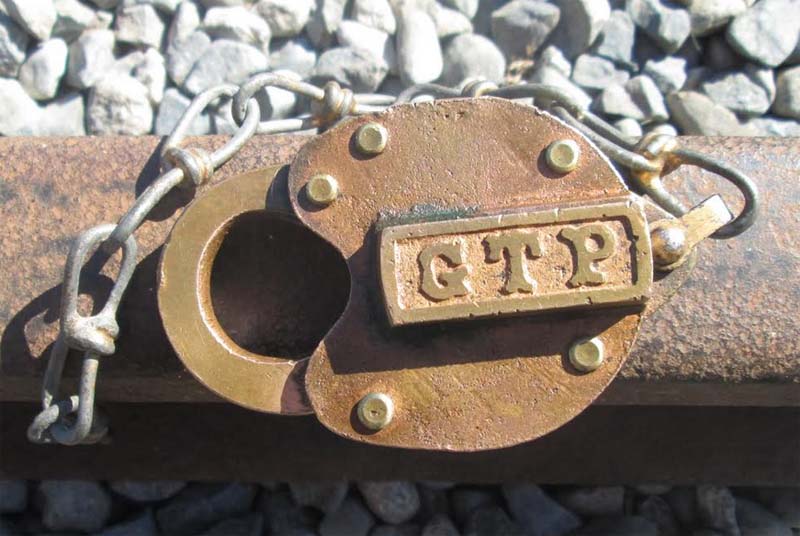
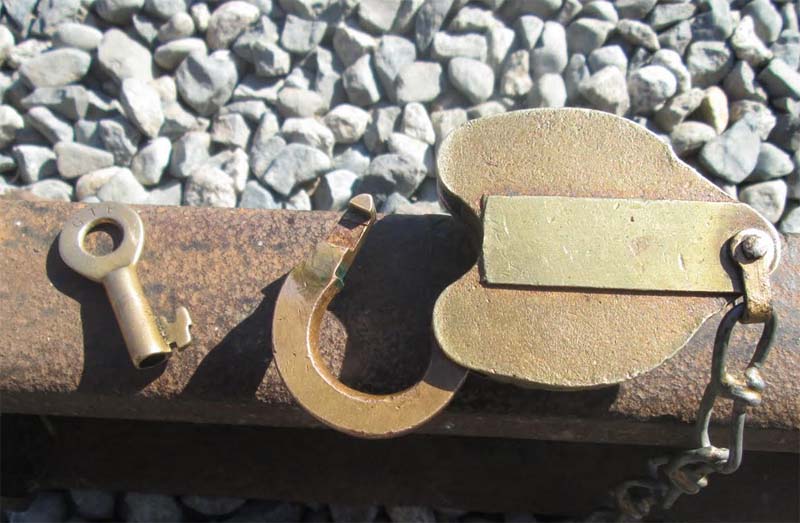
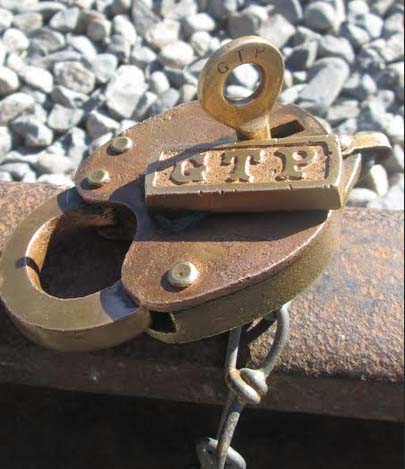
From Steve Barnett, 2015: I would like to share some
photos of a GTP switch lock and key, (and you have my permission
to post on your web site). GTP artifacts are quite rare, and in
my quest to search for a GTP lock, I was quite surprised that it
not only took 26 years of waiting, but that there also were few
or no photos of GTP switch keys and locks to be found anywhere
that I could use as reference material.
******************** From Peter Newman, 2014: I thought that I would share a
link to a web site I recently created. It features 75
professionally restored slides taken in Canada during the final
days of steam / first days of diesels. The photographer was the
late Del Rosamond. I think you'll find his images remarkable for
their content and quality. In the last three weeks,
my embedded counter shows over 10,000 visitors. I hope that
you'll feel free to share this link with anyone / groups that
might enjoy site. From Larry Tallon, 2014: My father was, I think, was one
of the first operators stationed at Tyee. He worked for CN for
forty years and died at the Age of 63 in 1957. This means he was
sent out from Ottawa around 1917. I have a picture of him
sitting in front of the station. Would you have any access to CN
records about this? I have the original equipment they sent with
him. Typewriter, adding machine, practice key and a gold
Hamilton watch. I don't know exactly what to do with it all. Is
there a society for its preservation? I have no one to hand it
down to and don't want to sell it.
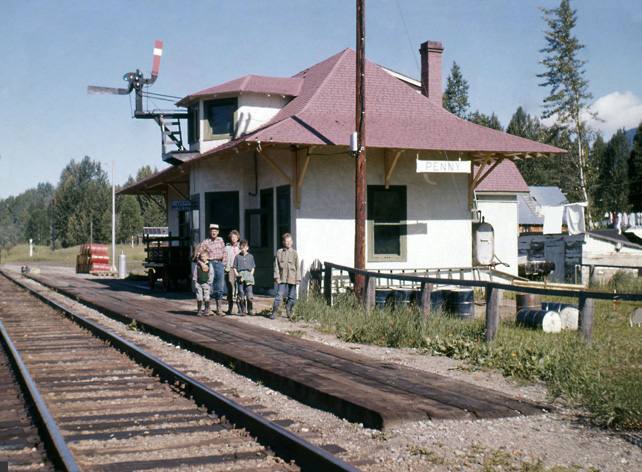
From Dirk Mendel, 2013: The
Penny Station in 1961. That's me under the arm of my dad, and I
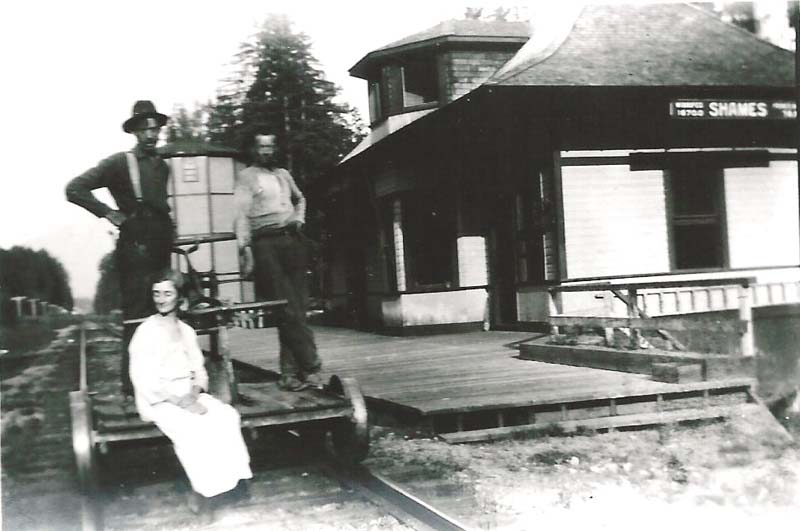
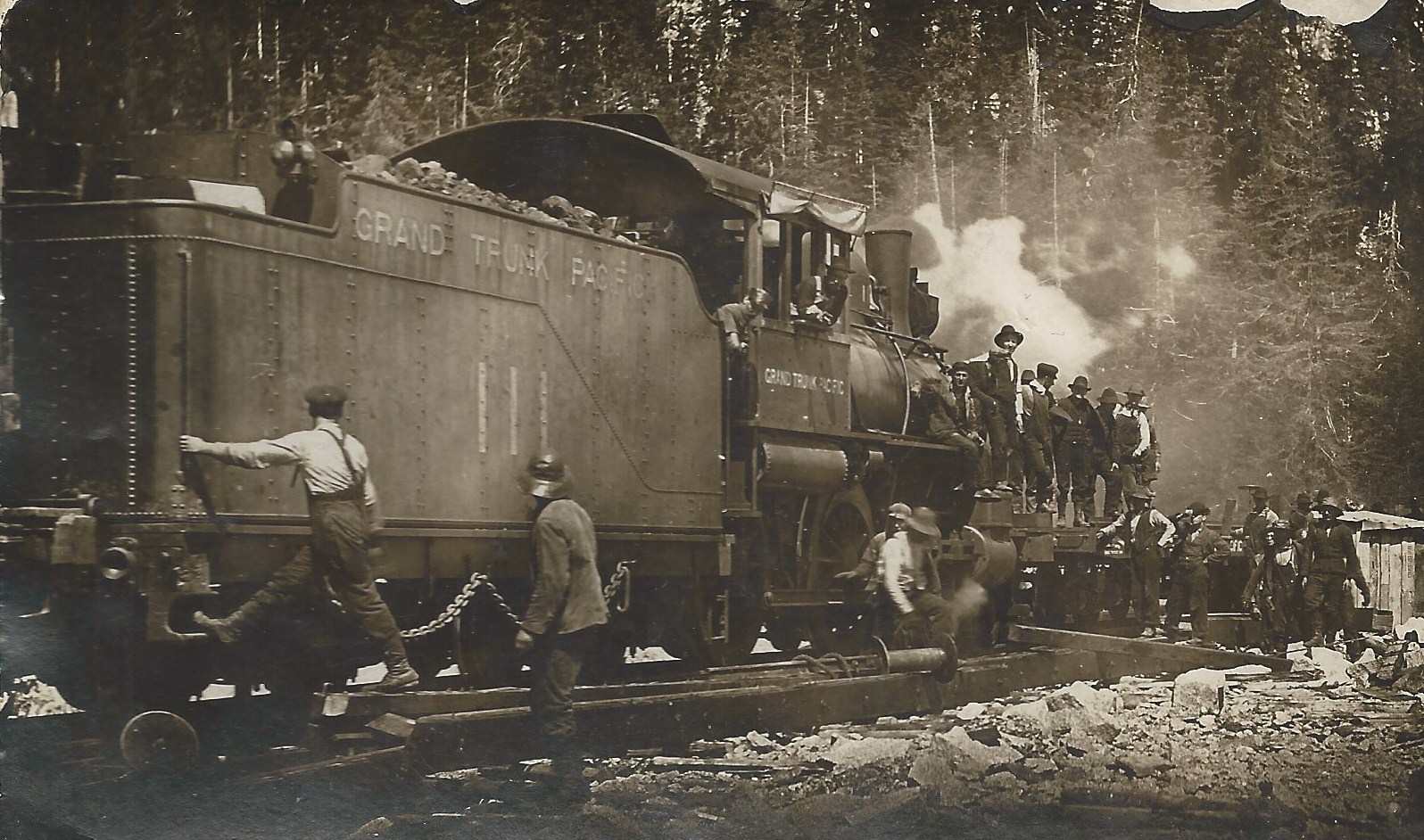
was born in Penny! From John Leybourne, 2012: In 1919 my father Fred Leybourne and his brother Lance had both just returned from France after WW1. Their uncle Ed Chesley was a prospector and railway man and had land in the area. Fred and Lance decided to go to BC from Ontario to homestead probably to recover from the effects of their wartime service. They had a little cabin just across from the station in Shames [3rd stop west of Terrace]. I don't know how long they lasted but they both returned to Ontario.
Below, a photo of a construction locomotive and crew from John Leybourne....
*** From Lorne Wasylishen, Smithers, 2011: I have in my possession a CNR station clock and need information to identify which station it came from. If anyone has pictures or memories of what the Kwinitsa station clock (or any station clock) looked like please contact Michael and he can forward the information to me. Earlier note: Pelham Hardcastle was the last permanent operator working in the Kitwanga station, he was later promoted to a a train dispatcher and is now retired in Alberta. There were some temporary people there after him before the station was shut down in 1985 when CTC came in. Between the shutdown and the station being moved I know two railroaders who were rummaging in there and found two brass GTP spittoons. One has since been lost in a house fire and I am presently trying to track down the other. I'm trying to collect photos of all the stations from Redpass Jct. to Prince Rupert, not even close yet but making progress. From Robert McDonald, Port Townsend, 2008: I got a copy of CN Western Stations (2002), and was irked to learn there officially no such thing as a "Type E station." Had to go back and change my photo options. Neither the GTP nor the CNR sanctioned that designation. The correct designation is Plan 100-152. There were eight Plan 100-152 stations on the Smithers Division, Skeena Subdivision. Update, 2008: Just a
note to say "Hello!" and let you know there is an update to my
CN stations blog entries.
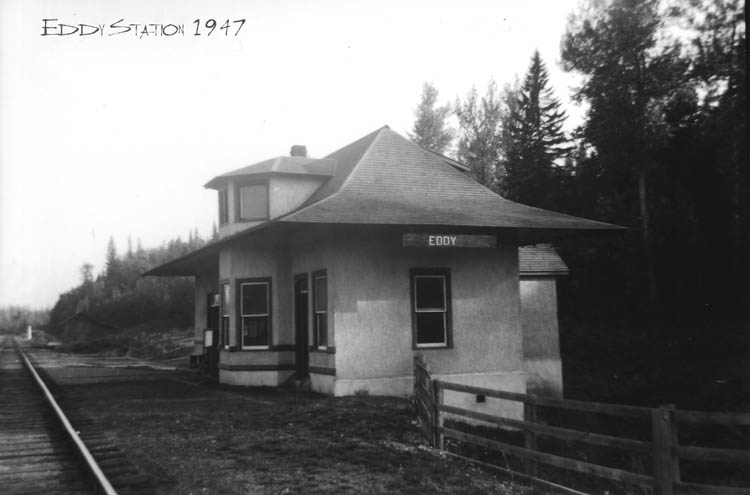
From
Robert Frear, 2011: This was at Eddy, B.C., about 7 mi
east of McBride. I remember this Station was still
standing in about '63, but the CNR burned it down shortly
thereafter. Too bad I was so young and foolish and rather
ignorant back then, otherwise it would be still be in Eddy, as I
am yet... |
|
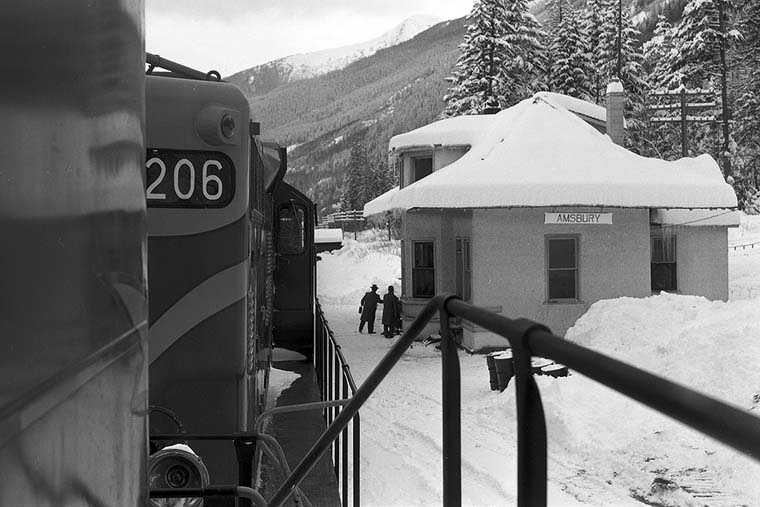
Note from Robert McDonald:
You have a wonderfully interesting web site filling in the nooks
and crannies that historians overlook in their broad brush
ramblings. My family lived in PR from 1957 to 1959. Being an
avid railroad fan, I got to the point of frequently riding
locomotives on the Skeena Subdivision. My last ride was in
November of 1959, on the passenger train. We made a stop at
Amsbury. All 14 stations on the Skeena Sub were identical, and
did reside on the north side of the track, except Tyee. Grand
Trunk applied to BC Government for water rights for their steam
engines. Amsbury was identified on Water Rights file 0127384, 13
May 1937; name confirmed 4 October 1951 on 103 I. The Grand
Trunk Pacific, later CNR, obtained their water from this creek,
which is at the Amsbury Station. How sad to see of their demise,
burned in 1963. Progress. Hope you enjoy the photo.
|
|
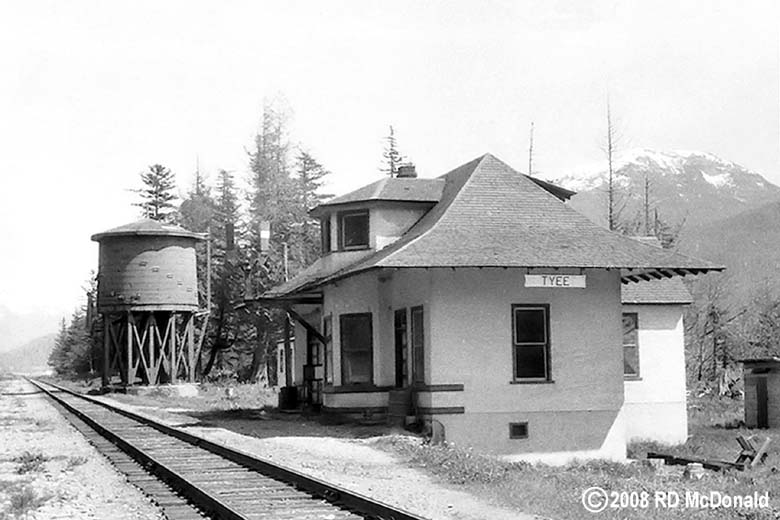
Photo taken looking east at CNR Station - Tyee, Mile Post 92.8. August 7, 1957. Highway 16 is just to the left off frame. I believe the nearby Ecstall River was the source for the water tank – Robert McDonald. Note from Judy Tidball, 2009:
Our little family moved from Blue River to Kwinitsa in 1974 when
our daughter was three years old. We lived there till she was in
Grade 3. We have many happy memories from Kwinitsa, and met a
lot of great people. One couple that we met, who lived in Prince
Rupert at the time, ended up being the last residents of
Kwinitsa. The family who looked after the station prior to us
moved to Penny BC (in between McBride and Prince George) My former name is Judy McInnis, and I was the wife of Ray McInnis, telegraph operator for Kwinitsa railway station. My personal email address is jtlabradors@gmail.com. Note from John Rinaldi, 2007: When we came to Canada in 1952 ( I was five years old) we lived in that Kwinitsa station for a few days while my dad ( Richard Rinaldi ) was making arrangements to transfer to Telegraph Point, just a few miles from Kwinitsa. My dad worked for the CN for 35 years and for seven years of that we lived in Dunster, B.C. (about 25 miles east of McBride). I have fond memories of living in that Grand Trunk station, which by the way was still there in 1988 and may still be. We lived in about 10 different places on the CN system. The last Grand Trunk station we lived in (just after we left Dunster) was at Amsbury, just out of Terrace, B.C. We left there in 1963, when the CN had their big station shutdown. A sad time for many class E Grand Trunk stations. The station at Amsbury was burnt in 1963, along with many others. Note from Wainwright, Alberta, 2004: Roy at www.railpark.org maintains a site related to railway history and the Main Street program there. Note from Kent Sedgewick, November 2003: There is a Type "E" station in Prince George at the Railway Museum, relocated from Penny, east of PG. Another, 6 km west of Entwhistle, Alberta, converted to a house. Kent Sedgewick's photos from the 1970s and 1980s of old GTP stations are on-line at the Fraser Fort George Regional Museum site. (If this link path doesn't work, click on the home page, then follow Online Exhibits-Settlers Effects-Prince George-The Crossroads-The GTP 1915-1965-pages 10 to 12). He has further photographs of vanished and vanishing towns and buildings in the area on the UNBC site. Note from Pete Amyoony, 2004: Three of us in Dunster have been working on a Community Web Site and it is finally up on the net. It is about all things in the community and includes some pictures of the Dunster GTP station in all stages from 1920's to the present time. The site is a work in progress and we hope to have more pictures of the station up soon. Note from Jeff Henricks, 2004:
There remain no less than 15 of these stations (the GTP, plan
“A” or type E) in Alberta. All built by the GTP.
Only one, remains on site. That of Park Gate Alberta (very
poor condition and beyond the words “derelict”). I believe
there may still be a couple others I have yet to find.
|
|
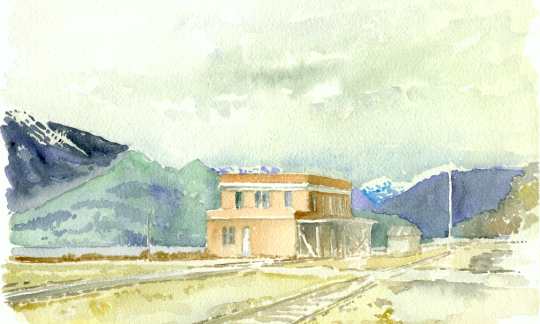
(Written by Michael Kluckner 2002) The modest, ramshackle Canadian National Railway station on the Prince Rupert waterfront (sketched above in 1997) was in fact the terminus of a vast national railway network, the Grand Trunk Railway--the third of the federally chartered Canadian transcontinental railway systems from the a century ago. Although the station was to have been designed by the legendary architect Francis M. Rattenbury, connected with a luxurious hotel in the midst of a thriving port and city, in reality the station appears to have been the work of an anonymous CNR designer, supervised by General Manager A.E. Warren and Engineer H.A .Hixon of Winnipeg. (Thanks to Sue Rowse for research.) Canadian National Railways runs its Skeena service from this station. It is an immensely scenic run, but regrettably doesn't generate enough traffic or revenue to pay for the refurbishment of the station or the waterfront. Like the City of Prince Rupert itself, rail travel in Canada has fallen on hard times. Prince Rupert has been in an economic tailspin for a decade or more, with the decline of the fishing and forest industries. Its population has dropped and real-estate values are shrinking. But there is talk of offshore oil and gas development, as controversial as it is potentially lucrative. It will be interesting, if any of us live long enough, to see the impact on the north of CN's takeover/buy out of the provincially owned BC Rail, announced by the provincial government in November, 2003. |
Map collection of Smithers Museum

|
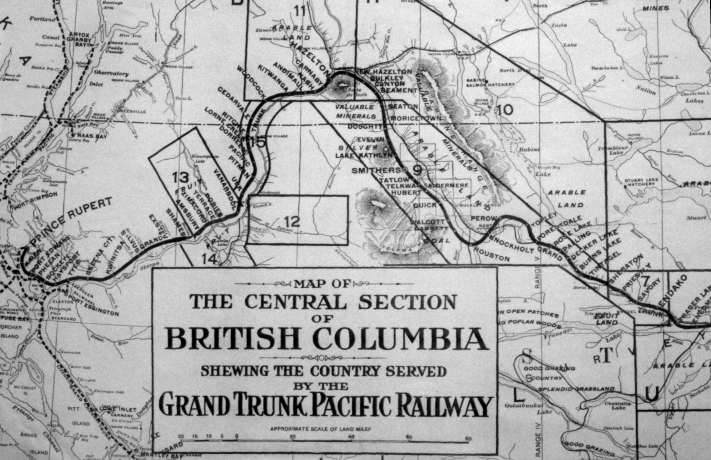
Although much of Smithers's business district is now focused along the highway, the old Grand Trunk Pacific station is well-restored, with "the beanery" an excellent cafe. I was so impressed by this view along the tracks, looking west--it seemed to encapsulate all the promise of the Grand Trunk in the years before the First World War, of new land and opportunities with the new northern terminus at Prince Rupert not far away, and productive agricultural land along the Bulkley River, such as the fields near Quick, attracting new settlers. Note from Ron Wheeler, 2008:
I grew up in Smithers, B.C.. In the late 50,'s, CNR
converted to diesel Power Locomotives and had to change the
tracks to a heavier RAIL to accommodate them. When this
conversion was completed, we saw the last of our beloved Steam
Powered Engines. They used to change Engines in Smithers
and take the un-hooked engine into the Round House for service
and repairs. Now, the Round House is gone, along with *** Written 2003: As I understand it, "The Beanery" was the universal name for Canadian National canteens/coffee shops along the line – does anyone know of a good written source or memoir about them, or can anyone provide some anecdotes? Also read the Blue River site. |

| Although Smithers's station
is the most dramatically sited, my vote for prettiest station goes
to McBride. Recently restored, with an excellent "beanery," it is
an absolute gem. According to The Robson Valley Story by
Marilyn Wheeler (McBride Robson Valley Story Group, 1979, p. 132),
the original McBride station burned in 1918, and was immediately
replaced by this graceful structure, by an unknown architect. Update from Pete Amyoony, 2008: The McBride Station is under the direction of the Village of McBride. The station has been mostly renovated (new roof about ten years ago and most of the interior has been totally done over. The exterior is well kept with new paint and platforms which are wheelchair accessible The main lobby/waiting room has been completely renovated as close to the original blueprints as possible. A large area is now "the Whistle Stop Gallery" where a a non-profit society composed of artists and crafters have filled the space with local arts and crafts. These range from the expensive to the very reasonable priced smaller nick-knacks so there is something in everyone's price range. There are many local paintings, wood carvings, needle work and quilts, notions, natural salves, souvenirs, etc. It hires students in the summer and thus creates local jobs. Throughout the entire station are many pictures of the old days around the station, rail yards and local area as well as memorabilia from days gone by. On the outside walls of the baggage area are two murals by local artist Matthew Wheeler. One includes a copy of the original blueprints of the station and layout of the yards. Another large part of the interior( the original Beanery) has been done over into a beautiful and cozy restaurant now called "Beanery 2" All the food is "home cooking" with lots of local ingredients and it also serves as the "McBride version of Starbucks" with all the varieties of coffee, cappuccino, etc. The restaurant also has an internet connection and computer available for folks from out of town. It is a very popular meeting place for many of the locals - just like the old days!! A small area between the Beanery2 and the waiting room is dedicated to the Tourist Information Booth on a year round basis. It has many brochures, videos, etc for visitors to learn more about the area. The director of tourism is currently (Mar 2008) working on an updated McBride website - www.mcbride.ca In the summer, just outside the station is a beautiful gazebo with benches to relax and enjoy the views all around. Next to the gazebo is a CN caboose totally renovated by a local railroader. The gardens and many planters around the station really give it a new life and make it a welcome stopover point for thousands of tourists every year. The Via passenger train "The Skeena" stops for a while on some trip so the passengers can nip into the Beanery2 for a coffee or a snack. Just inside the main door from Main street are two very well kept public washrooms. The station has once again become a main feature in the life of McBride and the Robson Valley both for locals and also for those passing through. By the way, Marilyn Wheeler is just about to go to print with a very expanded and updated version of The Robson Valley Story. There are almost double the number of pages from the first edition and is a wonder treasure trove of local history. Their contact is www.sternwheelerpress.ca |
|
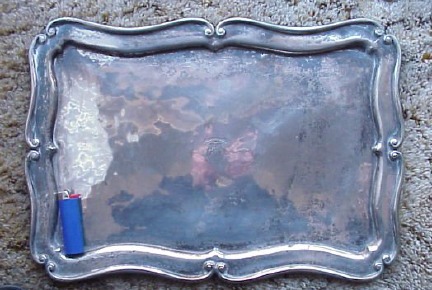
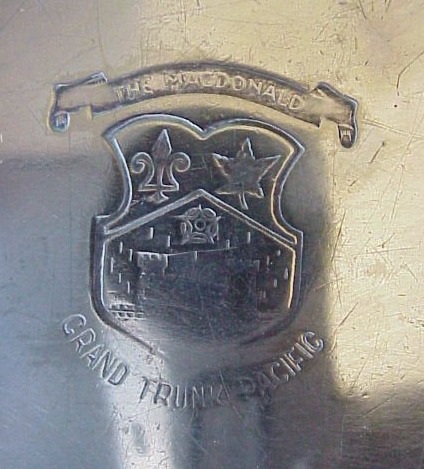
Reinhard, an antiques dealer in Victoria, sent along photos of a silver tray from the Hotel Macdonald in Edmonton (which still exists), from the time when it was a GTP hotel. |
 |
| Note
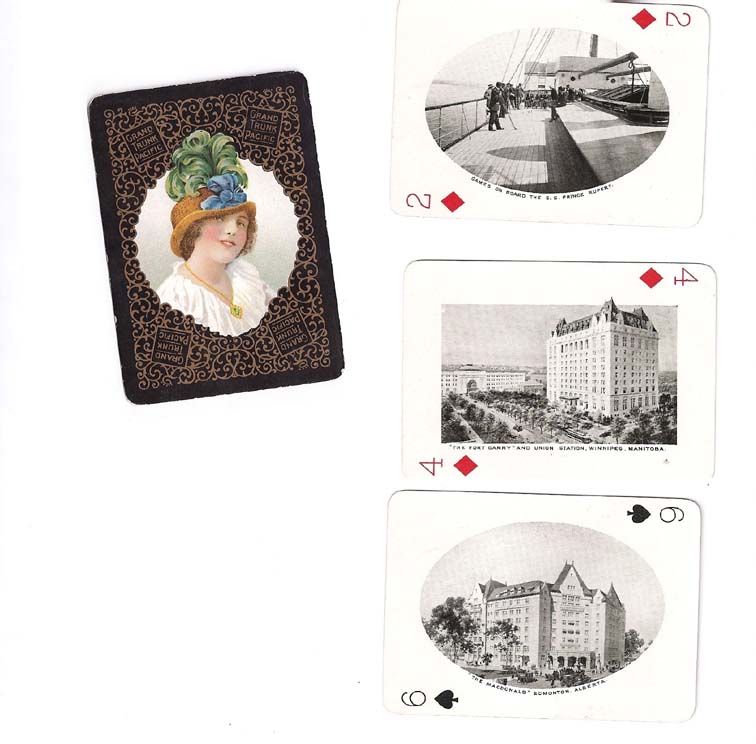
from Denise Friedrich, 2007: It is a rainy day here in
Germany ....and I've decided to 'dust' in the room downstairs
! I am English and live in Germany.... I have some playing
cards here and for years I have been wondering where they really
come from. In the days before internet this wasn't so easy. The cards are in a lovely wooden case... on one side it says Souvenir and on the other there are 3 playing cards painted on it. Two packs of cards. One pack has had some wear and tear.... but the other pack is in really good condition with a gold edge. I wonder how old these cards might be. I have enclosed a JPG and do hope you can open the file. The Ace of Hearts has a portrait of H.R.H. Prince Rupert and there is also a picture of the S.S.Prince Rupert along with many other scenic pictures which I guess are from the routes on the way. Jasper Park, MT Robson, Moose River Forks. I wonder if you could tell me a little bit more about these cards. I bought them years ago in Portobello Market in London. |
|
From MK: as the GTP was bankrupt by 1917 or so, and then became part of the Canadian National system, the cards would have been published during the First World War. Note from Gilbert, Timmins Ontario 2009: I have a picture frame from the "Grand Trunk Pacific Railway" (poster size). I have had it for many years and was wandering if you could tell some history behind it. There is only the frame, no picture, but for some reason it has followed me all of my life. The frame seems to be made of oak and very old but aside from that I have no idea where it would have been hung back in the day. In any case if you could shed some some light on this or know someone who might I would greatly appreciate it
|