© Michael Kluckner, 1998-2012
Return to main Vanishing B.C. page Return to home page
This page last updated February 28, 2012
© Michael Kluckner
| Update 2006: the Shaw House has been turned 90 degrees on its lot to face Ash Street and has been restored as a chic little eatery called Caffè Cittadella. |
| Written
2001: one of the most derelict of Vancouver's derelict
buildings is the Shaw House at the corner of 7th and Ash in
Vancouver's Fairview Slopes. It is a saga that demonstrates,
firstly, that a century-old house built of timber from Vancouver's
original forests can last for a generation or more without any
maintenance at all; secondly, that an owner of a property who
would rather get rid of a house can just sit and wait; and
finally, that the city's heritage management process, which tends
to be rather ponderous, can eventually get its way. Apparently,
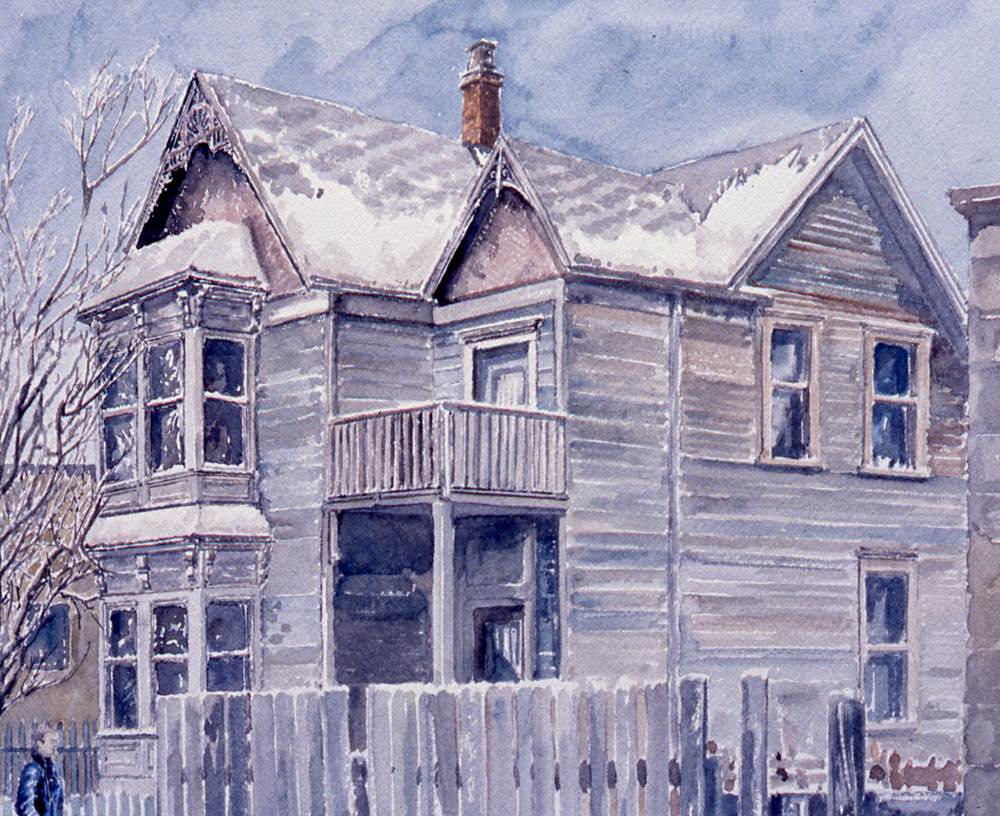
the house will be restored in the near future. I first painted the Shaw House on a snowy day in January, 1989, as part of my Vanishing Vancouver book project.
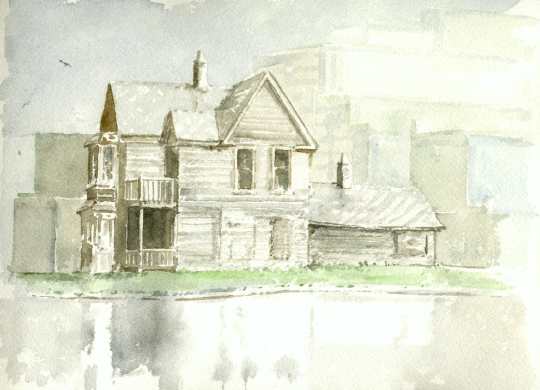
At that time, it had been boarded up for several years, and stripped of its ornamental detailing. It was connected to the city's water system in June, 1894. I wonder whether the building at the back predates the big house--like the house on the Okanagan connector, or the ranchhouse near Anarchist summit--and whether it's the back part that was built in 1894 and the front part later. However, the front part of the house is in a style typical of the early 1890s in Vancouver. How old could the back part be? The Canadian Pacific Railway sold land in Fairview in 1891, but 7th Avenue itself existed in the 1880s, and there were logging camps, shingle mills and sawmills along False Creek at that time, all within walking distance of Mr. Shaw. The first bridge at what was to become Cambie Street crossed the creek in 1891, so I would guess that Shaw's little back cottage dates from about then. The owner of the property, who at that time was playing a game of chicken with the city, eventually lost interest and moved on. I was astonished to discover more than a decade later that the house was still there, and added the picture above to the sketchbook in 2001. Because, as I understand it, the house is going to be restored as part of a new development, it really doesn't belong as part of a "Vanishing BC" project, but I received the notes below. From Christopher Sumpton in Vancouver: The house is just west of Cambie Street on 7th Avenue. It is rapidly deteriorating. There is now a development permit application, which means it will be torn or burned down soon. The house is creepy looking now, its windows are boarded up. The house sits like it doesn't belong, like an elderly person that society has decided isn't valuable anymore. It makes me sad, because when I see the house I think of the people who must've lived there, and what they saw and did, living in that different time. The house is part of the living heritage of this country. I always thought that old houses should be bought by the public and changed into community resources, but government is too busy spending our resources on making war, and giving themselves retirement pensions. When I see an old house I think of my grandmother's rhubarb pie, the smell of her sweaters, and the way she used to love to play piano. From David Dorrington: greetings from another artist ----who lives at finn slough; i remember when there were still people living in the house in your painting; the person I knew of was probably a renter --a man named Bob Calhoun--- a heavy drinker and full of bullshit; there was a house 2 lots to the east of the Shaw house that we called "the Cambie Lunch" that had lots of artists living in it in the early to mid 70s --I did not live there but was good friends with those people one of them is now a well known theatre designer--we were all from the Vancouver Art School before it was changed to Emily Carr. I am glad that you are doing this and hereby extend an invitation to come and visit us and paint the place if you feel like it I also know of a couple of important buildings (100 yrs+) in Richmond that I don't think that anyone has thought to paint and Richmond is hell bent to get rid of its heritage; on another note did you ever see the remains of the old wooden aqueduct that was on the west side of the fraser river after the fraser and thompson split and one is heading into the dry country towards williams lake; it was built before the WW1 but the guys that built it were all killed in the war so it was abandoned--it was still there in the sixties but I am sure it is long gone now -- have not been that way for 25 years now. |