Return to main Vanishing B.C. page Return to home page
This page last updated December 27, 2025
© Michael Kluckner
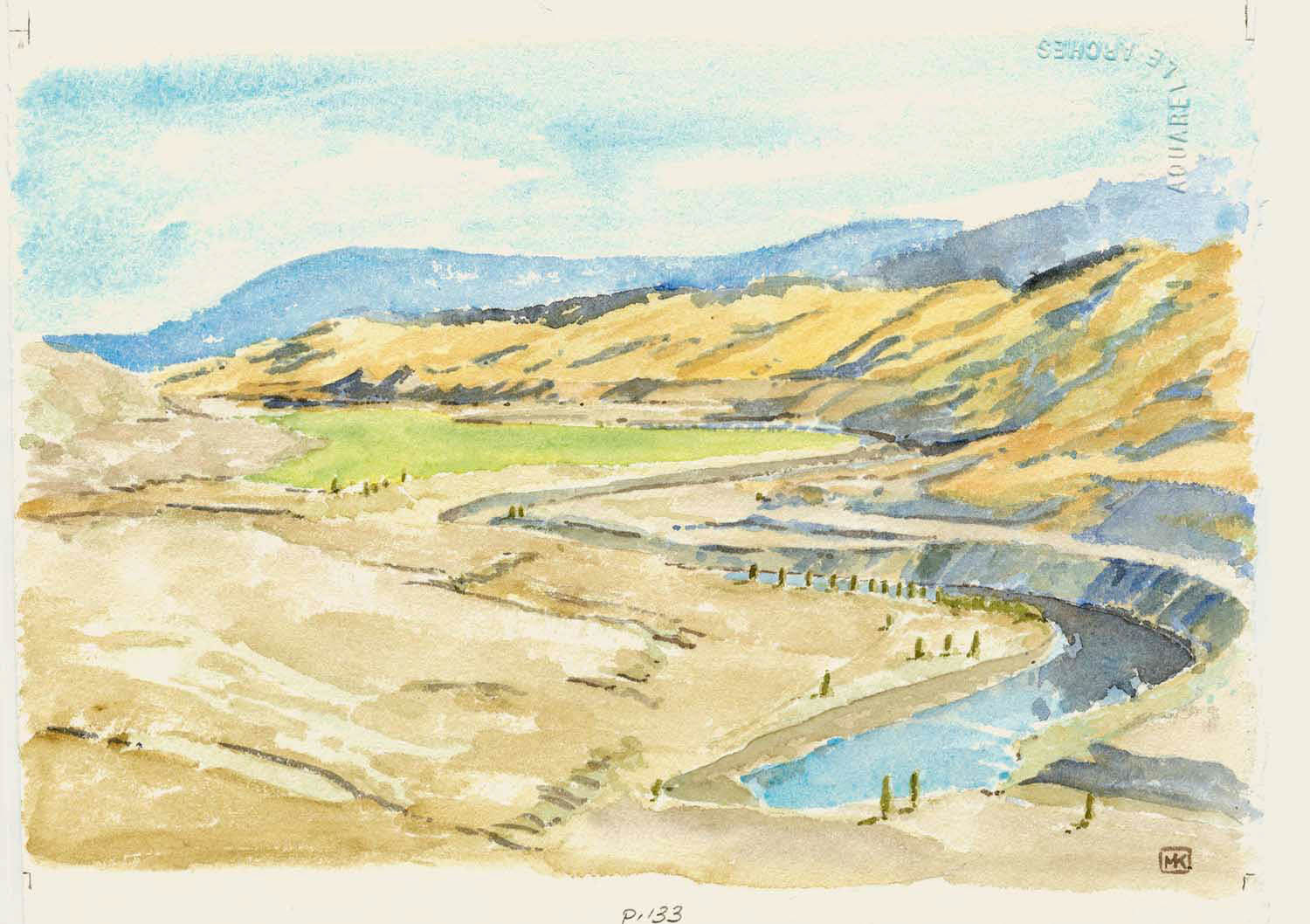
| Sketched/written 2004: From the viewpoint along the TransCanada highway, the view across the sagebrush-studded, arid landscape along the Thompson River towards Walhachin, which sits on the small bench in front of what look like two pyramids in the left distance – in fact, it's a single hillside that has been mined out for gravel. Modern pumps have no trouble supplying water to irrigate the alfalfa field occupying the former orchard land that was the raison d'etre for the community. It was a late September afternoon, about 4 o'clock, the low sun shading the hillsides into soft hollows. |
|
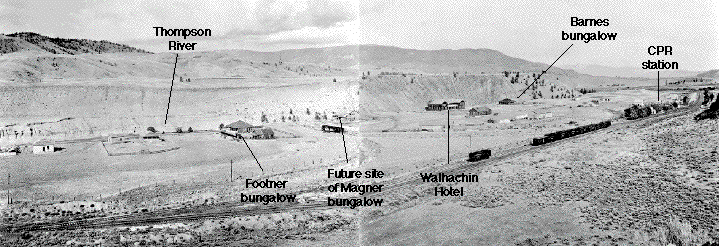
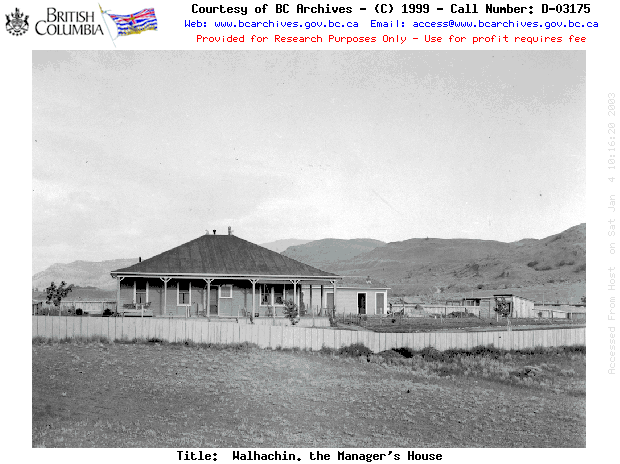
Walhachin in 1910 (photographer unknown; this is a composite of BC Archives photos D-8175 and D-8176). The Walhachin Hotel and the CPR station are long since demolished. The Barnes bungalow (photo below) – i.e. the manager's house – which still exists.
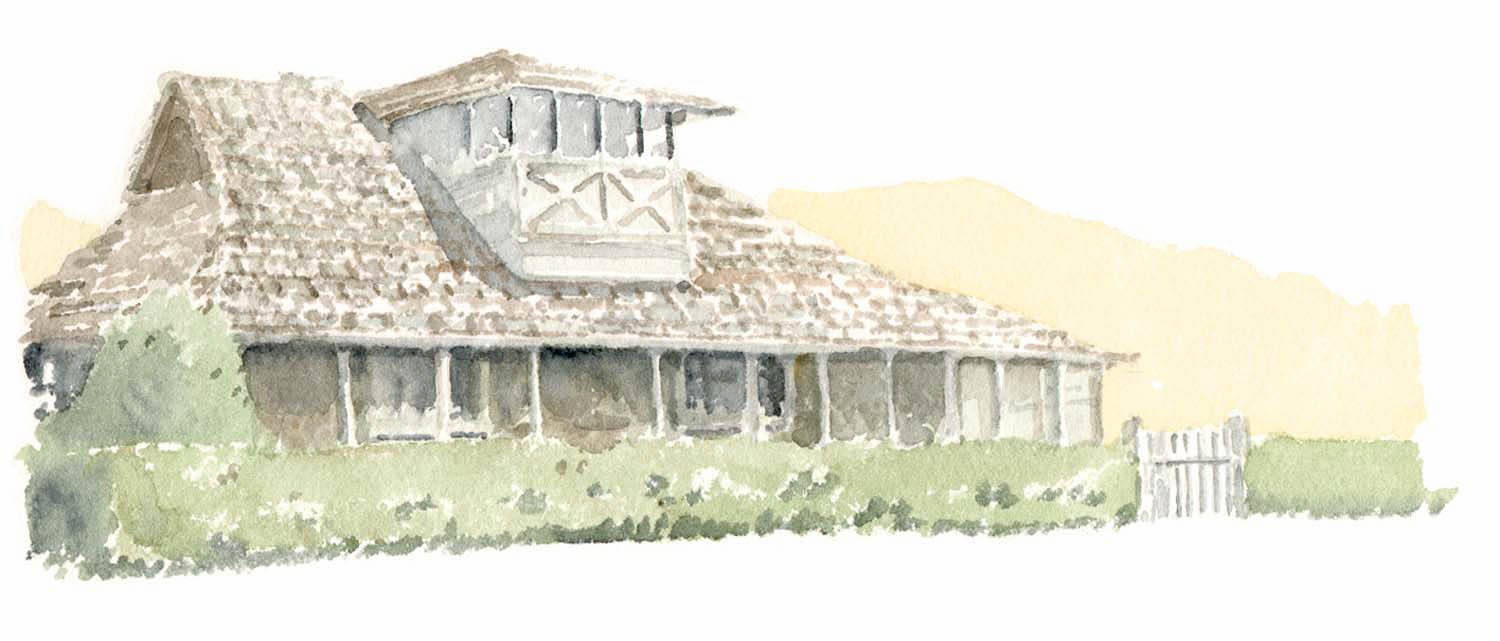
The Footner bungalow as it appeared before renovations a generation ago. The front porch was screened, as was the sleeping porch above. The upstairs dormer had a hipped roof, now changed to a gable; the roof itself was covered in cedar shakes--there is now a separate rafter system with metal roofing over it. The"X" board detailing on the dormer, which has since been removed, appeared in a photo of the house in an unpublished research document by Edward Gibson, written for the Canada Council in 1976 and only surviving as a very poor photocopy in the Heritage Branch library in Victoria. I was interested to see that pattern of boarding on the bungalow called "Rose Cottage" ostensibly at Pankot in India in the Granada TV program "Jewel in the Ground."
Photograph about 1910, photographer unknown Footner's houses reflected the colonial bungalow form that had evolved from indigenous Indian architecture and become the standard country house in England's hot-climate colonies, especially Australia. A high hipped roof (sometimes built as a true pyramid) provided a natural insulator to keep the main-floor rooms cool. Windows were set to catch views and breezes. Porches, sometimes open and wrapping around the house, other times screened, provided extra heat shelter. (The standard work on the subject is The Bungalow: the Production of a Global Culture, by Anthony King, Oxford University Press.)
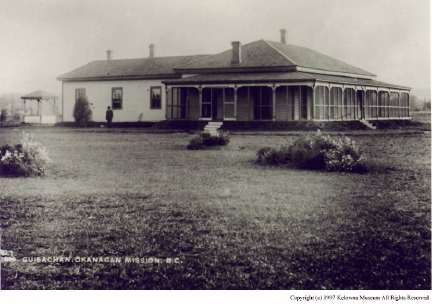
"Guisachan House," built by Lord and Lady Aberdeen in Kelowna in 1891, is now restored and used as a restaurant. It is the purest example of a British colonial bungalow in B.C. Photograph from the Kelowna Centennial Museum collection, 12260, part of the Living Landscapes series on the web. |
---------------------------------------------
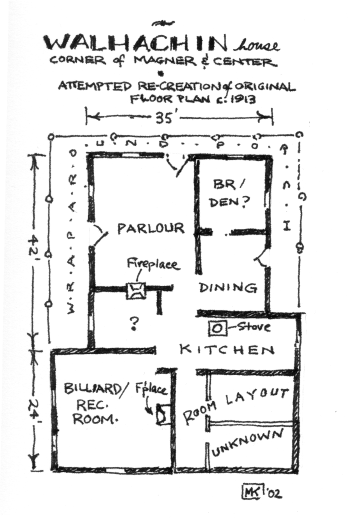
The house at Magner Street.
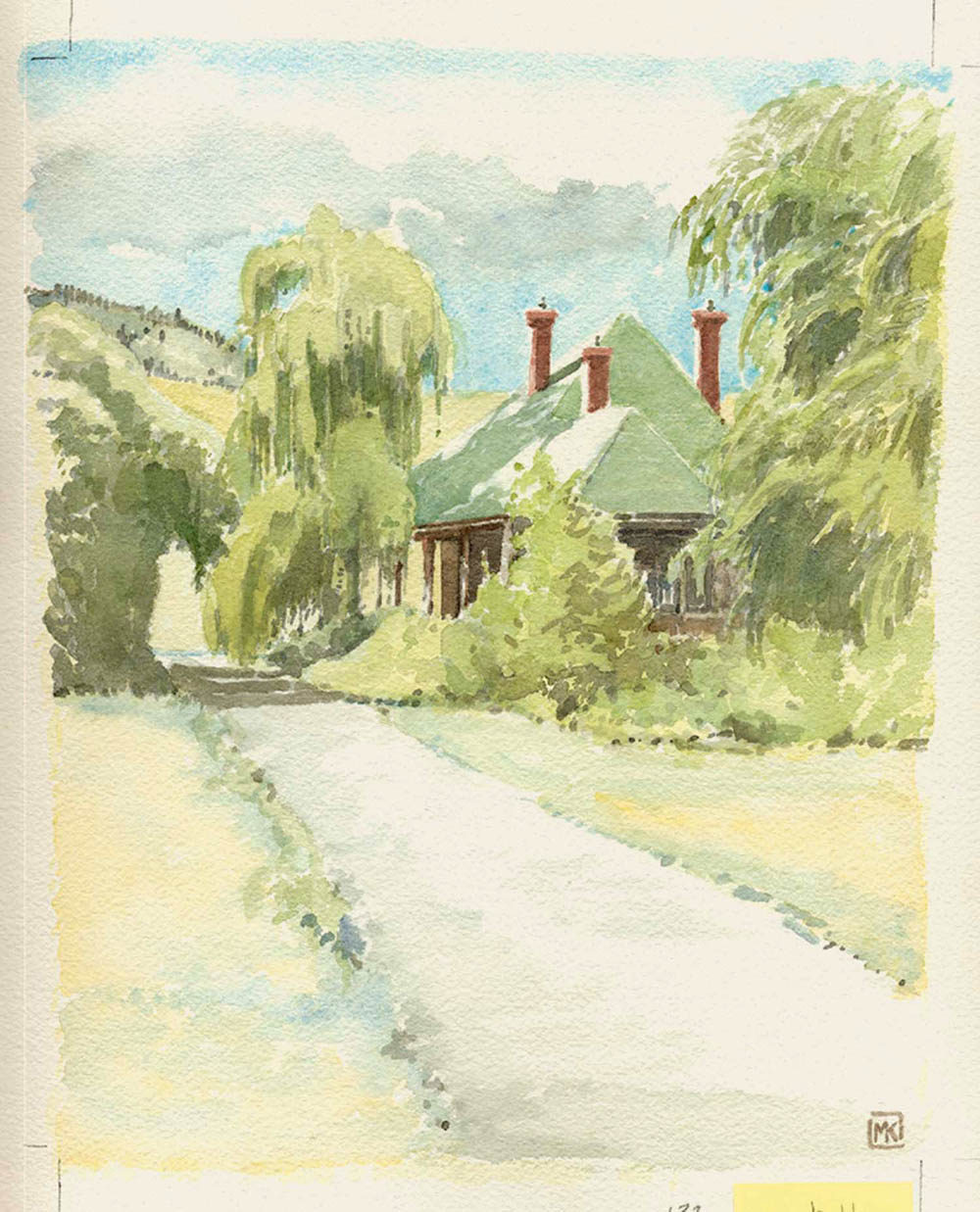
| The house at Magner and Riverview Drive in Walhachin, sketched in 2001. It is one of the finest surviving houses in the village, at least in the sense of its classic pyramid roof and wraparound porch--essential elements of the Colonial Bungalow--as well as for its three brick chimneys (reduced to only 2 in 2004). The third chimney for a fireplace in what was obviously a recreation or billiards room indicates the house's original owners were different folk from typical BC settlers. The house stands on the edge of the village, looking out onto what is now a verdant alfalfa field, due to the technological advances in water pumping in the 90 years since the original colonists struggled to water their arid, almost infertile landscape. I painted the house from behind partly to capture its roofline, but also because it has been greatly altered, with doors, windows and walls moved. The current owners, Dave and Arlene Taylor, were kind enough to let me see the inside, and attempted to explain what the house was once like. |
| Note from Janet Clarke, N. Ireland, 2006: my father in
law, Richard Clarke, was born in Walhachin around 1920. His
father, Jack Clarke, was one of the fruit farmers who came out
from England before 1st world war. We have the family photo albums
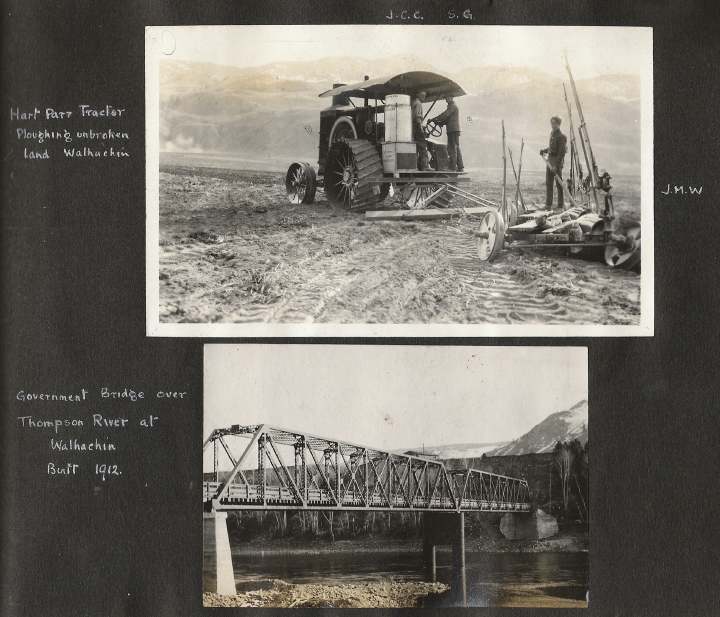
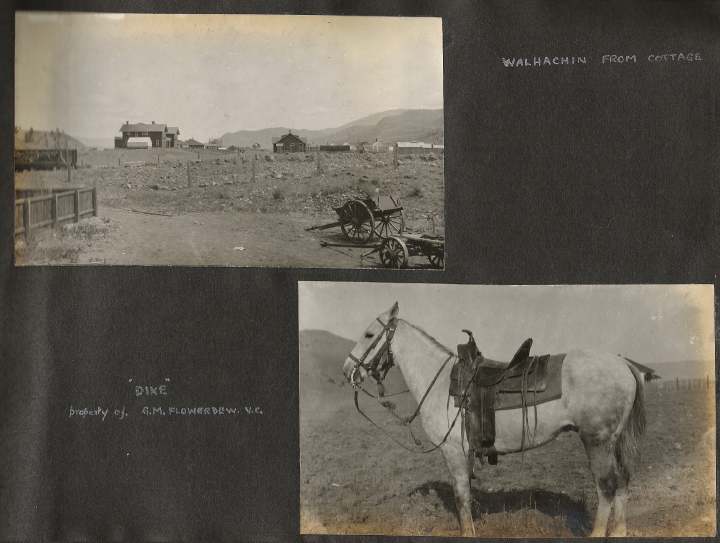
which give a good glimpse into life in Walhachin at that time. The Clarke photo album A CPR engine and the beginnings of the government bridge across the Thompson River
A farm tractor at Walhachin, and the completed government bridge
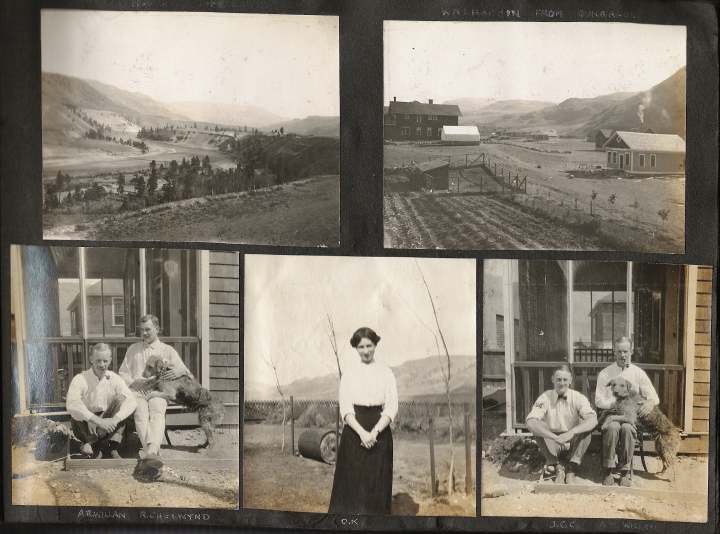
View from the bungalow. The people along the bottom are A.R. Willan, R. Chetwynd, O.K., J.C.C. and A.R. Willan
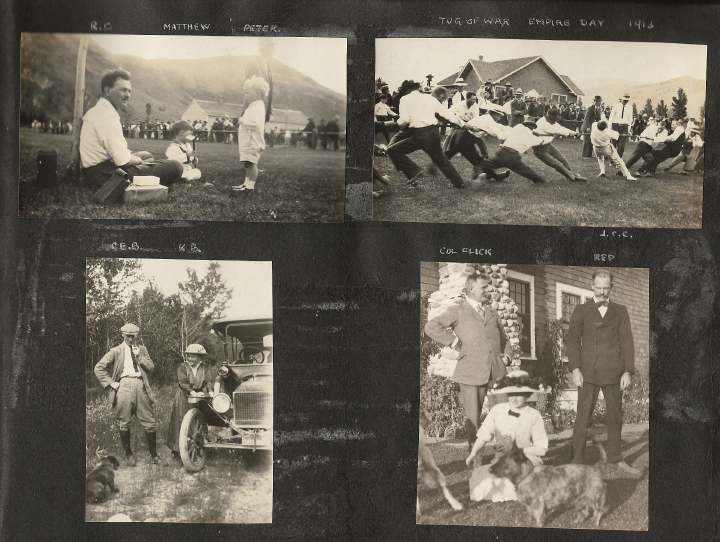
Along the bottom row, the people are C E B, K B, Col Flick, and R E P
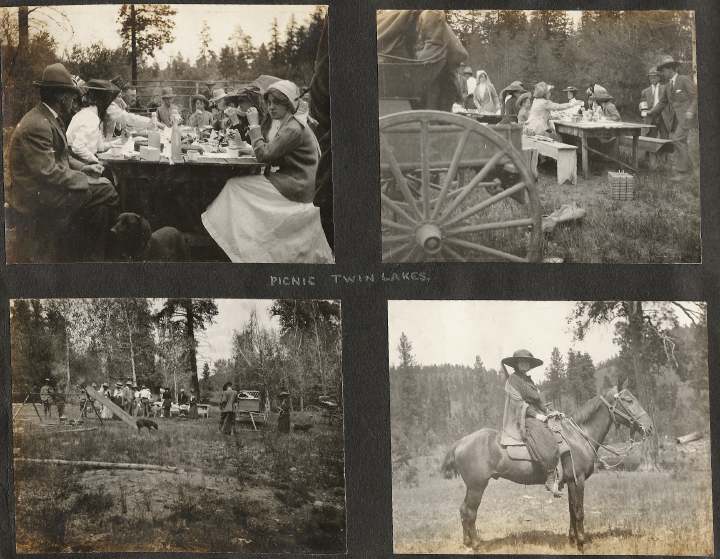
Picnic at Twin Lakes (There are also a few road trip pictures from this album at the Alex Bridge page and the Lillooet one. From Bill Smith, 2025: My grandfather was William Grundy, who apparently worked in Walhachin as a beekeeper and orchard manager around the time WWI started. The information I have on my grandfather's time in Walhachin is limited to what I read in this newspaper article. Our family members are doing some research on him and would love to learn more.From Dan Wallace, 2020: I work as a Community Planner at the Thompson-Nicola Regional District office here in Kamloops. I have been at the TNRD for 26 years but lived in Kamloops most of my life, growing up downtown on 7th and Nicola. I have always had a keen interest in local history and heritage buildings having grown up in a home built in 1936. I also sat on the Kamloops Heritage Commission for several years where I wrote a monthly article in the Kamloops Daily News called “This Old Heritage House” where I featured local heritage buildings’ history, architecture and connection with the built environment. My wife and I purchased our first home at 794 Columbia Street or the “black and white house" on the corner of 8th and Columbia here in Kamloops back in 1997. I knew it was an older stuccoed home but didn’t know much more about its history. As a matter of fact, the home that I was raised on 7th and Nicola, the house on the opposite end of our block, was built in the same ‘black and white’ stucco design. Our history lesson started when one day a lady tapped my wife’s shoulder while she worked in the garden. It turned out that she was the daughter of the man who built our house in 1936. His name was Sam Goss and while I’m not sure if he was from Walhachin, it was described that he and his brother travelled to Walhachin in 1935 to purchase this house. It was dismantled, transported and reconstructed on Columbia Street. I had always known about the “Walhachin House” in Kamloops’ West End but never knew that other homes existed in Kamloops, let alone the home that I lived. 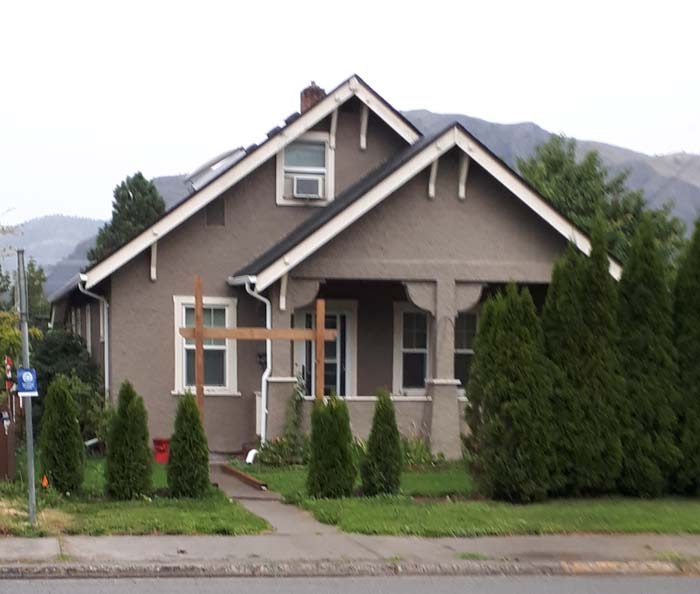 Your stories about Walhachin homes resonated with me as I did live in a real Walhachin house, just in a different location. I have learned that more than one Walhachin home was sold at bargain basement prices after the town went bust. My stepfather had told me that homes were often torn down and rebuilt or moved as it was cheaper than building anew. Have you documented any other Walhachin homes in the region that were rebuilt at a different location or do you keep a register? As an amateur historian and professional Planner here at the TNRD, I have learned about the full history of Walhachin and find it fascinating that such a place rose out of the desert. Today, I marvel still at the community spirit that exists here after all these years of trials and tribulation. From Alice Primrose, 2020: I’m trying to find info on the Stewart house in Walhachin.. Thomas and Viola Stewart raised their 3 kids..May, Alice and Glen there, back in the 30’s/40’s. I’m currently doing a family history for Thomas’ granddaughter and it would be great to include some pictures of the old house...amazing if they were in them. Thom Stewart used to have a trucking company called Stewart Truck Lines, that was based in Ashcroft. May married Bob Pickerall, Alice married Walter Gibson, and Glen married Georgina Blais. Perhaps more info than you need, but hope it will help. From Patrick Smith, 2014: A photo of Sam Smith and Emily Smith (Kuttai). These are my Grandparents who settled in Walhachin in the early 1900's. They had many children most of whom were born there. Their sons' names were Henry, Alex, George, Harold, John, and Danny. There daughters' names were Annie, Flora, Elizabeth (Betty), Helen, Emily, Mary and Teresa. 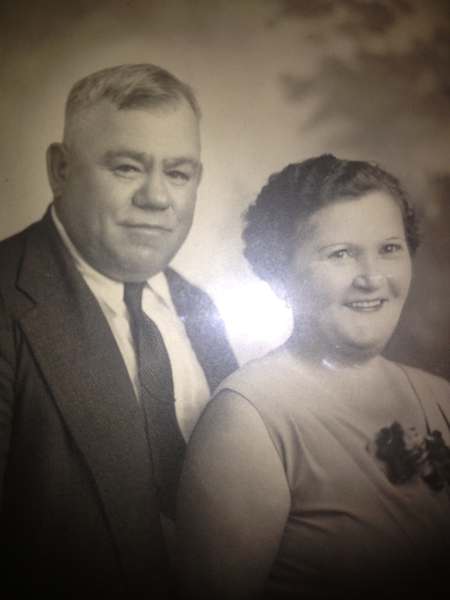 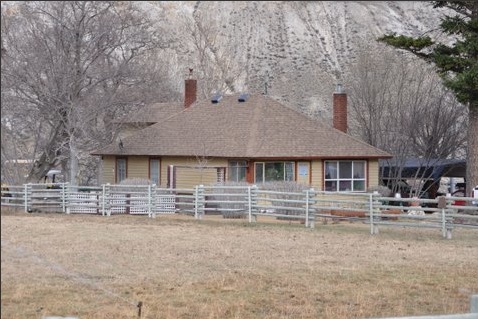 From Larry Jacobsen, 2014: I have completed my book and should have it in hand in about two weeks. I am attaching a picture and a synopsis of my book as well as an author photo. 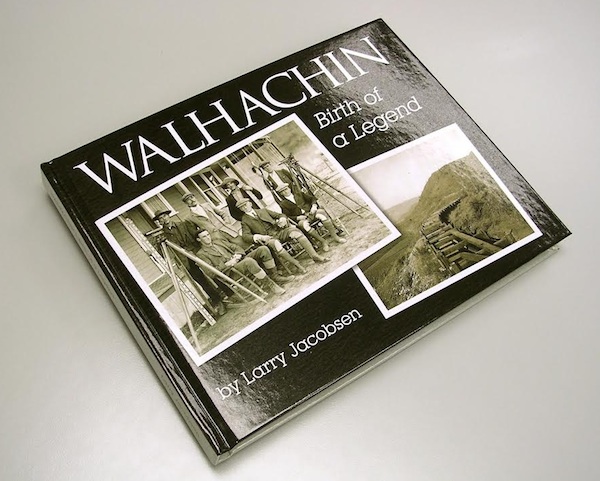 Earlier, from Larry Jacobsen, who is looking to contact people with knowledge of Walhachin and its history: I found your informative website while researching Walhachin and hope to find people whose families were connected to it in the early days. I am presently working on a Walhachin book. Unlike the ones written by Joan Weir and Mark Zuehlke it will contain the personal stories of people who were connected to Walhachin in one way or another. That would include the nearby ranching families as well as offspring of the Walhachin settlers. My first connection with Walhachin was in 1969 when I supervised the pioneering of the rock quarry there for Peter Kiewit Sons Inc. — we crushed ballast for the CPR. My second connection is through Reg Christie (son of Gerald Moffat Christie) a Civil Engineer who worked for Dawson Construction (a competitor). I presently have the stories of the Christie family, two of whom, though they were not Walhachin orchardists, were intimately involved. One (Reginald) was an engineer and the other (Gerald) an accredited land surveyor. They were employed BCDA in the engineering, layout, design, and construction of the irrigation system. Their sister, Phyllis, married Lionel Stobart the manager of the Gang Ranch at Clinton and their father was the government agent at Ashcroft from 1905 to 1919. Gerald Christie went on to do the legal surveys for the CNR right-of-ways from Edmonton to Prince Rupert and also from Edmonton to Prince Rupert. He had BC, Alberta, and Dominion Land Surveyor status. He was also the first mine manager for Placer Development at their Canex mine near Salmo even though he was not an engineer — a rare occurrence. I was a miner at this — the largest tungsten mine in Canada and second largest in North America — in 1952.  I am the author of a memoir, Leaning Into the Wind: Memoirs of
an Immigrant Prairie Farm Boy, (2004) and two oral
histories, Jewel of the Kootenays: The Emerald Mine,
(2008) and Salmo Stories: Memories of a place in the Kootenays
2012). You will find these books in most BC (and Yukon) library
systems. My Jewel of the Kootenays had a great review in
British Columbia History magazine in Jan. 2009 as well as in a
Denver mining journal. It's Introduction was also reproduced on
the Op-Ed pages of The Northern Miner newspaper in Nov. 2008.
I am the author of a memoir, Leaning Into the Wind: Memoirs of
an Immigrant Prairie Farm Boy, (2004) and two oral
histories, Jewel of the Kootenays: The Emerald Mine,
(2008) and Salmo Stories: Memories of a place in the Kootenays
2012). You will find these books in most BC (and Yukon) library
systems. My Jewel of the Kootenays had a great review in
British Columbia History magazine in Jan. 2009 as well as in a
Denver mining journal. It's Introduction was also reproduced on
the Op-Ed pages of The Northern Miner newspaper in Nov. 2008.I grew up on irrigated farms in BC and Southern Alberta, worked briefly in logging and sawmilling before spending 13 years as an underground miner before moving into construction work. I had my own consulting business for 25 years and was also involved with pipeline work as well as being the Contract Administrator for Duke Energy (now Spectra Energy) at their Vancouver office. From James Ferron Anderson, Norwich, England, 2012: I've been to Walhachin with my wife, and a copy of your painting of one of the houses, and the floor plan. We were in that very house, after talking to the young new owners. I found the whole area and its history as interesting as I had hoped. I've also written a novel set in Walhachin in 1918 and the Barrens in 1920 (based on the John Hornby-led deaths there): The River and the Sea, which has just won the Rethink Press New Novel Award, and there will be a book launch here in Norwich shortly, certainly before Christmas. From Sheila (Hood) Jensen,
2012: The Walhachin-related note written by Jody Ann
Anderson (nee Crothswaite) (2009) was of particular interest to
me and I wondered if there is any way you can contact her
with my email address so that she, in turn, can directly contact
me. In 1945 I lived in Walhachin and have just returned
from a visit. While visiting there, I met Val Carey and
discovered we'd been childhood friends back tin 1945. It
was thought that we lived in the "Stone House" and I have a 1945
picture of my sisters and me standing directly across the road
from it. I did not know my mother beyond 1945 and am trying to
piece together my history. My grandfather was a CPRail Trackman
and Foreman in Spatsum, Savona and Kamloops (c1917-c1947) and
I've just discovered my mother, Margaret Doreen Nicol,
boarded in Walhachin with a Mrs. Ades in the 1920's while
she attended the elementary school there.
I've attached the photo I referred to along with another of my
parents, William and Margaret Hood taken in that same time
period. The three children are from left myself, Doreen and
Louise (who later went by Maggie). We are standing across from
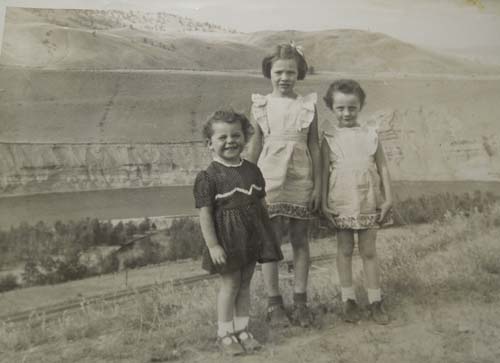
the 1910 Stone House in Walhachin. Note from Ellen M Torng (Na x No k Ksim Tsimilk):, 2009: we would like inform you of the Walhachin Centennial Festival scheduled for Aug 1, 2, 3, & 4, 2008. If you have any artifacts or photos relating to Walhachin that we could use in our display, please get in touch. Val Carey in Walhachin (250 457-6678) is trying to contact people interested in Walhachin's history and its old buildings to create a support group for the community. She is concerned with the gradual erosion of its historic quality and the unsympathetic renovation and demolition of the remaining pre-World War One houses, of which there are apparently only nine left. Please telephone her or email me and I'll pass the message along. Note from Jodi-Anne Anderson
(née Crosthwaite): My name is Jodi-Anne, and my family
onced lived in Walhachin. I was looking at some of the pictures
that you have added onto the site, I believe that the house
marked on the bottom as "a view from the bungalow", the second
picture from the right, was our old house. I could be wrong, but
I remember that it was a two story house, with an unfinished
attic upstairs that we kids got to sleep in. I was just a little
girl, about 9 - 12 years of age, so of course my memory is
faulty as most small children's memories are.
I remember that it had an old wood stove to cook on (how I miss that thing), an old claw foot tub in the bathroom. My mom would heat water on the stove on a big old pot and the boys would carry it down to the tub. I always wanted to be the first child to have the bath cause, you not only got hot water, but it was clean! When five kids are bathing in one water run, it got dirty very quickly. I know we had a chicken coop in the back yard, and a place to keep horses. I was bucked off one of ours and fell into the cactus patch, and wound up in the hospital in Ashcroft with appendicitis. The house seemed humongeous to me, but probably wasn't as we all but mom and dad and I think Jenny slept upstairs. My husband and I are planning to take a trip to all my old "wierd places the Crosthwaite's lived" tour, hopefully next year. I really want to see the old place, and am hoping to find it still there. I really loved that house! PS. My parents are Lawrence and Sheila, who have recently taken up residence in Limerick SK, they maybe able to help you more with some history of the town. Note from Gillian Rodie, Nova Scotia: It has always been told in our family that my husband's grandparents, Edward and Edith Windsor, went to Walhachin to set up fruit farming. They were talked into it by someone in England. They married in Shropshire in 1910 and apparently emigrated to Canada and Walhachin. From then on we know little except that they lost all their money and in October, 1912 were in Port Alberni where their first child was born. Life was extremely difficult as they had lost everything and in January of 1915 their second son was born in Vancouver. In May of 1915 Edward Windsor died of heart disease leaving his widow and two babies. So far I have been unable to find any proof of this story or any records of their stay in Walhachin. I am wondering if you might have any advice on how to find these records. Hoping to hear if you have any suggestions. Note from Theresa Kishkan: I have the Walhachin census information, 1910, and the Windsor name doesn't occur on it. Note from Chris Green: I live in Savona and accidentally found your site with the pictures of the Thompson River/ Walhachin area. I was delighted to recognize many of the buildings in the interior you've chosen to record, and to see my friends Val Carey, and the Gorings, mentioned.. One of my brothers wrote a play, a musical-, or film-script about Walhachin some years ago, but so far nothing has been done with it. I'll point out your site to him. The one person who greatly sticks in my mind from the pre-WW1 era, is one Gordon Flowerdew. When the war started, he helped organize a mounted horse tropp and eventually joined the fighting in Europe. In Poland, he led a mounted charge against an enemy machine gun nest, perhaps the last person from the British Empire to do so (The Polish Cavalry did something this in WW2, attacking the Germans--perhaps German tanks (?).) [From Alan Curragh: The charge was actually at the Battle of Moreuil Wood, in Northern France.] The water system in Walhachin has recently been given a much needed upgrade, with a big new well being drilled, after the town ran out of water during the summer of fires up our way. That, along with the relatively low property prices, might leadd to a small increase in the housing in the town. The old orchard properties accross the river are also being developed as 5 or 10-acre hobby farm parcels (with some real, if small, market gardens actually providing the owners with a good living), but they're nick-named "Sandblast Flats" for a good reason, as I learned when I did some construction there last summer. Note from Melody Thacker: It's a bit hard to tell but I believe my Grandfather owned and lived in the "Manager's house" for some time up to the early 1960's. At any rate most of my family lived in Walhachin. My Grandfather was Harry Ferguson he owned the Walhachin ranch along with 3 of his sons, Henry, Harold and Bill. My Aunt Babe also live in Walhachin and my parents owned Thacker's Store and ran the post office there. In the old days (before I came along) Walhachin held the best dances in the area, the hall has a fantastic floor for dancing, it's on springs I think? I know there is something special about it! We moved to Savona about 1964 as did my Aunt and Grandfather around the same time. (I was too young to remember the exact date!) My Mother truly loved Walhachin and all its history, some of the fondness has rubbed off on me I suppose. I remember visiting an elderly lady in a stone house and thought it was most fascinating as a child. Note from Jonathan Rand,
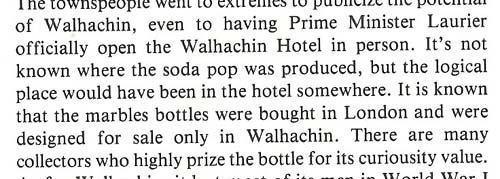
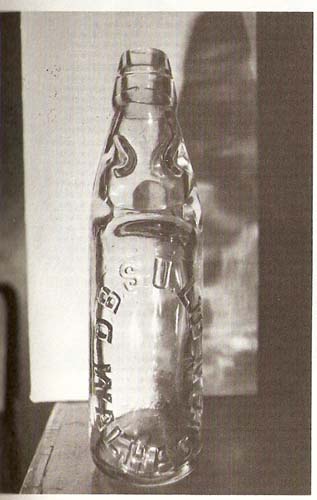
2009: The attached photos are from the book Pioneer
Soda Water Companies of BC which describe the
Walhachin Bottle and history about it.
***
|