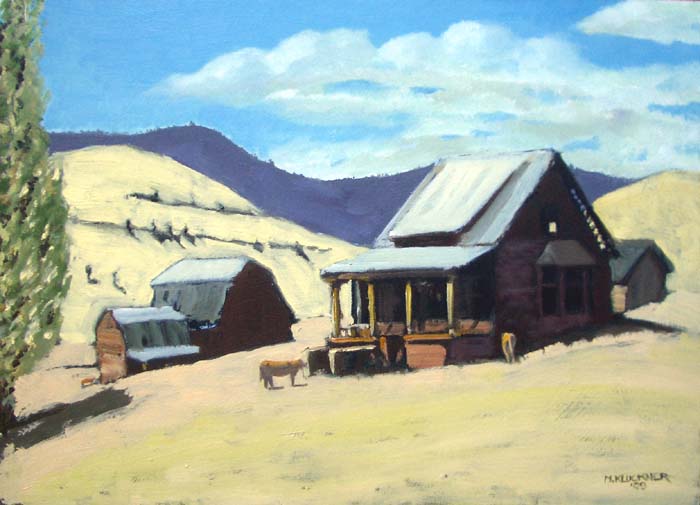
Sketched in 1995
|
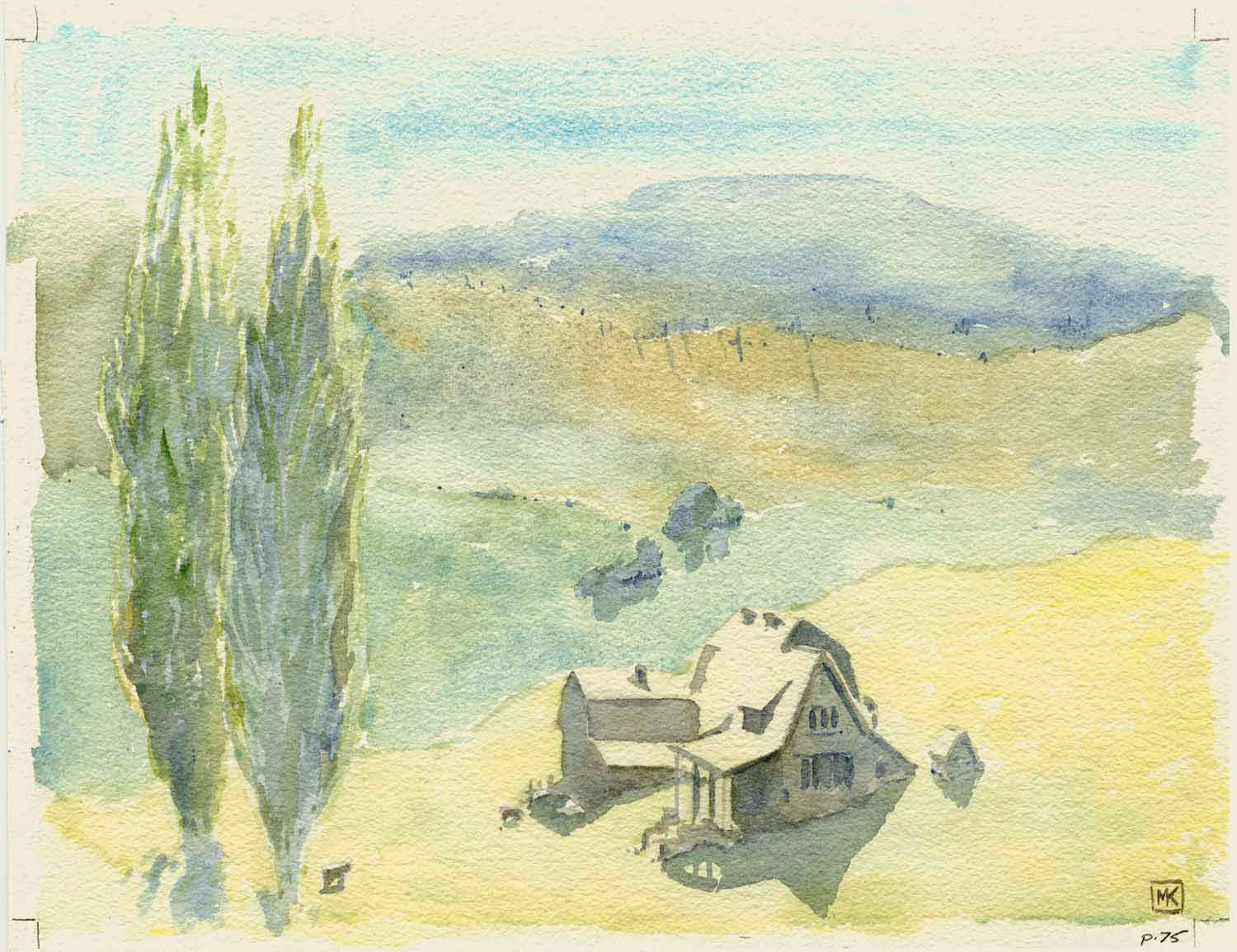
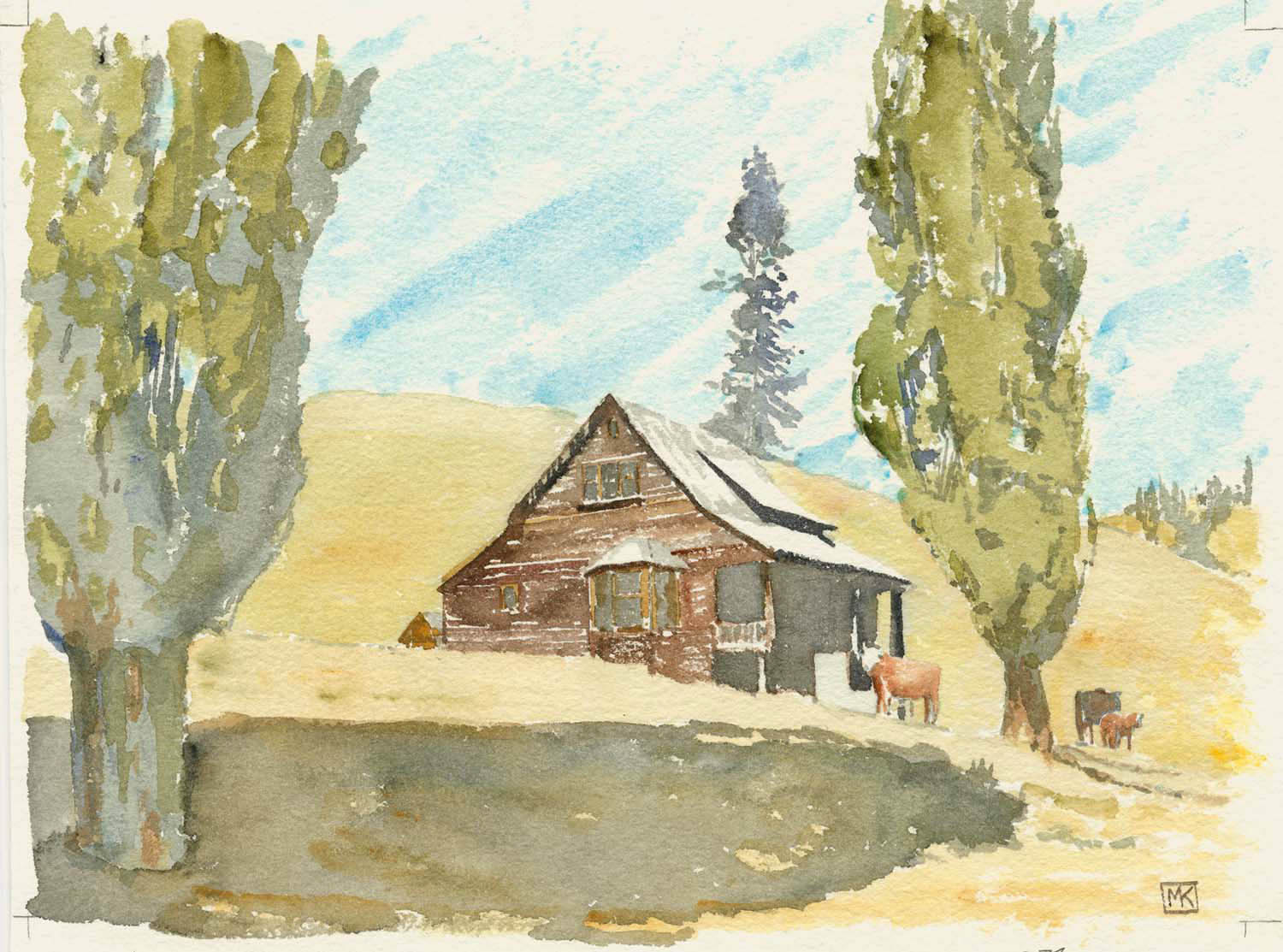
Written in 2003: This derelict old ranch stood just south of Highway 3, in rolling, arid land just west of Bridesville (it stood one kilometre east of the Anarchist summit in a gully on what's locally known as the Patterson Road). I first noticed it in the spring of 1995, due to the 2 poplar trees that stand out among the scattered ponderosa pines. A very curious building: Victorian shape, hipped-roofed bay windows on both sides, an unusual shed dormer in its roof that would have provided almost no light to any room I can imagine. Probably a couple of bedrooms upstairs. It had a poured-concrete foundation for its front steps. It looked very 19th-century. There were two gambrel-roofed barns at the time. When I went back past there in 2000 the house and the big barn had burned to the ground, with only the concrete foundations left from the house. According to Penny Dell, arsonists torched the place in 1995. According to Bunny Cox, daughter of Chester Charlton, who was born in the house in 1920, her father was the storekeeper and postmaster in Bridesville. He left his home town of Ilderton, near London, Ontario (where he had been born February 13, 1879), in his youth and moved first to the ranch of a cousin, John Mansfield, who was well-established and prosperous in Manitoba, producing wheat and Hereford cattle, which he drove regularly as far as Oklahoma. Charlton eventually rode across the open plains as far as Townsend, Montana, where he worked for the renowned A.B.Cook Ranch. His employer evidently liked him, and said, "If you ever get a ranch, I'll get you your first good Hereford bull." Eventually, Charlton moved north and for a time drove stagecoach into the mining boomtown at Camp McKinney,which introduced him to the area. In 1909, he purchased the Bridesville store and post office, and also bought a quarter-section (later doubled in size) in the rolling bunchgrass prairie south of Bridesville from Frank Kelsey, the pre-emptor. According to family legend, he imported the first registered Herefords into B.C. One of his colleagues, who became a good friend, was Allen Francis Eddy, the immigration and customs officer at Bridesville (a position required as the Great Northern Railway crossed the border to Molson and Oroville, see below, before returning to Canada near Cawston). A few years later he met Helen Wellia, from Cologne, visiting Bridesville in order to see her sisters, who had married Mark and Mike Dumont, owners of a pole and sawmill business. They married in 1914, and Charlton soon began work on the house, engaging builder Malcolm Gordon of Penticton. Probably he was delayed by labour and material shortages caused by the war, extending the construction period through about 1917. Their first child, Alice (in the photos below) was born in Oroville, where there was good medical service; Bunny, christened Bernice, was born "a blue baby" in the house in 1920 with Mrs. Kingsley, the local midwife, presiding. The doctor, who had gone to Molson, Washington, for the day, had been unable to make it back in time. In recent years, by comparison with the days when people and goods flowed casually back and forth between communities like Bridesville and Molson, the international boundary has become like a neat part in a head of hair, with everything on each side directed away from the divide. The old Rock Creek border post closed in the 1970s, and travellers wishing to go back and forth have to use the Midway-Ferry crossing or the Osoyoos-Oroville one to enter the neighbouring country. At the bottom of the Patterson Road below the home site, there are a series of flat pastures with a few derelict ranch buildings and modern homes; in a few spots it is just possible to pick out the old GNR grade along the hillsides. |
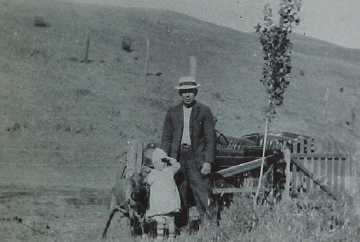
Alice Charlton with her "uncle," Allen Eddy, and one of the newly planted poplar trees, about 1919.
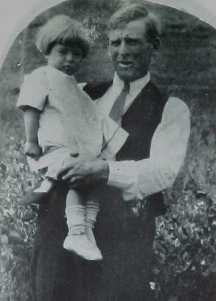
Chester Charlton and daughter Alice, about 1918
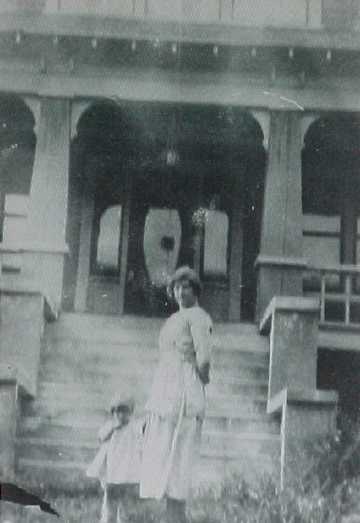
Alice and mother Helen in front of the farmhouse around 1919. (Photos courtesy of Bunny Cox)
Charlton soon moved on, looking for better land, and in 1922 he engaged builder Malcolm Gordon from Penticton to erect a $5,000 house on the Sidley Mountain Road – the much-altered house owned since 1946 by the Harfmans of the Circle 2 Ranch. He was among the first to import Rambouillet sheep into B.C. Later, he built the original log cottages at the Wagon Wheel Ranch at Sidley. His daughters were educated at the Roman Catholic St. Ann's Academy in Kamloops. Charlton died in 1959 and is buried in the Bridesville cemetery.
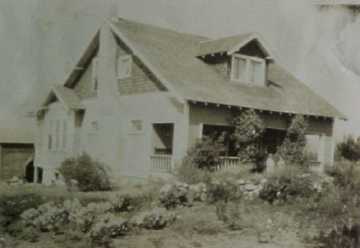
Charlton's second house on the Sidley Mountain Road, built by Malcolm Gordon from Penticton about 1922. A nice solid Craftsman house with a mixture of board siding and shingling on the gables and exposed rafter ends. The house still exists, although it has been renovated and expanded almost beyond recognition.
Charlton sold this ranch to Pete Reed of Victoria for a reported $20,000 – a very good price at the time.Subsequently it was bought by the Fosters, so the homestead became locally known as the Foster Place. The ranch was actually crossed by a spur of the Great Northern Railway, along the low ground at the bottom of the hill, but as the GNR was exiting BC by 1917 its proximity apparently didn't contribute to the ranch's prosperity (see the Brookmere section for some of that history, and read the addition below about the railway).
According to Arthur Harfman, there were three houses built by the same builder, two for Charlton and one called the Schorn house visible on the hillside above Bridesville at the east end of town.
Thanks to Penny Dell for the original contact information, and to Norah and Arthur Harfman.
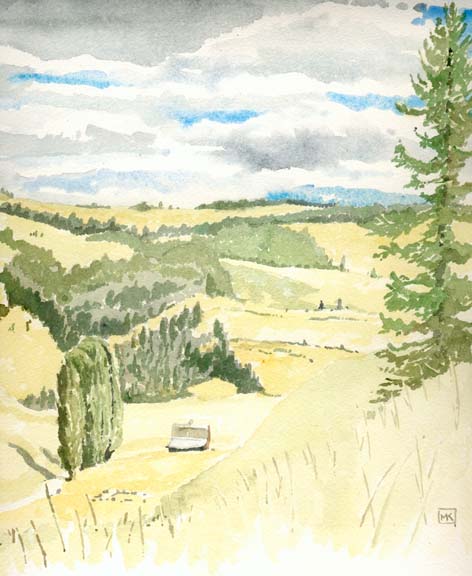
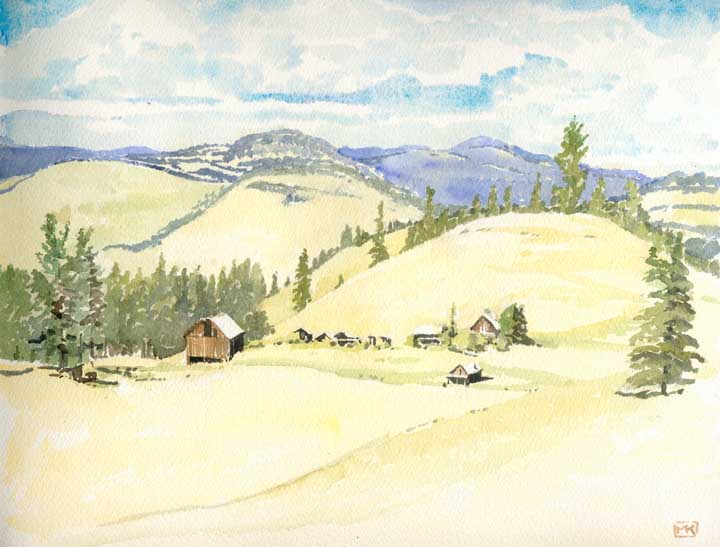
Above: the ranchhouse as it was in 1995, painted in oils. Below: I returned to the hills in the spring of 2005 and hiked around until I found a view down onto the site. Just the one, smaller, barn still exists, along with the poplar trees that first caught my eye. As with the old motel sites and homesteads in the Fraser Canyon, it will be the trees that will survive – the only markers of human settlement.
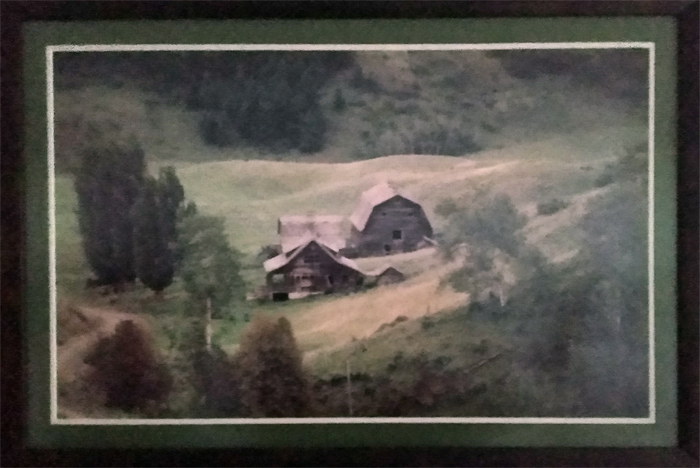
2020: From Mike Doknjas, a photo he took of the ranch in 1991.
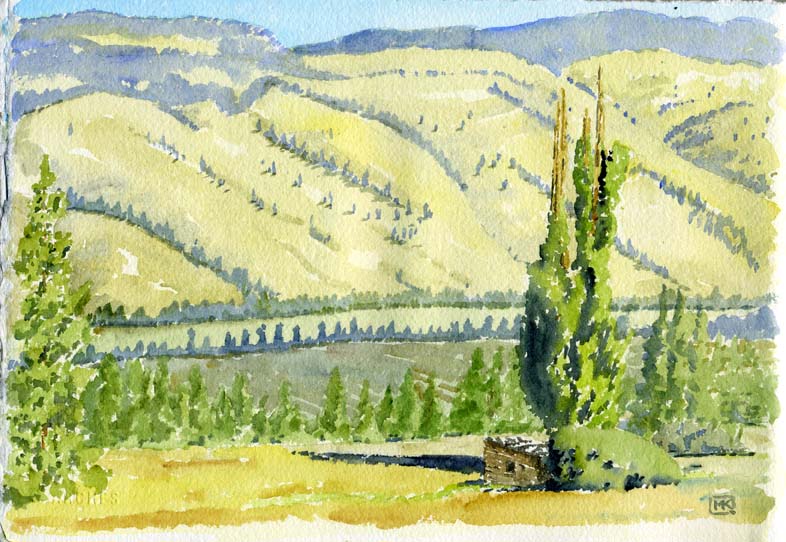
2013: travelled through the area again and found another example of a poplar tree and a ruined cabin, this time on Myers Creek Road between Rock Creek and Midway ...
The line of trees in the middle distance are the bank of the Kettle River. There's a map with the approximate location of this watercolour, and some others from the area, in the travel section. Poplars have a life span like that of humans, so these were probably planted about 1920, like the ones on the Charlton property.
***
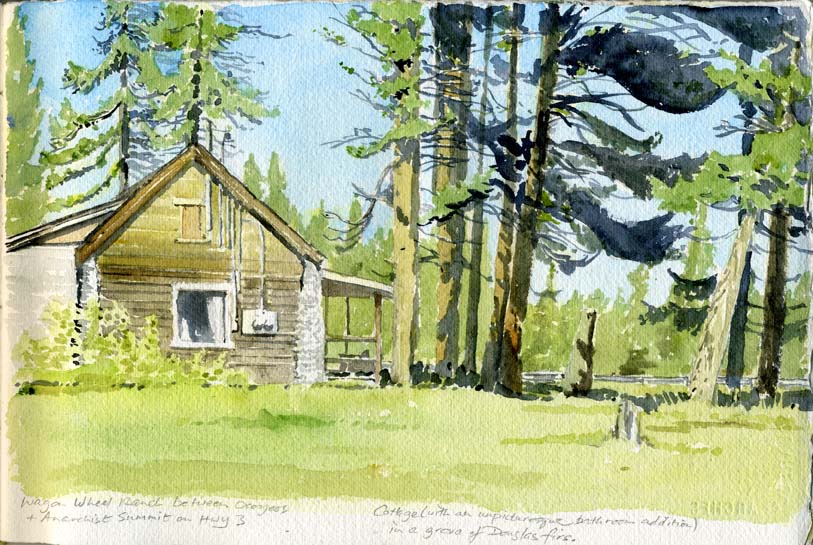
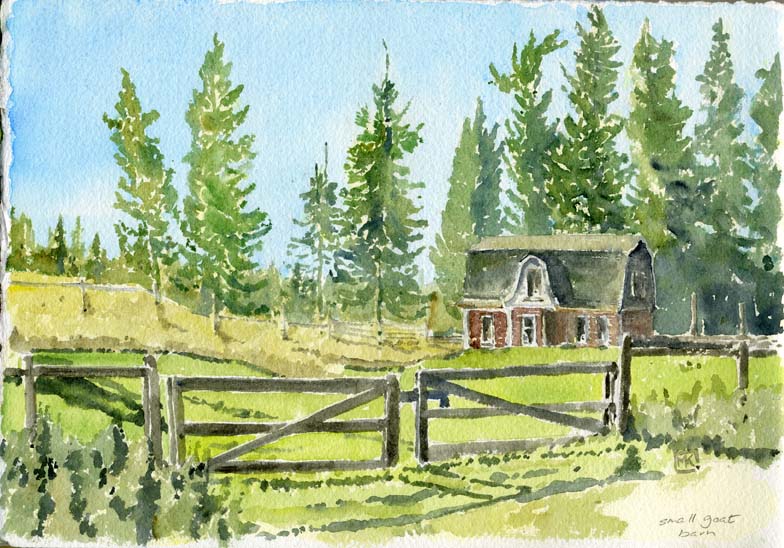
Written in 2013: Chester and Helen Charlton moved west a few miles from their Bridesville property to the Sidley area in the 1920s and built a set of log cabins and barns with gambrel roofs – a very unusual form for the Boundary Country (gambrel roofs are the standard form for dairy barns in the Fraser Valley and in wetter parts of the Interior, where you need both hay storage and an ability to carry a heavy snow load).
I don't know anything more about the ranch than this, so perhaps somebody will send in information of its more recent history. First, a couple of watercolours from a beautiful September morning ...
The cabin in the grove of Douglas firs out by the highway ...
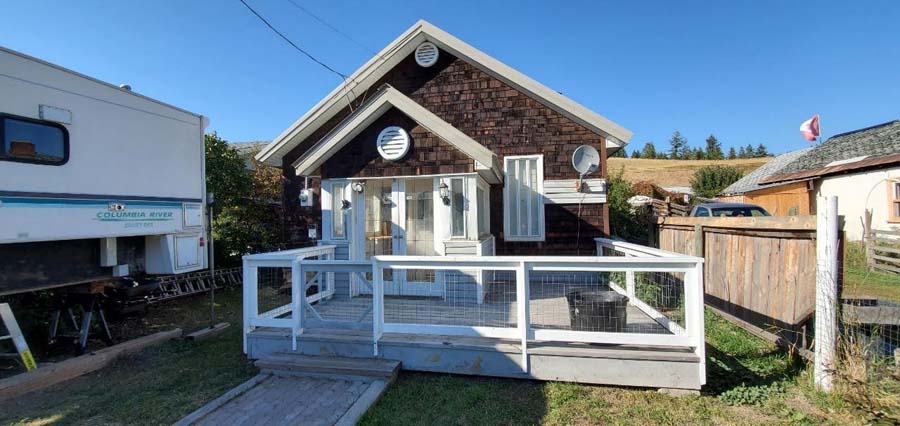
The small barn, maybe for goats or a couple of cows ... and, below, a few snapshots with the cell-phone camera –
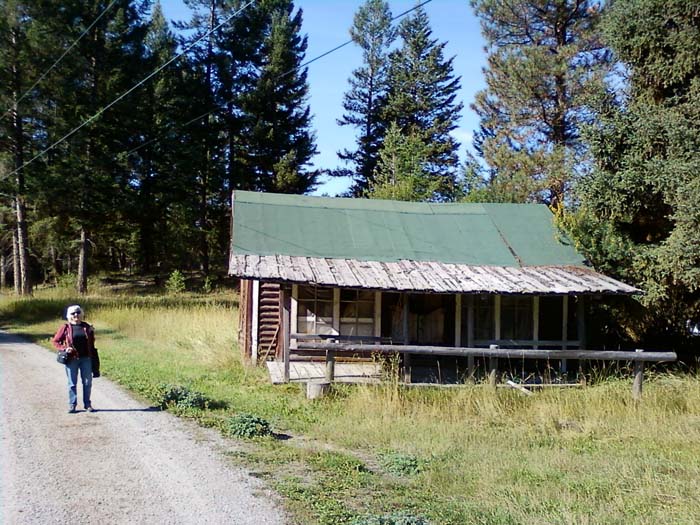
another cabin
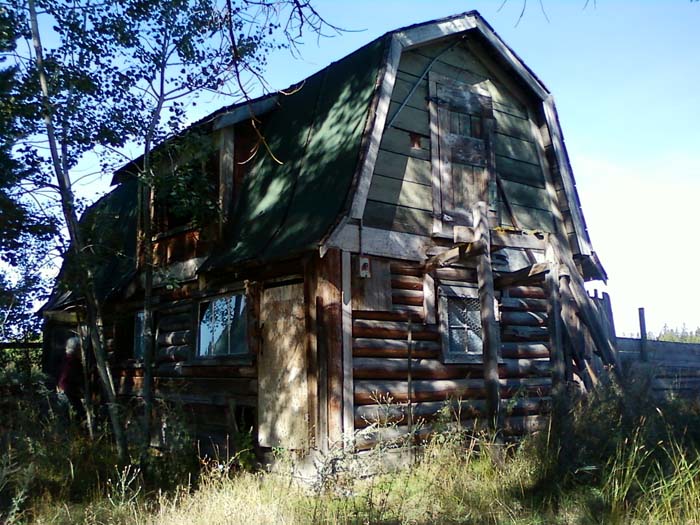
the henhouse
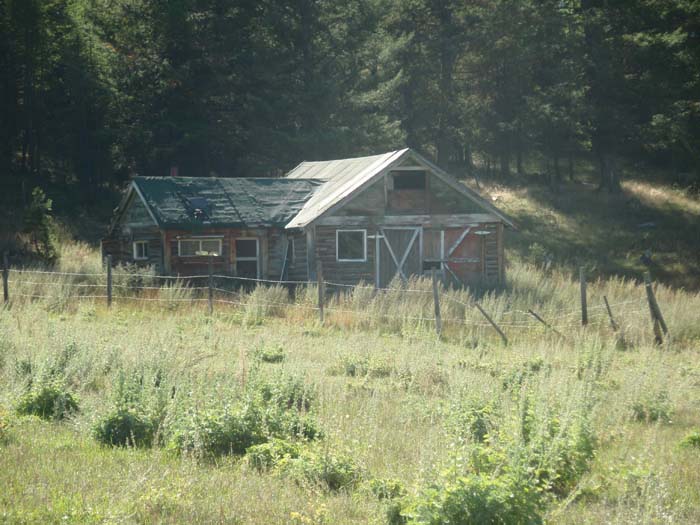
and the old garage and filling station. A woman who lives on the ranch told me that this building was on the edge of the highway until the mid-1950s, when government roadbuilders shifted the route about 100 metres north to its current alignment. At that time, she said, the old bowser-style gas pumps were removed and relocated to Trout Lake City in the Lardeau, where they remain today.
Bridesville & other ranches nearby
Sketched in 2005: the picturesque old ranch of Charles and Kathleen Eek on the Rock Creek-Bridesville Road. This is a well-known local family and much information will be added henceforth (maybe).
Note from Rod Gould, 2007: My son and I are pasturing some horses at the old Charlie Eek ranch on Rock Mountain. It truly is a lovely place, particularly with the slough just west of the house. It's sad to see it falling into disrepair. Charlie Eek died years ago, and it seems to me that old Johnny Eek has died as well. Dale and Duane Eek, of the next generation, live in the Kettle Valley and run Freeman's Farm Supply there.
Correction from Wolfgang Schmidt, 2007: Johnny Eek hasn't died yet. Matter of fact, he recently got a book published with his Cowboy Poetry.
published in 2004
Note from Michael Hollin, 2007: regarding the eek ranch painting on the rock creek bridesville road....i used to work up that road and drove past the ranch 5 days a week....i am a timber framer by trade and have taken photos ofthe barn there...it's a traditional timber frame apparently built by a scotsman at the turn of last century....he apparently built others in the area one of which is near the house you've painted of the ranchnear anarchist summit....just thought i'd add some info to your excellent site....
prana timber frames www.circleworks.ca**********
From Stephen Sands, 2025: his new book "Bridesville Homesteaders." For further information contact BridesvilleOldOK@gmail.com
From Tracy Lee Bozarth, 2023: I am looking for information pertaining to my great grandparents who were some of the first settlers in the area in the 1800s. James Madison Bozarth and family. They came from Washingon and built a log home in the area and I was told it is still standing. There was mention of him in your story when talking about Rock Mountain (below).
*********
The following information gleaned from Anarchist Mountain Settlements by Katie Lacey. (Okanagan Hist society Vol. 16, 1952. pp 112-117)
The divisions of the large district are as follows: Haynes Mountain extends from Osoyoos to Nine Mile Creek (i.e. 9 miles from Osoyoos via the Dewdney Trail); Anarchist Mountain from Nine Mile Creek to Johnson Creek, and Rock Creek from Johnson Creek to the Kettle River.
R.G. Sidley, the namesake of Sidley Mountain (and the dot on the map called Sidley), came from Ontario, his brother a professor of English at McGill, and took up a homestead in 1885 at the forks of Nine Mile Creek, almost on the 49th parallel. He gave Anarchist Mountain its name and established its first post office. It was the strikes at Camp McKinney that brought settlers to the region. The wagon road from Camp McKinney to Sidley in 1893 brought in the ten-stamp mill for the Cariboo mine at Camp McKinney. The Dewdney Trail to Wild Horse Creek wound around the hill on the south side of Anarchist Mountain, sometimes on the Canadian side of the boundary and sometimes on the American side, depending on the grade. At the time of the Rock Creek gold rush, Chinese packed supplies over the Dewdney Trail, but were waylaid on the US side; subsequently they cut a new trail on the Canadian side, known as the China Road.
Charles Cross with his wife and three children arrived in 1894. They came from Lynden over the Dewdney Trail with cattle to homestead. Other early settlers were: Dave McBride, Jim Kehoe, Zeb Kirby, Chester Charlton in 1899; Bill Acres, the Cudworth family, Grahams Higginbottoms, and the Kelseys. Manning Cudworth became the mailman between Midway and Sidley.
It was possible to take wagons by way of 9-mile creek to Oroville, where Okanagan Smith still had a trading post. The road from Bridesville to Osoyoos not completed until 1910. Bridesville was first known as Maud, a name given by the postmaster, Hozie Edwards, in honour of his wife. Immediately south of Bridesville is what is now known as Rock Mountain. It was known as One-eyed Mountain because the first three settlers, Delanders, Bozarth and Wilder were all one-eyed. The first school in the Bridesville district was on One-eyed Mountain. It was built on Joe Jonson's ranch about the year 1902.
* * *
From Tracy Janes, 2022: I am interested in the history of the Bridesville townsite’s repurposed heritage church which is now a home. Do you know anything about this building and its location? It is located at 5709 Bridesville Townsite.
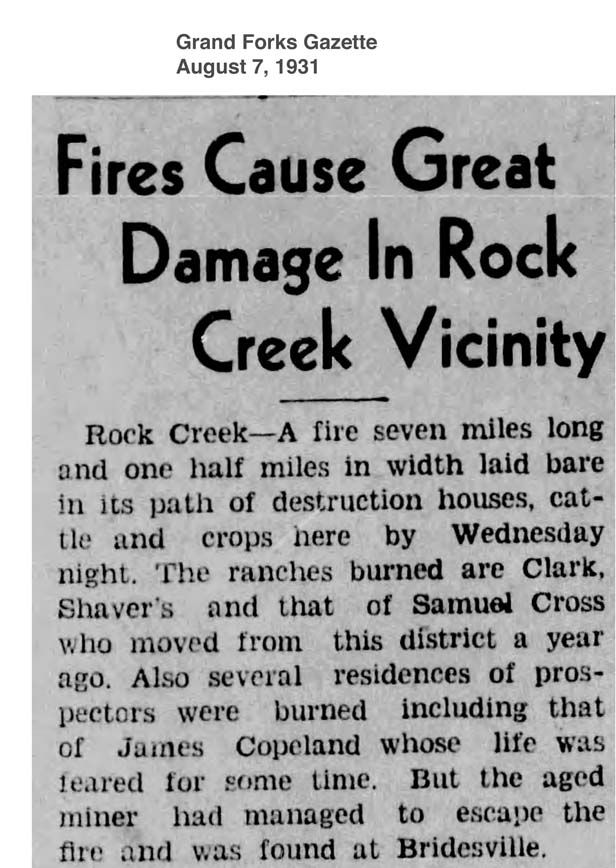
From Lyle Litzenberger, 2022: Has anyone heard of the historic McLean Ranch, which was situated in the Bridesville-Rock Creek area? It was purchased by Sam Cross in the mid-1920s. Sam and Mertena Cross moved to the Coast in November 1930 but apparently retained the ranch for a little while longer. In August 1931 a fire devastated several ranches in that area and the Cross ranch buildings were burned. At the time, the family of Donald Alden was living on the Cross Ranch at the time of the fire, evacuating in advance of the flames. Any information about the location of this ranch, its history, or information about the Cross family would be greatly appreciated.
[Click on the clipping below to open a 5 mb pdf of stories on the 1931 fires]
From Sally Kempston, 2018: My great grandmother, Olive Kempston Johnston, was the postmistress in Bridesville after her first husband died in the first world war. I am searching for a possible family connection by the name of Joe Kayes. He apparently lived in Bridesville as a young man (18 to 20 or so), His father (who died in 1920) and stepmother lived in Rock Creek, and it appears that after his father died, Joe moved to Bridesville, possibly to work on a ranch. My great aunt Kem was married to Fred Schorn from the Schorn ranch - he may have worked for them.
From Warren McKay, 2014: Do you have any info on John Jarrette who lived at Rock Creek and died at Greenwood in Late 1800’s/early 1900’s with a connection to James Gang? There was a Lorna who was asking about it as well. Live in Grand Forks and have a family connection.
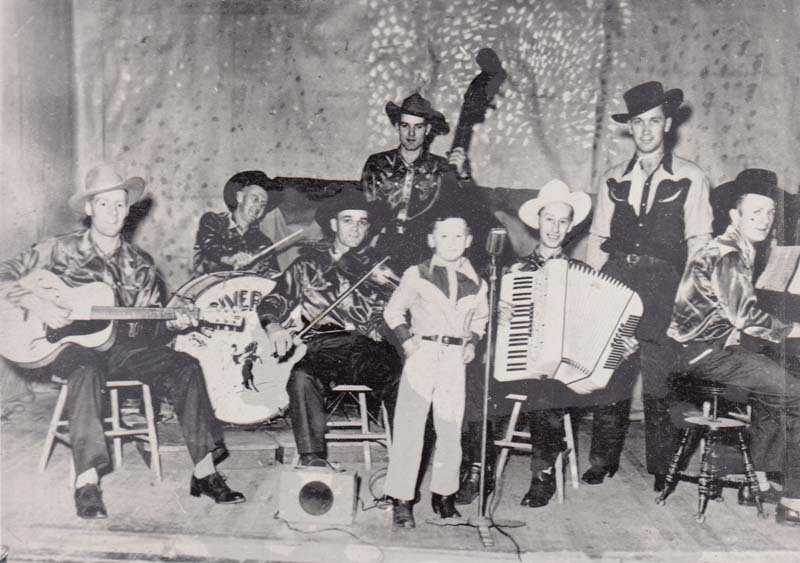
From Bonny Billups, 2013: This is band that played in Bridesville area in the early 50s called the Okanagan River Boys. They started in 1948, and cut a record in Oliver that I would love to get a copy of.
Clyde Billups; Guitar and sang (standing with black hat ); Ed Glasier – Drummer; Archie McGlivery – Violin; Roy Degenstern – Accordion; (Boy) Johnny ?- Singer; Vern Dowart - piano; Red McGellen – Guitar Harold Tompsin –Base
2013: geographer Michael Kennedy tipped me off to this place, which is said to be an Eaton's kit house ...
on the Myers Creek Road east of Rock Creek. He is doing a project on orchard subdivisions from a century ago with historian Richard Mackie. Does anyone have any information on it?
Here are some more photos on a separate page.
From roysphotos, 2012: I have been reading more about Bridesville and before my dad died in 2001 he told me that David McBride was his uncle but were not very close with that part of the family. That would make him my great uncle ?
My Great Grandfather was John McBride who came to Canada from Northern Ireland during 1860's. They settled in the Toronto area and the family spread out from there and some are Americans and mostly Canadians that farmed across Canada. My relatives moved to Sask., then on to Rocky Mountain House, Alta., and from there to Langley, B.C., and on to Vancouver, B.C. My Dad had 5 brothers and nine sisters,whew!
They were mostly storekeepers and butchers.
My father was a watchmaker by trade and owned a business on 4th Ave., after WW2 was over.
He took us to Bridesville many times when we were kids and knew lots of people in the area as we moved to Penticton, B.C., in the summer of 1954.
I remember the first time I went to the Wagon Wheel Ranch in 54 and stayed in the log cabins. We stopped there one day to see what it was like and it had a cafe off the highway so we went in. The lady came from the kitchen and it turns out they were old friends of my mom and dad during the war years and hadn't seen each other since its end.
We stayed there many times during the next 6-8 years and their names were Len and Helen Stevens. I don't know if they owned the ranch but they ran it. There were more Stevens living near Bridesville at the same time and I believe they are still in the OK., somewhere.
The other big family was the Scailings which I mentioned before and I believe a few of them live in or about Osoyoos, B.C.
I visited the Bridesville Cemetery in about 2006-7 ? one early morning just as the sun was coming up and with a flashlight read the names on the graves but didn't know any of them. That was late in April and I came across a grave that the local Rattlesnakes were denning in for the winter and must have decided to leave the den while I was there. I climbed up on a big tombstone as maybe 30-40 snakes came out from under a grave. It was not something you want to be near and it scared the hell out of me as I watched the snakes head down the hill. I got out of there real quick never to return ... Ever !
I stopped by Bridesville and talked with 4-5 residents and told them my story but I don't think anyone believed me. Oh well, I am a relative of the person the town was named after. A lady asked me for proof or pictures ... How many had a camera in those days or a place to get the films and or developed anywhere around there ?
My dad was very old before he passed in Kelowna so his memory was not the best so I am only trying to remember what he told me back in 2001. His father was Tomas McBride, my Grandfather who I never knew to well as our family was quite big and kept him very busy. Whether it is all true is beyond me and things can be misleading during the years that have passed so I am only adding what knowledge I have siphoned from the older family members whom have mostly passed on now.
From Bonny Billups, 2011: I was wondering if anyone would know of the exact location of the Joe Johnston farm on Rock Mountain east of Bridesville.
There our great great grandparents Edward Johnston and Catherine Johnston are supposedly buried on the farm and we would like to know where this is and if the graves are marked if anyone has a photo of the graves or of them.
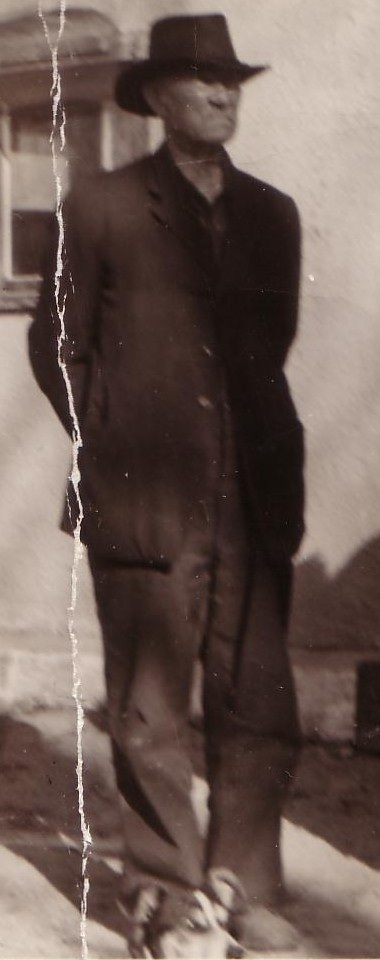
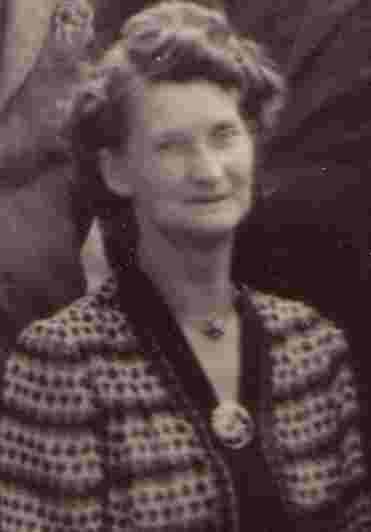
These are photos of Steven Johnston, their son, who lived and farmed in the area as well, and Steven's daughter Phoebe Johnston , Stevens Johnston's daughter. She married Luman Billups (below) who farmed in Bridesville too.
From Joanne Johnston, 2014: I noticed a lady named Bonny Billups has asked for information about our Great Grandparents, Edward and Catherine Johnston. Stephen Johnston and Joseph Johnston, my grandfather, were brothers. My dad, Daniel Joseph Johnston, was born on the Wagon Wheel Ranch in 1917.
From Bonny Billups, 2011: I was wondering if anyone has photographed the graves in the lawless cemetery.
I am interested in and uncle and aunt buried there,
JOHNSTON Ernest Stephen 1948
JOHNSTON Georgina Olive 1983
From somebody who didn't want their name used, 2011: First I recognized the Charlton Ranch, which as you wrote is just below the Pattersons', (My grand parents were Bill and Jennie Patterson), it was they who brought the horses out of Alberta, (Last wagon train to leave alberta).
I've been browsing for more photos of the area to try to piece the life together. There was a painter, Frank Western Smith, painted a lot of the older homesteads in the surrounding area in the 70's & early 80's I was looking for photos of his as I remember seeing a painting of the Patterson Ranch in Grandforks, years and years ago. My Mother Ruby is still alive, 85 this year and doing great!
Note from John McBride, 2010: I lived my childhood years in Bridesville with my parents, William and Cora McBride, on the Goodyear ranch that my mother inherited from her Uncle Goodyear……….my Grandmother, Anna O’Rorke, was his sister. I lived on ranch until I entered the US Army in 1943.
I recall that a William Patterson Family lived on the former Miller Ranch and that he had a herd of horse. I believe that his daughter Evelyn married Jimmy Kehoe of Sidley. I attended the Brideville School for eight years. Earnest Johnston delivered the mail from Rock Creek and his wife, Olive, was the post mistress in Bridesville, her daughter Kim was married to Fred Schorn who operated the local store. The Bridesville Hotel was run by the Purdys, had a beer parlor and a dance hall. My father raised Pure Bread Aberdeen Angus cattle, sold the ranch and moved back to Coeur d’Alene.
The entire area has changed since I left. Where there were 25 ranches today there are 3, the main highway was improved, BC Tealephone brought in electricity as the new phone system used resistors for the dial methodology.Note from Lloyd Jeck, 2010: I am currently doing some research on BC history and would like to learn about a large herd of horses that was brought into BC from Alberta. I remember reading about this many years ago and do not have much to go on.
But I do remember that these horses came into BC somewhere in the south, possibly Crows Nest Pass. From there they were moved through the Kootenay country into the Okanagan where they spent their first winter in BC. In the spring, after some searching for a place to settle, the people involved moved the horses into the area around Bridesville – not sure exactly where. As I recall it was quite a large number of animals, like more than 300.
If you are able to add to this, or pass on a contact who might know something about this, I would appreciate it.
My wife's Grandparents lived for a few years at Bridesville. Would have been during 1940s. The last name was Kohnke.Details from Neil Rougley about the railway line, 2004: It was the Vancouver, Victoria & Eastern (a.k.a. the Great Northern), on a line that entered British Columbia at Midway and travelled west along the boundary south of Highway #3, through Bergen, Myers, Myncaster, Syackan, Dumont and then Bridesville. The line then went south into Washington, to Oroville via Molson, then north to cross the boundary again, following the Similkameen River to Keremeos and Princeton and beyond.
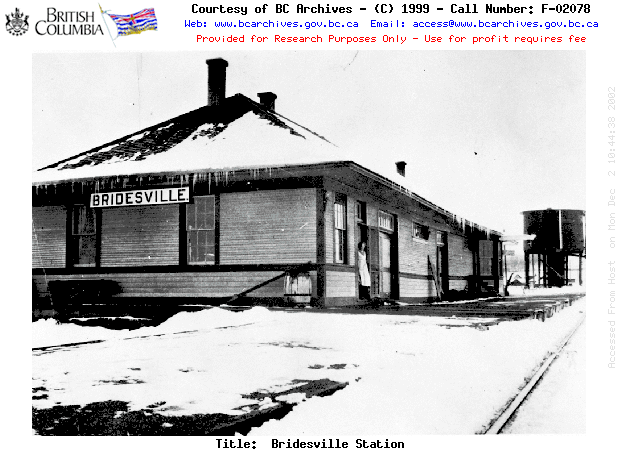
The line to Bridesville was built in 1905, and there used to be a station in town. The line was cut off from Spokane in 1931 when the section from Curlew, WA to Ferry, WA (across from Midway) was abandoned (known as the Washington & Great Northern), with the Canadian section (from Midway to Bridesville) being officially abandoned in 1935. Bridesville was named after David McBride, a pioneer settler who granted land to the GNR on the condition that the townsite be named after him.Note from John Fleming, Sierra Vista, Arizona, 2005: I read your article on the Bridesville area of BC and it brought back many memories (and a tear or two). During the winter of 1957/58 I spent several months on a ranch owned by a young fellow from Penticton. His name was Dick Byers. Those months were the greatest in my life as I learned so much from Dick and his father Emile. I've often wondered how their life turned out over the years. I don't remember the Charlton ranch, but I think we may have visited or done some work there. It sounds familiar. I'm so sorry to hear of the arson that occurred there. It's a shame that people can't appreciate the historical treasures that are fast becoming a faint memory. I especially appreciate the photos of the Bridesville hotel. I still remember the pot belly stove and the old guys sitting around it telling their tales. The few times during that rough winter of '58 that we were able to make it down there made the trip worth it.
Note from a man who didn't want his name used, 2006: I spent quite a bit of time around Bridesville when I was just a kid about 6 years old . I have many memories of the area and I was at the Wagon Wheel Ranch this Sept. and talked with the owners for a few hours. I was able to give them some knowledge of mine and straightened out a few things they couldn't figure out to some degree. I knew a few of the old famillies from the 30's onward but I guess they are all gone elsewhere now. One name that comes to mind is Scaling. Grandma Scaling held the Sunday School at the Bridesville gazebo for a long time and had a pedal organ brought in every Sunday on a pick up truck. The kids came from everywhere.
Note from Don Thomason, of Moses Lake, WA, 2006: I have reviewed your articles on Sidley, BC with much interest and approval. My mother, Medaine Orthene Gates Thomason, who presently lives in Ellensburg, WA, was born about 5 feet inside Washington State from the Washington/BC border in Molson in 1923. Her parents were John and Emma Gates of Chesaw. John Gates did custom threshing for many farmers around Molson, Myncaster, Rock Creek, and Chesaw.
I am a bit mystified as to the reasoning that there is no Customs checkpoint at Molson or Chesaw on the border. Perhaps you can offer some information on this? Personally I feel we are losing a lot of serious knowledge because of having to drive to Oroville/Osoyoos or Midway to access the area just north of Molson or Chesaw and vice versa.
My father's sister married Richard Hirst of Molson/Chesaw. I spent a lot of my younger years in that vicinity....sometimes I feel tempted to just go there and walk back and forth across the border, thumbing my nose at the Mounties or Sheriff as the case may be. I'm not sure of the legalities of an American Citizen such as myself breaking any American law by simply crossing that border without benefit of Customs.
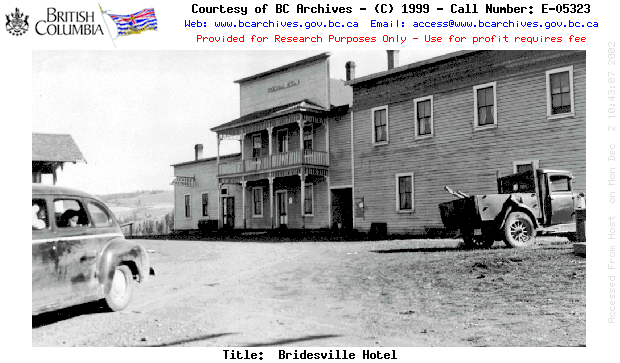
1948 photograph of the Bridesville Hotel by "Lythgoe."
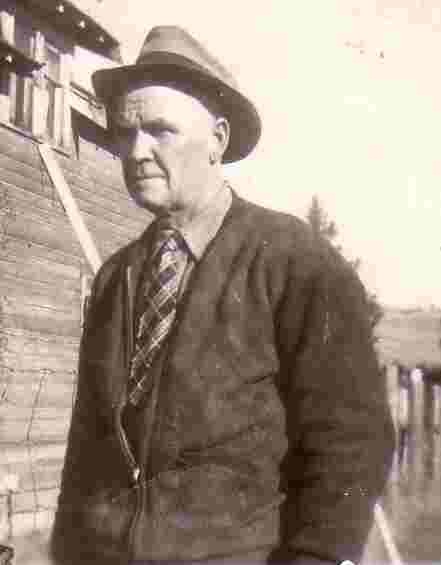
Photo c. 1920 by an unknown photographer